Showing posts with label language. Show all posts

Monday, March 06, 2017

A POET, A POPE AND A PLATE


It was with great pleasure that I participated, on Saturday, in the launch of Modican poet Antonio Lonardo's 40th anniversary collection, Alla ricerca dell'Oreb, which I had translated.

Before the big event, of course, two visits were necessary - one to Giovanna Linguanti of Beauty Giò, and the other to Giorgio at Saloni di Successo:


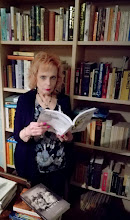
At last, I am ready!


Alla ricerca dell'Oreb [In search of Horeb] is a collection of poems dedicated to migrants, describing their hopes, losses and heartbreak - a cause which is, as many of you will know, close to my heart. The second part of the book is dedicated to the migrants' champion, Pope Francis and I can assure you it makes for moving reading for people of all religions or none.  There are also poems dedicated to Gabriel García Márquez [born 90 years ago today] and to Mandela.

Besides reading my English versions of the poems at the launch, I spoke about the particular difficulties a translator of poetry faces and the changes necessary, especially in word order, when translating from Italian into English.  I ended by saying that, whilst very few translations ever match the beauty of the original - the linguist George Steiner said it was possible but rare - I hoped that mine had done justice to Antonio Lonardo's message.

Here are some more photos from the event:


Me with Antonio Lonardo
At the end of the evening I was delighted to receive this commemorative plate, specially commissioned by Antonio. I shall treasure it:


Thank you, Antonio and many congratulations again!

Friday, January 06, 2017

WHEN A SHIRE IS NOT A SHIRE

Many of you will know that I am a great fan of MasterChef Italia, which has recently made a welcome return for its sixth season on Italian TV.  I am also an admirer of Joe Bastianich, whose biography I reviewed here and I did laugh at the pronunciation lesson that Joe gave an unfortunate contestant last night. You can see the video clip here.

However, it has to be said that Joe is not teaching British English! For those of you who are confused, the term shire means county and is usually used as a suffix, as in Gloucestershire or Yorkshire. In this case, the i is pronounced like the er in her in British English. It is pronounced in the "Joe" way in the term the shires, meaning counties. Having to deal with the eccentricities of Modican Englishitis every day, I do empathise with both Joe and the poor contestant!

Worcestershire Sauce, by the way, is a British ingredient which is readily available in Italy and I was glad to see an Italian being adventurous enough to use it.

Wednesday, October 12, 2016

SCHOOLS NEED A HISTORY LESSON

I am more often than not ashamed of my own country these days and am particularly so today regarding a gaffe involving my beloved Italy:

Online enrolment forms for certain schools in England and - I am sorry to say - Wales, ask parents to indicate their child's nationality. For Italians, however, there is not one code but four and they read as follows:

ITA     Italian
ITAA   Italian [Any Other]
ITAN   Italian [Napoletan]
ITAS   Italian [Sicilian]

Is this stigmatising the South or is it just ignorance?

The Italian Ambassador to the UK, Pasquale Terracciano, protested yesterday, pointing out that Italy has been unified since 1861 and today the Foreign Office has formally apologised to Italy, promising that the forms will be amended.

Whoever compiled the form seems not to know the English word denoting a person from Naples, either.

I would be interested to know what kind of schools were involved and if I find out, I will update this post.

Update: 13.10.16

It seems that these were state schools and that the forms were compiled by the British government. A government spokesperson has said that there was "an historic administrative error" in the language codes used. Are we to believe, then, that in the 21st century, the UK government is using pre-1861 language codes for an online form?

The first complaint is reported to have come from the city of Bradford.

Wednesday, September 28, 2016

A TOUCH OF MAGIC

It's always lovely when someone brings you a present from home and when you live so far away, I think the memories that these thoughtful gifts evoke can flood your mind - in a good way.

My maternal grandad was a Cornishman [though he spent most of his life in Wales] so when a friend brought me a Cornish pixie wall plaque the other day, I immediately thought of Grandpa and felt I could hear his soft,West of England tones as he told me the pixie-themed little brooches or ornaments he would bring me back from his annual holiday in Cornwall held magic powers.  Of course, Devon has pixies too and they are not to be outdone in the magic stakes! Mum, Dad and I used to head for Paignton every summer and I've had the pixie ornament from Dawlish Warren since I was about five.


Now that Mr Dawlish Pixie has some company, I'm convinced my luck is about to change!

Wednesday, September 07, 2016

FUN TIME

"What nice watches", I thought as I looked in Carpisa's window this evening - and then I saw the notice. The muddling up of "fun" and "funny" drives every English teacher to exasperation here, so I went into the shop and asked why the watches are labelled "funny". "Divertente", [enjoyable], chorused three shop assistants, looking at me as if I were mad. I explained the mistake but fear I was not believed.


Now, I can understand a small, independent shop in a small town getting it wrong but a national chain like Carpisa? Come on, guys, check your English!

From my booklet:  A-Z: English Language Tips For Italian Students


Wednesday, July 06, 2016

AND AGAIN!


And for any Italians still in doubt, yes, it's a NATION, not a region!  

Friday, March 04, 2016

FEELING "PETALLY"?

Flower petal carpet, Noto, 2015


At the end of the week which included St David's Day, you could say that petals, particularly those of daffodils, have been much on my mind.  But that's not the only reason for, like everyone in Italy, I have been enchanted this week by the story of an eight-year-old boy from Copparo [ Ferrara Province] who has coined the word petaloso.

It all started when Matteo's teacher gave a lesson on adjectives and Matteo wrote about a flower which was petaloso. The teacher, Margherita Aurora, liked the word [which did not previously exist in Italian] so much that she suggested sending it to the Academia della Crusca, the National Institute for the Protection and Study of the Italian Language, for evaluation. On February 23rd she received a very pleasant reply, saying that the word was well-formed, beautiful and clear but that, to be inserted into the Italian dictionary, it would have to be understood and used by lots of people.  Following a facebook post by Margherita, thousands of people began using the word on all social media, with Prime Minister Renzi congratulating Matteo on twitter.

Matteo's father even tried to get the word registered as a trademark, only to find that three other "inventors" had requested patents in this name three days before, it has emerged today. It has not been revealed exactly what kind of brands these are.

Meanwhile, though, let us add our congratulations to the flood of those reaching Matteo and his teacher and let's enjoy rolling the lovely word petaloso around on our tongues!

Friday, December 18, 2015

MULTILINGUAL CAROL SERVICE 2015

I always think that Christmas has been well and truly declared when we have our multilingual carol service in Modica and this year has been no exception.

We again opened with Venite Fedeli, included the famous Italian carol Tu scendi dalle stelle and closed with  verses of Silent Night sung in English, French, German, Italian and Spanish. Other carols were sung in all these languages and there were readings in other languages including Malagasy:


I read from Mary Jones and her Bible - not particularly Christmassy but a nice story. I'd been thinking about Mary Jones a lot this year because Mary Jones World was opened in Bala, North Wales at the end of 2014. [One day I'll get there!]

As my contribution to the feast, I made my "Christmas chews" again, as I did last year.  As always, there was delicious food from every country represented:


It wouldn't have been a proper British contribution if someone hadn't made yummy mince pies and Christmas cake......


.... and it wouldn't have been quite Modican without several kinds of focaccia!


Tuesday, September 15, 2015

S-PIED

Or rather, I did NOT espy a final -s on the word which is supposed to tell you what this object is for!


Italians have a strange antipathy to the final -s in English and even when they do add it, they often refuse to pronounce it. This habit is a common symptom of Modican Englishitis but it is also widespread and the above example was espied in a Catania store on Saturday.

I hope purchasers of this rack enjoy the one magazine they put in it!

Friday, August 28, 2015

SUMMER SORROW - 4

At the end of yet another week of migration tragedies, I have to admit that I do not know what to say. I had hoped, you see, that once the desperate situation that I have been writing about for nine years finally came to the world's attention, migrants would be helped and that we would see an end to the perilous journeys they feel compelled to make. I did not anticipate an end to their coming, but an end to deaths on migrant routes. Instead, more and more people are dying and attutudes are hardening in several parts of the world. 

Last weekend Italian and other operatives in the Mediterranean saved 4,700 people and on Wednesday alone, in ten Italian Coast Guard operations, 3,000 people were rescued. However, Wednesday was also the day on which a Swedish ship rescued 439 migrants from an overcrowded boat but found 52 bodies in the hold. The arrival of these bodies in the Port of Palermo late last night was another sad sight of a type that we have, I am afraid, become used to in Sicily. Italian police said tonight that survivors have told them that migrants trying to get out of the hold to access water and air were held back at knifepoint by the people traffickers in charge of the boat. In addition, this afternoon the BBC started to report that hundreds of deaths are feared after two boats capsized off Libya earlier. 

Other reports tonight say that the number of bodies found in a lorry in Austria has risen to 71 and that four of these poor souls were children. It is also being reported that UK police have arrested 27 migrants found on an Italian lorry in the County of Surrey. [The driver was also arrested but later released.] Meanwhile Hungary builds a barbed wire fence and security in Calais is still being increased. Suspected people traffickers continue to be arrested in all the receiving countries but the basic problem, which is that people are literally running for their lives, is not being addressed.

To cries of,  "They only come to Britain for the benefits" I would say that few people would put their lives in such obvious danger for a few hand-outs after a bureaucratic process. Besides, would you rather live in a country that people want to come to or one that people flee?

Mrs Merkel, a lady I have not often praised in these posts, braved booing crowds this week to condemn racism and attacks on asylum seekers and later in the week she and President Hollande called for a faster and more unified EU response to the situation. Could it be that these two leaders have woken up or was the statement prompted by the fact that Germany is taking in more asylum seekers than any other country in the EU? Italian Foreign Minister Paolo Gentiloni saw the statement as grounds for cautious hope, so perhaps we should, too.

You may have noticed that I have used the word "people" instead of "migrants" several times in this post for, as Al Jazeera English pointed out a few days ago, the term "migrant" is fast becoming pejorative. This set me thinking, for language, of course, matters. When I first started writing about the crossings to Sicily, I used the term that the Italian media used at the time, which was clandestini. Sometimes I used my own unsatisfactory coinage, "would-be illegal immigrants" because they were not illegal immigrants if they were arrested and sent back, as they often were. Over the past few years I have dropped the term clandestini, as has the Italian media, in my case because the term had a negative connotation and because there is nothing "clandestine" about braving the Mediterranean Sea in an inadequate, open boat. I despair when the media talk about the migrant "burden", as Sky News did last night in an otherwise insightful report, as until we start seeing refugees as human beings with the same aspirations as ourselves, there is no hope - for them or for us.

Friday, June 19, 2015

ENGLISH AND ITALIAN COURSES - SUMMER 2015

Se sei a Modica e vuoi imparare l'inglese quest'estate, chiama London Town - Centro Linguistico Internazionale ora!

English speakers in Modica for the summer may be interested to know that London Town - Centro Linguistico Internazionale offers Italian courses too. Please call for details:


Tuesday, December 16, 2014

CHRISTMAS BOOKLET

It's time for another bit of shameless self-promotion! This is my new booklet for London Town, Modica - Centro Linguistico Internazionale. It contains Christmas vocabulary, information about British Christmas and New Year traditions, a puzzle and a Christmas quiz:


Nel libretto troverete: un vocabolario natilizio inglese, informazioni sulle tradizioni natilizie britanniche, un gioco di parole nascoste e un quiz.  Chi s'iscrive avrà il libretto!

Thursday, July 10, 2014

MODICAN ENGLISHITIS

There is, as Tim Parks writes in Italian Ways, an Italian fantasy about English usage and the proof is in the execrable attempts at translation which can be seen on notices and in advertisements everywhere in this lovely land. The modicani, however, have taken this art to new heights and I have finally identified the habit as a disease called Modican Englishitis.  

Modican Englishitis first manifests itself in a stubborn refusal to imitate correct pronunciation, so that if an English teacher corrects a student who prononces guitar as gweetar, with the stress on the first syllable, the student will listen politely, nod, say, "Ah, gweetar" and happily continue with the erroneous pronunciation.

As the disease progresses, sufferers will insist on pronouncing all past simple tense - ed endings as a separate syllable [finish-èd] and are particularly resistant to the final -s on any English word. I used to think that this refusal to pronounce the final -s came about because foreign nouns which are used in Italian don't have plural forms but now I've come to the conclusion that it is just bloody-mindedness. Patients are perfectly capable of pronouncing the final - s, for where there is not one you can be sure they will add it!  

In Modica you will be invited to use "slots" [but not slot] machines, eat your dinner in the chicken rather than the kitchen and visit the say-ah [sea] to "have a bath". This last is presumably because you don't have a bathroom in the "eighth century" house you have purchased [a mistranslation of ottocento - the nineteenth century]. 

You may not understand a word of the English used in Modica, but never let it be said that life is dool hair [dull here]!

Saying "goodbye" if you have Modican Englishitis


Friday, July 04, 2014

SUMMER ITALIAN COURSES IN MODICA!

I am re-posting this because there is still time to sign up for these courses!


At London Town, Modica - Centro Linguistico Internazionale we are very happy to be able to announce that, in partnership with Vacanze Craunari, we are offering Italian courses this summer:

Italian for English Speakers
€450,00 per person

Course dates:
31 August - 7 September
7 September - 14 September

Price includes:
7 nights in a shared apartment
12-hour Italian course
7 breakfasts

Services available upon payment of a supplement [must be pre-booked]:
Lunch
Dinner
Airport or port transfers


If you are already in Modica or have planned your trip and would like to learn Italian, London Town, Modica - Centro Linguistico Internazionale also has the following summer offers:

ENGLISH SPEAKER IN MODICA?
LEARN ITALIAN THIS SUMMER!

Summer offers – courses from €160!

8-hour and 12-hour courses
July, August or September, 2 or 3 hours per week
Tailored to your needs
Minimum:  group of 2

36-hour course
July, August and September
Tailored to your needs
Pay for 2 months and get one month FREE!!
Minimum:  group of 2

Individual courses can also be arranged.

Call Pat at the Centre now!
[0039] 0932 905642  /  +39 366 119 6467


PARLA ITALIANO QUEST’ESTATE!


SPEAK ITALIAN THIS SUMMER!


Wednesday, July 02, 2014

A SURPRISE FROM WALES

It had been a long time since the postwoman brought me something pleasant so imagine my delight today when a completely unexpected package arrived from Britain. It contained goodies from my friend Carol King, who last week visited Wales for the first time:

The coloured card shows three very woolly sheep and says, "Rush hour in Abergavenny".  Below it are three fridge magnets - Cardiff Castle, the cutest dragon and a "Patricia" magnet with a picture of a daffodil.  The other cards have the text of the Lord's Prayer in Welsh and in Italian. Perhaps now my students will believe me when I tell them that the Welsh language is completely different from English! The slate beermat says, "Happiness is having Welsh friends."  Happiness is also having friends like Carol!


I loved the television series Call the Midwife so I was very happy to receive this book as well. I can't wait to read it!

Thank you, Carol.

Friday, June 06, 2014

LEARN ITALIAN IN SICILY!


At London Town, Modica - Centro Linguistico Internazionale we are very happy to be able to announce that, in partnership with Vacanze Craunari, we are offering Italian courses this summer:

Italian for English Speakers
€450,00 per person

Course dates:
30 June - 6 July
31 August - 7 September
7 September - 14 September

Price includes:
7 nights in a shared apartment
12-hour Italian course
7 breakfasts

Services available upon payment of a supplement [must be pre-booked]:
Lunch
Dinner
Airport or port transfers


If you are already in Modica or have planned your trip and would like to learn Italian, London Town, Modica - Centro Linguistico Internazionale also has the following summer offers:

ENGLISH SPEAKER IN MODICA?
LEARN ITALIAN THIS SUMMER!
Summer offers – courses from €160!

8-hour and 12-hour courses
July, August or September, 2 or 3 hours per week
Tailored to your needs
Minimum:  group of 2

36-hour course
July, August and September
Tailored to your needs
Pay for 2 months and get one month FREE!!
Minimum:  group of 2

Individual courses can also be arranged.

Call Pat at the Centre now!
[0039] 0932 905642  /  +39 366 119 6467


PARLA ITALIANO QUEST’ESTATE!


SPEAK ITALIAN THIS SUMMER!


Monday, May 19, 2014

AN OLD STORY

At last! Someone has provided the Comune of Modica with the correct translation of "centro storico". I've been telling my students that "old town" is preferable to "historic centre" for years, but few of them have believed me. One of our local newspapers isn't entirely convinced, either but I'd like to assure them it's right. Long may the old town live on!


Wednesday, July 24, 2013

A TOOTHY DISTRICT?

With the world's attention having been on babies, and one baby in particular, for the past few days, I did not post yesterday or on Monday. What do you think about when you think of babies? Cribs, cradles, rattles and baby buggies? The babies themselves and how irresistibly cute they are with all the smiles, gurgles and cuddles? Or perhaps you remember the more stressful moments, like those of teething.

You could be forgiven for imagining that there are rather a lot of teething babies in a district of Modica called "Dente". Or could it be that the area has more than its fair share of dentists? Perhaps the area is shaped like a tooth? The area where I live is called the "Sorda", after a deaf woman who had a café here, so maybe a somewhat toothy lady owned a similar establishment in Dente?  No, none of these provide the reason for the district's name and I've always wondered about it.  Now, thanks to a student of mine, I can tell you the etymology of "Dente":

It seems that, at the beginning of the last century, a wooden sculpture of a Byzantine Madonna was found in the area and afterwards that part of Modica was always called "Urenti", the Sicilian dialect pronunciation of "Oriente". But this is also the way in which "dente" ["tooth"] is pronounced in Sicilian dialect. Later, when the term was translated into standard Italian, a mistake was made and the district acquired the name "Dente" instead of "Oriente."

Tuesday, May 21, 2013

SYNTACTICAL GALLANTRY

Speakers of other languages are often surprised to find that, in English, it is possible to string several adjectives together in one sentence and that there is an accepted order for these adjectives, according to their meaning.  We say, for example, "a nice young man" rather than "a young nice man".  The native speaker usually uses the correct order automatically and does not have to think about it but the English learner needs some rules to hold on to, so is taught that the "opinion" adjective comes first, then the "size" one, then the "age" adjective, then "shape", "colour",  "nationality", "material" and "purpose" ["a nice, big, new, rectangular, brown, British, wooden dining table"].

We were practising such combinations today in class and, towards the end of the lesson I asked students to use three adjectives together in a sentence describing a person and another three in a sentence describing an object.  One student wrote,

"My English teacher is a beautiful, middle-aged, Welsh woman."

Besides admiring his good judgement in his choice of "opinion" adjective, I could have hugged him for having the gallantry to leave "size" out of it and for not writing "old". What's more, he even remembered that I am Welsh! Could this mean that I am getting somewhere in my campaign to convince Sicilians that "Inghilterra" is not Britain and that Britain is not England? No.... that would be too optimistic!

Weren't these the days?
Image:  WP Clipart

Friday, May 03, 2013

AS IT WERE....

I once taught the subjunctive to an Advanced Level French class, all of whom were also studying Advanced Level English Literature, by using French versions of lines from Shakespeare that they already knew, because they were more likely to find the subjunctive in Shakespeare than in modern English. The method, I am glad to be able to report, worked.

Here is a confession: I love the subjunctive. I love its elegance, its sound and the grammatical hoops you have to go through in order to use it.  But what is it? It is not a tense but what is known grammatically as a "mood", implying that what is important in the utterance is not what happens but the speaker or writer's attitude towards it.  A simple example in Italian would be, "Penso che sia buono" ["I think it's good"]. The second verb - part of essere [to be] - is in the subjunctive; the speaker or writer thinks something is good but it may not be - so the subjunctive is often an indicator of uncertainty. Half the fun of using it, in the Romance languages, is in judging the degree of uncertainty. In Italian, as in French and Spanish, the subjunctive is also used in certain set expressions and after certain verbs and conjunctions but the uses are not necessarily the same in the different languages.

Frequency of subjunctive use varies from language to language, too: The subjunctive is a rarity and a formal mode of expression in British English so it may surprise some of you to learn that it is more often used in American English. However, it does survive in British English and most of us are unaware that we are using it in forms such as "If I were you". It also survives in our national anthem, for the line "God Save the Queen" is the expression of a wish. 

Alas, even in French, a language passionately defended by its académiciens, the present subjunctive is drowning out the other forms and it is now quite common to hear "Penso che è" rather than "Penso che sia" in Italian - so much so, in fact, that Rosalba Occhipinti, a primary school teacher from Gela, has formed a Society for the Protection of the Subjunctive. All signora Occhipinti's pupils are members of the society and they have promised to seek out examples of the use of the subjunctive and to correct any errors that they come across. Next year, the school will run a competition based on exercises involving the use of the subjunctive. Long live [there's another one] the Associazione a tutela del congiuntivo and may signora Occhipinti's students continue to have fun with the subjunctive for many years to come!

Counters


View My Stats