Showing posts with label poetry. Show all posts

Saturday, March 01, 2025

Happy St David's Day

I hope everyone who is celebrating manages to enjoy St David's Day despite the fear and gloom caused by the events of the past 24 hours. Let's think daffodils and song!

Here is a poem that I wrote for St David's Day last year:

Cwtch

Apart from Welshcakes, song and vales,
What is it that I miss from Wales?
To see the dragon flying high
and daffodils in March - oh, my!
Then that accent and cadence,
(I hear it now and tears commence.)
Dull grey mornings, Cardiff rain,
No rain like it - don't complain!
But when my life is in a muddle,
a "cwtch" - that is, a warm, Welsh cuddle.


© Pat M. Eggleton, 2024.


Friday, March 08, 2024

BUONA FESTA DELLA DONNA

It's International Women's Day and in Italy that means there is mimosa blossom - or creative representations of mimosa blossom - everywhere. As I've written before, the person who inspired this tradition was Teresa Mattei, one of the "Mothers of the Constitution" and very glad I am of it, because on this day all the bars and pastry shops have mimosa-inspired cakes while shops and businesses offer discounts to women and even give us little bouquets of mimosa. This morning I didn't have to pay for a coffee in my local bar because the owner of a nearby business had paid for all the women's coffees for the whole morning!


On a more serious note, here is a poem I have written for this day:

International Women's Day 2024


A Poem for Every Woman


This poem is for every woman.
It's for every woman who has had an idea ignored
and listened to the applause when a man suggested the same thing.
It's for every woman who's been told she's too plain or too pretty,
too fat, too thin, too stupid or too clever.

It's for every woman who's walked home 

alone and scared in the dark
with her keys in her hand and her phone at the ready
and quickened her pace as the steps speeded behind her.

It's for every woman who's been cat-called,

derided, belittled, harassed
and gone home weeping
and whose story has not been heard.

It's for Sarah and it's for Giulia

and it's for Tina. It's for the woman
who was nearly my mother-in-law,
whose husband hit her every day
and left her lying in the grate.

It's for Jo and the women MPs
afraid for their safety, less for their beliefs
than because it's women who dare to hold them -
in the United Kingdom, of all countries.

It's for the women who raise awareness,
it's for the writers – for Maya, for Dacia,
for Gloria, Simone and Toni
and so many others.

It's for the 1950s and 60s women
forced to give away their illegitimate children
and never see them again -
- children like me.

It's for the 2020s women,
hostages, soldiers, medics, dissidents,
wives, mothers, facing war, starvation, enduring loss,
in scenarios we believed expunged from our era.
It's for you, Yulia Navalnya.

It's for the women who have
no access to education and read in secret
and the women who fight 
for them. So it's for you, Malala.

It's for every woman whose needs are dismissed
because she's single or childless or old
or different in some way
and does not know where to sit
at the laden festive table.

It's for Janey and the women who make us laugh,
it's for the women who hold us up,
the women who love with us and the women who cry with us.

It's for all the women who fear
and all the women who dare
and the women who fear because they dare.

This poem is for every woman.


Notes

Sarah Everard – kidnapped and killed, aged 33, as she was walking home in London on 3rd March 2021.

Giulia Cecchettin - brutally killed, aged 22, by her ex-boyfriend in Italy on 11th November 2023.

Tina Turner (1939-2023) – singer and songwriter who was abused by her first husband.

MPs – Members of Parliament.

Helen Joanne “Jo” Cox - British Member of Parliament who was shot and stabbed to death in Birstall, Yorkshire, UK, by a man with far-right views on 16th June 2016.

Maya Angelou (1928 – 2014) – American writer and civil rights activist.

Dacia Maraini (b. 1936) – Italian writer focussing on women's issues.

Gloria Steinem (b. 1934) – American journalist and a leader of US second-wave feminism.

Simone de Beauvoir (1908-1986) – French feminist existentialist writer and political activist.

Toni Morrison (1931-2019) – American writer and Nobel Laureate focussing on the Black female experience in the US.

Yulia Borisnovna Navalnya (b. 1976) – economist and widow of Russian dissident Alexei Navalny (d. 2024). She has vowed to continue her husband's work and on 28th February 2024, speaking in English, she addressed the European Parliament.

Malala Yousafzai (b. 1997) – Pakistani activist focussing on the rights of girls and women to education. She was shot and very seriously injured in 2012 while on her way home from school. She is the youngest Nobel Laureate.

Janey Godley (b. 1961) – Scottish comedian and writer.

© Pat M. Eggleton 2024

Happy International Women's Day!  Buona Festa della Donna!


Monday, July 03, 2023

ADDIO AL POETA DEL PONTE


I called my old friend the Modican poet Antonio Lonardo "my poet of the bridge" because he and his wife lived near the famous Guerrieri Bridge in Modica. Long-time readers of this blog may recall that I had the privilege of translating two of Antonio's collections, Il profumo del pensiero and Alla ricerca dell'Oreb and, working with him on these, got to know him well. Sadly, Antonio, who had been ill for some time, died, aged eighty, on Friday and his funeral is taking place in Modica's lovely Duomo di San Giorgio today. 

Antonio Lonardo was born in Taurasi, Avellino (Campania) in 1943. As a young man, he did several jobs in the countryside and then went to Milan, where he worked as a school secretary. He then studied at the University of Salerno and trained to be a teacher.

Antonio started writing poetry in 1977, finding solace in it following the death of his fiancée. He met his future wife Carla in Bergamo in 1981 and they were married after thirteen months. It was because of Carla that Antonio came to Modica. He wrote of the day he met her,

Nelle premesse
di un giorno,
con il sole
alle spalle,
l’orizzonte illuminato,
il domani s’attendeva radioso.

In the words
of a single day,
with the sun
on my back,
the horizon alight with hope,
a brilliant tomorrow was promised.

( Antonio Lonardo, Quel giorno)

The couple adopted their daughter, Lilli, from Romania in 1975. At thirteen, she was illiterate but Antonio and Carla slowly and patiently taught her to read. 

Antonio was for many years a teacher of Italian literature at the Istituto di istruzione superiore "Archimede" in Modica and generations of students will remember him with affection. One of his former colleagues told me that he would often present her, and others, with a newly written poem on Monday mornings and I have often imagined what a happy start to their week that must have been!

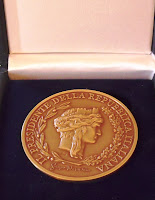
Antonio won many prizes and certificates for his poetry, among them the Silver Medal of the President of the Republic and The Medal of the Speaker of the Senate. These were all proudly on show in his home, in a room devoted to them. In 2009, Antonio was invited to receive a prize at the Premio Internazionale di Poesia "Coluccio Salutati" awards ceremony in Buggiano (Pistoia) and I was thrilled to accept an invitation to travel there with him. (Unknown to me before the ceremony, but known to Antonio, I was to be awarded a prize too, for my translation of Il profumo del pensiero.)

Migrants and others who were voiceless or without hope found a defender in Antonio Lonardo, as can be seen in the second collection I translated for him, Alla ricerca dell'Oreb. During that journey by train and ferry to Florence (whence we would travel onwards to Buggiano by car) a passenger whose views were abhorrent to both of us entered our carriage. I (with difficulty) kept out of the argument but Antonio skilfully and calmly demolished the gentleman's assertions and today I remain as impressed, recalling that discussion, as I was in 2009.

Antonio once told me that he was sad that young people did not seem to appreciate poetry, not understanding that it can explain this very puzzling world. To the young people of Modica, then, I would say, "Read! Read your poet!"

I will always be grateful to have had the opportunity to translate some of Antonio's work and he was delighted to know that people in other countries were reading it.  

When the poet and songwriter Charles Aznavour died, President Macron said,

"En France les poètes ne meurent jamais - In France, poets never die."

I am sure the same is true in Italy.

Ho scoperto l'orizzonte
dove spunta il sole:
è nei profondi occhi
di chi sorride alla vita.
....

Ho saziato la fame
dell'intellettuale curiosità:
è nel profondo intimo
di chi stimola lo spirito.

I have discovered the horizon
where the sun rises:
it is in the depths of the eyes
of those who smile at life.
....

I have satisfied the hunger
of intellectual curiosity:
it is in the innermost being
of those who move the spirit.

(Antonio Lonardo, Singolari Esperienze)


Friday, November 12, 2021

AN ACCESSIBLE SAINT

As I mentioned in my hurricane pasta post last week, Sicily has suffered some very bad weather lately. Just one week after the almost total devasation of Catania, floods hit the province again last night, affecting Agrigento and Siracusa provinces as well. Even Ragusa did not escape this time. So there was no "St Martin's summer" ("Indian summer") for us this year.

I have written about this favourite saint of mine before and long-term readers may remember that I explained that the term "St Martin's summer" is used for good weather which lasts into November because of the legend of St Martin's cloak:  In the fourth century, Martin met a beggar at the gates of Amiens on a very cold day and cut his cloak in two with his sword to give half to the poor man. It is said that the sun came out and began to shine brilliantly at that very moment, hence the term estate di San Martino, a phenomenon which I have enjoyed many times in Sicily.

The Feast of St Martin is celebrated on 11th November, the anniversary of his funeral in 397 ( he had died on 8th November) and, because this is also Remembrance or Armistice Day in Britain and my mind yesterday was on my paternal grandfather who was blinded in action in 1918, I'm afraid I had forgotten about St Martin until I was offered fritelle in his honour in my local bar. Fritelle are often served on feast days but are particularly appropriate for St Martin's Day because they can be fried  using the season's new olive oil and go beautifully with the vino novello which is opened on this day. Fritelle are akin to doughnuts but are much smaller and lighter and can be sweet or savoury. They can contain ricotta, walnuts, sultanas and / or fennel seeds, among other ingredients and I must say they are just what you need on a blustery, rainy day like yesterday.

Fritelle


I think St Martin is a very accessible saint for several reasons: we know quite a lot about him and he is a multicultural saint, having been born in what is now Hungary, brought up in Pavia, joined the Roman army and been posted to the Amiens area. He eventually became Bishop of Tours and founded the monastery of Ligugé, the first monastic community in Gaul. As Bishop of Tours he kissed a leper and cured him ( hundreds of years before St Francis did so) and he is credited with encouraging wine-making in the Tours area and introducing the Chenin blanc grape there. I discovered by accident yesterday that the Capetian dynasty of French kings probably owe this name to St Martin because the early kings were lay abbots of the Basilica of St Martin of Tours where part of the cappa (cloak) was kept and it is likely that the name Capet comes from this.

Going back to the weather, I like the the line in Carducci's poem about St Martin's Day in which he describes a miserable, cold day on which the aroma of wine  - presumably the vino novello - manages to "touch the soul with glee." This is what the story of this very human, accessible saint always does for me. I hope it warms your hearts too.

Monday, March 06, 2017

A POET, A POPE AND A PLATE


It was with great pleasure that I participated, on Saturday, in the launch of Modican poet Antonio Lonardo's 40th anniversary collection, Alla ricerca dell'Oreb, which I had translated.

Before the big event, of course, two visits were necessary - one to Giovanna Linguanti of Beauty Giò, and the other to Giorgio at Saloni di Successo:


At last, I am ready!


Alla ricerca dell'Oreb [In search of Horeb] is a collection of poems dedicated to migrants, describing their hopes, losses and heartbreak - a cause which is, as many of you will know, close to my heart. The second part of the book is dedicated to the migrants' champion, Pope Francis and I can assure you it makes for moving reading for people of all religions or none.  There are also poems dedicated to Gabriel García Márquez [born 90 years ago today] and to Mandela.

Besides reading my English versions of the poems at the launch, I spoke about the particular difficulties a translator of poetry faces and the changes necessary, especially in word order, when translating from Italian into English.  I ended by saying that, whilst very few translations ever match the beauty of the original - the linguist George Steiner said it was possible but rare - I hoped that mine had done justice to Antonio Lonardo's message.

Here are some more photos from the event:


Me with Antonio Lonardo
At the end of the evening I was delighted to receive this commemorative plate, specially commissioned by Antonio. I shall treasure it:


Thank you, Antonio and many congratulations again!

Sunday, March 05, 2017

DOMENICA MUSICALE

Asked to talk about the process of translation last night at the launch of Antonio Lonardo's poetry collection, Alla ricerca dell'Oreb, which I have translated, I quoted some lines from this Aznavour song. Although, in this case the "song" had already been written, I felt the search for the right words in another language was similar.  Here are the French and Italian versions of the Aznavour song: 

Friday, February 17, 2017

A TIMELY COLLECTION


Some years ago, I translated a collection of poetry called Il Profumo del Pensiero - The Essence of Thought for the Modican poet Antonio Lonardo. 

This year, Antonio celebrates 40 years of publishing poetry and I was delighted, in the summer, when he asked me to translate his new collection, Alla Ricerca dell'Oreb - In Search of Horeb.  Most of the poems in this new collection are on the theme of migration and the plight of migrants, a cause which, as many of you will know, is close to my heart. 

There is no good time to be forced to leave your country but the era we are living in is one of the most dangerous and precarious the world has witnessed so a collection of poems on this theme is, in my opinion, timely.

As you see from the poster above, the book launch takes place in Modica on 4th March 2017 and I shall be proud to be part of it.  

Thank you, Antonio, for giving me the opportunity to work on these poems.

Thursday, November 26, 2015

GOING, GOING......

Plaque on Salvatore Quasimodo's birthplace in Modica


A little piece of Sicily is to go on sale next week in the form of the Nobel Prize medal awarded to one of Modica's most famous sons, the poet Salvatore Quasimodo, in 1959.  This will be the first sale of a Nobel medal in Italy.

The lot, to be auctioned by Bolaffi of Turin, consists of the medal, the diploma, the original photos of the ceremony and a DVD of it [although the latter is available online anyway].  The starting price is €50,000 but it is estimated that the collection will sell for €100,000 - €150,000.

Bolaffi have decided to set aside €20,000 of their commission to create a scholarship which will enable a student from the Istituto A.M. Jaci, the Messina high school which Quasimodo attended, to study in Milan, the city where the poet lived from 1934 and in which he is buried.

It remains to be seen whether a Sicilian cultural association or other entity will bid for the lot but the Bolaffi decision does mean that Sicily will derive some benefit from the sale. Who knows where the lucky student's Milan experience will lead him or her and what ideas he or she might bring back to Sicily?

Thursday, May 14, 2015

DYLAN DAY IN SICILY

Today, the anniversary of the first public reading of Under Milk Wood in New York in 1953, is the first International Dylan Day.  Events will be held in many countries to celebrate the work of this great Welsh poet.

As part of the celebrations, people are being asked to post selfies on the theme of reading Dylan on twitter [#DylanSelfie]. Here is ours:


How could one not love the poet who wrote this line?

"There are always Uncles at Christmas."

Friday, January 23, 2015

A FAVOURITE BARD

Sunday, of course, is Burns Night and at London Town, Modica students can pick a Burns quotation and enjoy a shortbread biscuit. [No, I didn't make them this time - they come courtesy of Lidl Italia.]


Liz just asked me, on facebook, if I was serving haggis as well and I had to admit that I lack the courage to explain haggis to Italians!

Burns is one of my favourite poets and I tend to turn to him in bad times, such as this.  When I think of where my little Simi is I remember,

"Behold my love, how green the groves."

["My Chloris, mark how green the groves" in some versions.]

And sometimes I want to go and lie down on the earth that covers her until I go too.

A Burns line that sustains me is,

"I bear a heart shall support me still."

I hope I do, but it's hard!

Monday, October 27, 2014

CAITLIN IN SICILY

As I write, back in Wales the Dylathon is in progress in Swansea, the home city of our great Welsh poet, Dylan Thomas. There are, of course, other celebrations of the centenary of his birth taking place in many countries but tonight I'd particularly like to be in Wales.

Never mind - my thoughts are with Dylan and the magic of his words is something that I can carry with me daily. But I'm also thinking of his wife Caitlin, who, though long-suffering, was, by all accounts, a larger than life character herself, for this interesting lady had a connection with Sicily:

In Daphne Phelps's book A House in Sicily, the story of how she fell in love with and maintained the beautiful Casa Cuseni in Taormina, there is a short chapter entitled Mrs Dylan Thomas.  By this time, Daphne Phelps was taking bed and breakfast guests and she was not a little disconcerted when her friend Wyn, a companion to the widowed Caitlin, announced the latter's intention to descend upon Casa Cuseni, which she deemed a suitable setting in which to write her autobiography.  

Daphne made excuses in writing twice and didn't answer the third letter from Wyn but one night, the two women turned up, Caitlin carrying a large bottle of wine. Daphne told her, truthfully, that she was going away the next day but managed to put them up in a small pensione. 

When Daphne got back, she found a letter from a worried Wyn, explaining that Caitlin had fallen for a Sicilian man from whom Wyn had tried to separate her, believing the match would not be a happy one. Caitlin, however, had missed him, had written to him and had now gone away with him.

The Sicilian was film director Giuseppe Fazio, who became Caitlin's partner and with whom she had a son, Francesco. Daphne Phelps says that, according to Wyn, Fazio "beat" Caitlin but I can find no corroboration of this. Caitlin spent the rest of her life with him, apparently staying sober during her last twenty years and she died in Catania in 1994.

Caitlin, then, was attracted first to a fiery Welshman and then to a presumably fiery Sicilian. Some say there is Latin blood in the Welsh and I wouldn't be a bit surprised. I think it would have been fun to have known Caitlin and to have talked to her about Sicily.

Post scriptum:  I like to think I have brought a little of Dylan to Sicily myself, having, for the past three years, read from A Child's Christmas in Wales at our multilingual carol service. It goes without saying that no one reads it like Dylan!

Wednesday, April 23, 2014

WILL DAY

The subject of this post is not the second in line to the British throne but a much older Will, the bard of Stratford-upon-Avon, whose 450th birthday - or the generally accepted date of it - is being celebrated today.

Yesterday evening a friend who also comes from Stratford-upon-Avon gave a little party in the poet's honour, and tiramisù alle fragole, made to Matthew Fort's recipe which I've mentioned before, was my attempt at a themed dish:


As I tend to do everything arse-backwards, I'd decided on the quote I wanted to use first, and then tried to think of a dish. The quote, in case you cannot see it clearly, is,

"The strawberry grows underneath the nettle"
- Henry V

The "leaves" at the top were my best effort at making pasta di zucchero nettles and, by the time I came to the second one, I decided to leave out the fancy work on the edges. Most of the strawberries, of course, were underneath the mascarpone!

At the party the place settings were decorated with rosemary "for remembrance":


These were just some of the lovely treats:  Ah, sausage rolls!


 Another friend had brought hot cross buns all the way from the UK!


As you see, there was quite a mix of traditions


and in Sicily, in spring, there had to be ice cream!


My friend also provided what, as a teacher, I would call some "realia":


Then there were some readings from Shakespeare's works. [I read Sonnet XXIX, for  my Dad, who died 41 years ago this Easter.] Three friends made rather fabulous witches, I must say!  Finally, I lowered the tone by reading a little ditty I had composed: 

Will Day


Will Shakespeare, yours was quite a muse
from errors down in Syracuse
to propaganda for Queen Bess –
- your plays were thirty-eight, no less.
Poor Hamlet – what a tortured bloke,
for him existence was no joke.
He could have saved some brouhaha
if he’d just said, “Siamo qua.”
But let us find a cheerful fellow,
Macbeth won’t do, nor will Othello.
Bottom, Touchstone, Mistress Quickly
meddled in the plot quite thickly.
Down the ages comes their laughter,
hope it reaches the hereafter.
If it’s true what some folk say,
you never loved Anne Hathaway,
the sonnet lady was a lad,
we don’t care ‘cos your rhymes weren’t bad.
They claim that Bacon wrote the plays –
- one must admit, he turned a phrase,
but not like you, dear Stratford bard,
held for centuries in regard.
We celebrate your birth this eve
and some among us really believe
that though the thing is still the play,
you were Sicilian, anyway.

© Pat Eggleton, 2014

Notes

"Siamo qua" = "We are here" - a common Sicilian saying. It took me some time to realise that it is not an acceptance of physical location, but a reference to the fact that we are still alive and should be grateful!

The idea that Shakespeare was Sicilian is taken quite seriously here and books have been written about it.


Tuesday, May 28, 2013

THE RETURN OF "IL POETA DEL PONTE"

"My poet", Antonio Lonardo, whom I also call "Il poeta del ponte", has been busy since he last appeeared on this blog. Since the collection of poems Il profumo del pensiero, which I translated into English, three more Lonardo anthologies have been published and Antonio has continued to be awarded honourable mentions in, and to win, numerous poetry competitions.

His latest collection is entitled Orizzonti sconvolti [Unsettled Horizons] and is divided into three sections: Storia, about historical events and people in history; Crisi, about the crisis in our values; and Speranze, about hope.  The author of this article calls Antonio a "determined" poet and, whilst I would agree with this, I would also describe his message as triumphant, for he always gives us hope.

Incidentally, I get a mention in the article too!

Tuesday, June 19, 2012

A HARVEST OF CULTURE


Congratulations to Antonello Buscema, Mayor of Modica, Cultural Councillor Annamaria Sammito and everyone involved in the second edition of Modica's Miete Culture, or "Harvest of Culture", a series of cultural events running from mid-June until the end of August.  The Festival has been awarded the Medaglia di Rappresentanza by President Giorgio Napolitano and the organisers say that this recognition has encouraged them to work even harder to make the event a success.

This year, on the tenth anniversary of the inscription of the Val di Noto towns of Caltagirone, Militello in Val di Catania, Catania, Modica, Noto, Palazzolo Acreide, Ragusa and Scicli in the UNESCO World Heritage List, the Festival is paying tribute to the Arab Spring and in particular the Jasmine Revolution in Tunisia. This evening the Tunisian street vendor Mohamed Bouazizi, who set himself alight in 2010 in protest at economic conditions in his country and his own treatment by police and officials, is being honoured in Modica's Palazzo San Domenico, where 200 jasmine plants have been placed along with a ceremonial torch as part of an art installation by the Brazilian artist Marcel Cordeiro.  Mr Bouazizi's sister, representatives from the Tunisian Embassy in Rome and the mayors of the other seven Val di Noto towns are attending the ceremony.


Dance, music, drama and other literary events also form part of the Festival, which was opened last week by the 90-year-old  torinese poet Maria Luisa Spaziani, whose 1970 collection L'occhio del ciclone was dedicated to Sicily.

It is hoped that the President's recognition of the initiative will help this annual Festival to become more widely known on a national level and raise awareness about life in other Mediterranean countries.

Modica's Miete Culture Festival
as depicted at the Infiorata Netina,
 May 2012.

Monday, September 19, 2011

ANOTHER DITTY - FOR THOSE WHO CAN STAND IT

www.bigoo.wswww.bigoo.wswww.bigoo.ws


Things have been rather sombre on Sicily Scene recently so in an attempt to cheer you all up, I am posting my entry for the wonderful Stan Carey's limerick competition.  Stan is an editor, linguist and writer so, not surprisingly, the poem has to be about language.  Misuse of the apostrophe in general, but particularly in "its" irritates me no end but my Italian students, at least, have some excuse for their errors.  They don't believe me when I tell them that many British people also make mistakes when writing "its" and that mostly they add the apostrophe where it is not needed rather than omitting it:

Oh, what a problem is “it’s”
It’s driving me out of my wits
When “its” means “belong”
the apostrophe’s wrong
but students think “its” is the pits!

I wish that my name were Lynne Truss
who, spotting this error in us,
put it all in a book -
you should have a look,
She made a few million thus.

Lynne Truss is the author of Eats, Shoots and Leaves: The Zero Tolerance Approach to Punctuation.


If you would like to join in the limerick fun, pop over to Stan's blog - you have until 23rd September - and you will learn a lot about language while you're there.

Tuesday, September 13, 2011

I TACKLE THUMBTACKS - A "LET'S BLOG OFF" POST


Every two weeks, the blogosphere comes alive with something called a Blog Off. A Blog Off is an event where bloggers of every stripe weigh in on the same topic on the same day. The topic for this round of the Blog Off is "Thumbtacks".

The subject this week is thumbtacks
which rather stopped me in my tracks
for, being a Brit,
I have to admit
this word my vocabulary lacks.

So to my computer I turned
and soon I surprisingly learned
that over the pond
and even beyond
a drawing pin this name has earned.

Are drawing pins, then, still in use?
[I hope I do not sound obtuse.]
I've some on this board
and have quite a hoard
for Christmas, along with my spruce.


But are they used round and about?
I decided I had to find out.
And down in the squares
whilst selling their wares
the traders could not do without!


To be serious for a moment, it is important to let you know that, for every participating post, Let's Blog Off will make a donation to Jane Devin's kickstarter campaign for her book Elephant Girl: A Human Story.


Below is the full list of participating blogs in this Blog Off:

Monday, May 02, 2011

A ROUNDABOUT FIT FOR A POPE

On the day when 1.5 million people gathered in Rome for the beatification of the Blessed Pope John Paul 11, the  50,000 inhabitants of Modica also remembered this most human of pontiffs by unveiling a statue of him in the little garden on this roundabout in the modern Sorda district.


I am pleased to be able to report that the seats in this pleasant oasis, for so long disfigured by graffiti, have had a makeover for the occasion:


This seems an appropriate day on which to repost Antonio Lonardo's poem Outsider, which is dedicated to the Blessed Pope John Paul 11, along with my translation.  The poem is published in our collection Il Profumo del Pensiero.  [For details, see the sidebar.]


OUTSIDER

Policromia dell’esistenza,
incrollabile empireo
di una vita vissuta
a coniugare costantemente
la forza delle idee
con il turbinìo dei tempi…

Caleidoscopica luce,
venuta dall’Oriente,
ha attraversato i deserti
dei cuori induriti,
scavalcando i muri,
caduti con le ideologie.

Desideroso di vita,
ha baciato, estatico,
le orchidee trasparenti,
fecondate dall’amore
e protese nel tempo
a raggiungere il cielo.

Strabilianti coincidenze,
profeticamente scatenate,
di pericolosi attacchi
miracolosamente superati:
eroismo decretato
dalle masse festanti.

Coraggiosa volontà
d’inginocchiarsi alla storia
e chiedere perdono
di macroscopici errori:
costante paradosso
di tempi ormai superati.

Universale visione,
ha valicato confini contratti,
inchinandosi a qualsiasi terra,
per avvicinare l’umanità
alla radice comune
di un’unica origine.

Incessante torre orante
di visione geo-trascendente
per disincantare i temuti silenzi
di un Dio certamente offeso
da insensati conflitti
scatenati da supposti moventi.

Dolorosa esistenza
del corpo e dello spirito:
assurda miopia di gruppi,
provvidenzialmente sconfitti
da miracolosa resistenza
decantata dalla storia.

OUTSIDER

A many-coloured existence,
unshakeable empyrean
of a life lived
constantly linking
the intensity of ideas
with the turbulence of the times…

Kaleidoscopic light,
coming from the East,
you crossed the deserts
of hardened hearts,
climbing over walls
felled with their ideologies.

Lover of life,
you kissed, ecstatically,
the lucent orchids,
conceived in love
and reached out in time
whilst seeking heaven.

Astounding coincidences,
prophetically unleashed,
dangerous attacks
miraculously survived:
decreed a hero
by rejoicing crowds.

The courageous will
to kneel before history
and ask forgiveness
for macroscopic errors:
constant paradox
of times now past.

Universal vision,
you crossed agreed boundaries,
bowing in any land,
to bring humanity close
to the common root
of a single origin.

Incessant tower of prayer
of geo-transcendent vision
breaking the fearful silence
of a surely offended God
at senseless conflicts
loosed by so-called “causes”.

A painful existence
of body and of spirit:
the absurd myopia of groups,
providentially defeated
by the miraculous resistance
extolled by history.


Friday, November 26, 2010

ITALY MAGAZINE ROUND-UP - 24


Here is my pick of last week's Italy Magazine articles.

Everyone is talking about the rubbish crisis in Naples but, in the run-up to Christmas, let us not forget a more positive claim to fame that the city has.  Everyone also continues to talk about Mr Berlusconi and you really would think that the Prime Minister's manhood had caused enough trouble;  then this story broke.  If, on the other hand, you are fed up with stories of the airheads who surround him, here is the perfect antidote.

Immigrant workers in Brescia found a unique way of drawing attention to their plight but the day after this story appeared torrential rain forced them down from their crane.  

Tired of politics and protests?  Here you can learn why it will shortly be time for tea in Rome 

With an early genereal election in Italy looking increasingly likely, I wrote about my personal experience of participating in Italian elections for my Patti Chiari column.

Happy reading.

Wednesday, September 01, 2010

"A RED HAT WHICH DOESN'T GO"


Just over a year ago, before Italy "shut down" for the summer, I showed some women students Jenny Joseph's poem Warning.  I wanted to leave them with something pleasant, they were linguistically ready to read such a work and I think that women from all cultures can relate to the poem.  Warning was voted Britain's favourite post-war poem  in a 1996 BBC poll. 

It's always nice when students remember a cultural insight you have given them so I was delighted when, just before this year's recess, a student from the same class brought me an article about the poem from D. La Repubblica delle Donne, a Saturday supplement for the newspaper's women readers.  The article's author laments the fact that there is no Red Hat Society in Italy and wonders why.

I think the answer is quite simple:  you will have no trouble getting an Italian woman to wear a red hat, but you will never, ever get her to wear a purple dress with it.


Counters


View My Stats