In a world that seems to be largely run by oligarchs, charlatans and megalomaniacs there are few leaders who, when they pass, receive genuine praise from other heads of state, heads of government and religious leaders of all political persuasions and faiths. Pope Francis is one who has.
Probably like most of you, I woke up to the news this morning and immediately felt a deep sadness. I am not a Catholic but I feel drawn to that faith; I am not a Protestant but must admit I used to like a good sing-song in a Protestant church now and then; I am not a believer, nor am I a non-believer but I would like to believe.
Why, then, am I saddened by the death of Pope Francis? Because I think he was a force for good in the world and I have found him a relatable figure ever since the evening he was elected Pope and came out onto the famous balcony and said, "Buonasera" to enormous cheers from the crowd. It was so simple yet so appropriate and it felt as if your neighbour was greeting you in the street.
In January 2020, when our fears of the virus were growing, this agnostic blogger who is leaning towards Catholicism bought, on impulse, a book entitled Preghiera (Prayer), a collection of Pope Francis's thoughts on the matter. In a section called How to Pray, there is a quote from a speech he gave in 2016. He says,
Do not forget to pray. Pray in any way you can, and if you fall asleep in front of the Tabernacle, you will still be blessed. But pray.......Do not lose your closeness to and availability for others, and also, I allow myself to say to you, do not lose your sense of humour. And we will go forward!
A Pope who valued humour could not, and did not, fail to be loved.
Our estate di San Martino (Saint Martin's summer) has been well and truly over since Sunday and I sit here writing this on a cold, rainy afternoon. A prolonged summer is named for the saint because, according to legend, in the winter of the year 335 St Martin of Tours met a freezing, starving beggar at the gates of Amiens. He cut his cloak in two and gave half to the man and, coming across another man in a similar condition moments later, gave the other half to him. It is said that the sun came out when he gave away the second half of the cloak - hence l'estate di San Martino.
Frittelle (deep-fried pastries or doughnuts)) are traditional on St Martin's Day (11th November) not only because they are small and symbolise pieces of the cloak, but also because they contain few ingredients and centuries ago could be made by rich and poor alike. They can be fried using the new oil from the olive harvest and are often served with the vino novello which is traditionally opened on this day.
St Martin is associated with the poor and is the protector of soldiers, innkeepers, hoteliers and beggars. He died in Candes, now Candes-Saint-Martin, in 397. He is one of my favourite saints so I really wanted to find some frittelle yesterday and I did, in my local fruit shop.
It is mid-August and once again it is the Feast of St Lawrence, followed by la notte di San Lorenzo, the night on which young Italians often stay on the beach, looking for shooting stars or le lacrime di San Lorenzo (St Lawrence's tears). If you see some, they are said to bring you good fortune. As I wrote last year, the only notte di San Lorenzo on which I've managed to spot some was in 2019 and whether they brought me good luck depends on how I interpret 2020! I suppose they did, in that I have been lucky enough to survive the pandemic so far and in 2020 I managed to complete my memoir.
This year. I think I will be disappointed again, though, as it seems that the Perseids will mostly be active on the 13th, but may be obscured by a very bright full moon. Never mind, I love the Sicilian moon!
Whether or not you see the stars, here is a lovely song for you to enjoy tonight:
Let's start with the festival: Sanremo 2022 ended on Saturday, after a great week's entertainment, with an overall win for the duo Mahmood and Blanco and their song Brividi. They will go on to represent Italy with this song at the Eurovision Song Contest in Turin in May so you'll be hearing a lot more of it.
I liked it very much, but I also likes Elisa's song, O forse sei tu, which was beautifully sung and it was nice to see the singer back at the Festival after 20 years. (I've always followed Sanremo, even from Britain.) Elisa came second and also won the the prize for best musical composition. She must have been very pleased as later she skateboarded back to her hotel, still in her beautiful, long, floaty white dress. Brava, Elisa! The Gianni who is so loved in Italy that he is sometimes known as the "Gianni nazionale", the great Gianni Morandi, came third with Apri tutte le porte - Open all the Doors, a song which, with its description of waking up feeling indolent and then being determined to open the doors of life and let the sun in, appealed to everyone's mood. Morandi, with Jovanotti, won the Cover Night (in my opinion always the best night, as I like to wallow in nostalgia) and really the singer has made a fantastic comeback after suffering serious burns to his hands and legs last year in a garden accident. I wish I had his energy!
My favourite song, and therefore the one I voted for, was Irama's Ovunque Sarai - Wherever You Are and he gave it everything on the final night, saying,
" This evening I'm going to sing to remind all who have lost a loved one that love and beauty always remain in the present."
Irama was placed fourth but I'm sure he will win the Festival one day.
It was also good to see female co-presenters who had been chosen not only for their looks but for what they had to say, which was consistently interesting and I mentioned Lorena Cesarini in my post last Thursday. Had there been an elegance prize, it was generally agreed, it would have gone to to Drusilla Foer, the alter ego of the actor Gianluca Gori. It was the first time Sanremo had been co-presented by a celebrity en travestiand well done to the organisers for moving with the times. Last week, I said that if I make it to the age of 82 I want to be like Iva Zanicchi but after the following exchange on Saturday I've decided I don't:
Iva: "How tall you are!"
Drusilla: "Taller than you!"
Iva: "You've got other things I don't have!"
Drusilla: "Yes, I'm cultured."
So Drusilla took the repartee prize too and went on to say that she thought we should stop focussing on our diversity and concentrate on our uniqueness. She is strongly tipped to be the main presenter of Sanremo 2023.
From the Festival to another celebration, that of the Platinum Jubilee of Her Majesty the Queen: I'm not entirely a monarchist, as regular readers will know, but I'm not entirely an anti-monarchist either, absurd though the institution can be. Anyway, my friend Carol King and I decided it would have been churlish not to at least drink a toast to her. I think we have all decided to celebrate whatever moments we can in this third year of the pandemic so a "Lizzie lunch" was planned: I prepared some antipasti - my green tomatoes in balsamic vinegar, Asiago cheese with cotognata (quince paste), dried sausage, sun-dried tomatoes and olives.
We ordered some chicken and chips from a popular rosticceria (as that's a bit British) and a tray of little cakes including these pretty mini-cheesecakes and chocolate cups from my local pasticceria.
As it's carnival time (although many carnivals have been postponed to the spring because of the pandemic) I also got in some traditional chiacchiere biscuits. This is the first time I've seen some drizzled with pistacchio cream instead of chocolate and very good they were too.
As I said, it would have been churlish not to...
People have remarked that the Queen's Accession Day 2022 Message is "perfect pitch" and indeed it hit the right note and concentrated on the positive. Her Majesty had the courage to look to the future and also to grant the wish that she knew would make her son and heir apparent happy - that is, to recognise his wife as future Queen (and not Princess Consort as originally suggested in deference to public opinion almost seventeen years ago). We have all moved on, I think, though many people I have spoken to here are indignant on behalf of the late Diana. My view from abroad is that the British have not forgotten her and even if they had, there are series like The Crown to remind them, but that they have forgiven Charles and come to respect him more. Even future kings can make mistakes in their personal lives and my own view is that he has paid for them.
What, I wonder, would Pope Francis think about that? I don't think he would pass judgement on a non-Catholic marriage but perhaps he would quietly wish Charles, who had great respect for his predecessor-but-one and who postponed his second wedding to attend the latter's funeral, well. It would seem so judging by the humility of this man on Sunday's Che tempo che fa programme. The Pope surprised us all by admitting he had wanted to be a butcher as a child, because, shopping with his mother or grandmother, he had seen that the butcher had a bag into which he put money. Quite a change of vocation! The Pope was most angry about what he described as a crime - the treatment of immigrants - saying that they were being held in what amounted to concentration camps in Libya and he saw war as the cause of most of the world's ills:
"A year without arms and there would be enough food and education for the whole world."
Asked about the suffering of children, Pope Francis said that, despite his faith, he could give no explanation and I admired his honesty.
On a lighter note, he admitted that one of his reasons for not choosing to live in the Papal apartment was that the popes who had lived there before him were saints, while he is not one and he needs people around him, for friendship sustains him. He also said that a sense of humour is like a medicine.
Presenter Fabio Fazio has been criticised today for being a little too humble in this edition of Che tempo che fa but I think he is a great interviewer and he did not avoid difficult questions. And who would not have been overawed when interviewing the Pope?
All these events were pleasant distractions from what is happenng in my own country and I found each of them uplifting. If only I could stop scrolling the news more often!
How lovely it is to see the Sanremo Festival back this year with a live audience in the Ariston Theatre. This, of course, wasn't possible last year, when everyone did their best but presenters like Amadeus and Fiorello need the interaction which only a live audience can provide for them. More importantly, though, being able to watch the much-loved Festival in its usual format is giving Italians a sense of normality and goodness knows, all our psyches need that.
So what were the highlights and controversies of the first two evenings on Tuesday and Wednesday? Well, much will depend on how you view certain matters, for the always original Achille Lauro was the first contestant to get himself into a row and not any old row, but one with the Catholic Church because he appeared, bare-chested, barefoot and tattoed and performed a mock baptism. This led to accusations of blasphemy. The singer defended himself by saying that he had dedicated the performnce to his mother and that mothers give life and therefore renew us every day. Another person to defend him has been Carmelo La Magra, the former priest of Lampedusa, who asked if people only demonstrate their Catholicism when Achille Lauro sings. He also said that the singer is an artist whose job is to deliver messages and advised people to be scandalised about other things and to allow themselves to laugh now and then. Meanwhile the editor of the Vatican City newspaper, L'Osservatore Romano, wrote,
"Sanremo is Sanremo. The Osservatore is the Osservatore...... They don't make sinners like they used to."
I rather think that those should be the last words on the controversy but I leave judgement to those more versed in religion than I am.
Like most of my contemporaries, I love a golden oldie type of song and Massimo Ranieri gave us one in Lettera al di là del Mare. I must admit to being rather cross with Mr Ranieri, though, for in a recent interview the singer, who will be 71 in May, talked about his desire to have a son.
"Fortunately a man of a certain age can reproduce and I sincerely hope to do so."
He said he thought he would be an ideal dad - he has a daughter but he didn't recognise her until she was 24 - as he has the body clock of an artist and rarely goes to bed before 3 am. Therefore staying up with a crying baby would not bother him. It may be true, as he says, that 70 is not old these days and as I am just over that age too I am happy to believe him. However, I couldn't help thinking that if a woman of that age expressed her desire to become a mother, she would be widely vilified, as indeed many women twenty years younger have been. Anyway, I enjoyed the song, Massimo.
Next up on this blog is 82-year-old Sanremo veteran Iva Zanicchi, who looked fabulous and belted out a song called Voglio amarti. I must admit I didn't take much notice of the lyrics, as I spent her performance time with my nose almost pressed to the screen trying to work out exactly what shades of eyeshadow she was wearing so that I could copy them. When I heard the song again later, I particularly liked the lines,
E se un giorno scoprirò Nel mio cuore una ruga in più… sarai tu
And if one day I find
Another wrinkle in my heart ... it will be you.
When Iva Zanicchi was placed last in Wednesday night's press and media vote, her reaction was,
"Well, at least they noticed me."
If I make it to 82, I want to be like Iva!
The singer in first place was Elisa, back at Sanremo after twenty years, with O forse sei tu. I, too, thought this was a beautiful song but the public votes which start on Thursday could change everything.
Perhaps the most touching moment on Wednesday night was when co-presenter and actress Lorena Cesarini spoke about her experience of racism, quoting some of the cruel comments she has received on social media since the announcement that she would be co-presenting on Wednesday:
"After Amadeus's announcement I discover that, at 34, it isn't true that I'm an Italian girl like the the others - I'm black... But I keep asking myself, 'Why? Why are there people who have a problem with the colour of my skin?' "
I don't know, Lorena and I can't imagine how this must feel. I can only tell you to keep on being your brilliant self and to hope that we will emerge from the pandemic having learnt that we are all human and must stand together.
I am not watching Sanremo tonight (Thursday) because Masterchef Italia requires my attention but I'll be watching tomorrow and on Saturday (the final night) and will probably take part in the public vote.
As I mentioned in my hurricane pasta post last week, Sicily has suffered some very bad weather lately. Just one week after the almost total devasation of Catania, floods hit the province again last night, affecting Agrigento and Siracusa provinces as well. Even Ragusa did not escape this time. So there was no "St Martin's summer" ("Indian summer") for us this year.
I have written about this favourite saint of mine before and long-term readers may remember that I explained that the term "St Martin's summer" is used for good weather which lasts into November because of the legend of St Martin's cloak: In the fourth century, Martin met a beggar at the gates of Amiens on a very cold day and cut his cloak in two with his sword to give half to the poor man. It is said that the sun came out and began to shine brilliantly at that very moment, hence the term estate di San Martino, a phenomenon which I have enjoyed many times in Sicily.
The Feast of St Martin is celebrated on 11th November, the anniversary of his funeral in 397 ( he had died on 8th November) and, because this is also Remembrance or Armistice Day in Britain and my mind yesterday was on my paternal grandfather who was blinded in action in 1918, I'm afraid I had forgotten about St Martin until I was offered fritelle in his honour in my local bar. Fritelle are often served on feast days but are particularly appropriate for St Martin's Day because they can be fried using the season's new olive oil and go beautifully with the vino novello which is opened on this day. Fritelle are akin to doughnuts but are much smaller and lighter and can be sweet or savoury. They can contain ricotta, walnuts, sultanas and / or fennel seeds, among other ingredients and I must say they are just what you need on a blustery, rainy day like yesterday.
Fritelle
I think St Martin is a very accessible saint for several reasons: we know quite a lot about him and he is a multicultural saint, having been born in what is now Hungary, brought up in Pavia, joined the Roman army and been posted to the Amiens area. He eventually became Bishop of Tours and founded the monastery of Ligugé, the first monastic community in Gaul. As Bishop of Tours he kissed a leper and cured him ( hundreds of years before St Francis did so) and he is credited with encouraging wine-making in the Tours area and introducing the Chenin blanc grape there. I discovered by accident yesterday that the Capetian dynasty of French kings probably owe this name to St Martin because the early kings were lay abbots of the Basilica of St Martin of Tours where part of the cappa (cloak) was kept and it is likely that the name Capet comes from this.
Going back to the weather, I like the the line in Carducci's poem about St Martin's Day in which he describes a miserable, cold day on which the aroma of wine - presumably the vino novello - manages to "touch the soul with glee." This is what the story of this very human, accessible saint always does for me. I hope it warms your hearts too.
I
would see her four or five times a year, usually in summer, as I sat
writing in the bar on the corner of my street in Centochiese. Once, I
saw her in the hairdresser's, on a Saturday like all the other times,
and once in the run-up to Christmas – always with the same group of
friends and even in winter, when it gets cold and windy in Sicily,
seated outside the bar where those who wished to could smoke. She had
the kind of easy elegance that every woman secretly covets and I
noticed her first not for the beauty she undoubtedly had, but for
this. When she moved she glided, her long dark hair seemed
effortlessly in place and her clothes, simpler in style than those of
her friends, seemed smarter because of the way she wore them; few,
but perfect, accessories, make-up applied by a painstaking beautician
to look as if it wasn't there and, most importantly, she wore them
with confidence.
Beauticians
do rather well in Centochiese – there are six within a five-minute
walk from my house – and they do especially well on summer
Saturdays, for when there is a wedding, not only the bride, but every
female guest will have what we would call in English “the works”
and will be made up as if for a television appearance. An Italian
beautician can make anyone look stunning, including, on occasion, I
like to think, me.
So
it was that I knew they were a wedding party from their attire –
the women in evening dress or at least what used to be called
“cocktail dresses” in the early afternoon, and the men in their
expensive suits teamed with trainers – yes, trainers – that had
probably cost as much as the rest of the outfit. It made a stylish
combination. The other clues were the group's general celebratory
mood and the time of day: I would see them at around 2pm or between
6pm and 8. You see, in Sicily, people don't just have their wedding
photos taken in and outside the church or at the reception, but the
bride and groom leave their guests, sometimes for several hours, to
go off to a specially chosen location – often the beach - with the
photographer. What do the guests do in the meantime? Well, those who
live near enough sometimes go home whilst others, such as this group,
repair to a favourite bar to smoke, gossip, have an aperitvo
and share a plate of struzzichini while they wait for the real
celebration to begin, at perhaps 8.30 or 9.30 pm. This will go on
until the early hours, comprise many courses, the viewing of the
wedding video or perhaps a clip or montage of the couple's story,
dancing and high jinks and possibly – something which frightens me
to death – the lighting of paper lanterns which fly dangerously low
over the guests' heads. Yes, these friends would have a good time
later.
The
wedding party girl, as I called her in my mind, never seemed to be
with any of the young men in particular, though some of the others
were obvious couples. She seemed of them, yet a little aloof, never
smoking, never talking or laughing loudly but smiling, graceful and
usually acknowledging me with a little nod. “Signora”,
she'd say quietly if I passed her.
Several
summers went by like this and after the first one, I'd notice a
couple missing from the group so I'd guess it was their wedding day.
Then the next summer they'd be back, the young woman perhaps with a
definite bump, and another two of the group would be missing. Yet it
never seemed to be the wedding party girl's turn to absent herself
from the group.
Then
one summer I didn't see her at all. On the first Saturday I thought
that she might have been the (non-blushing) bride but when she didn't
appear for the second or third time the group were there, I wondered
if she had moved away, as so many young Sicilians do, for university
or for work. I didn't know the group well enough to ask and if I had,
my British reserve would have got the better of me. I didn't see her
the summer after that either, and then I suppose I stopped thinking
about it as after all, what business was it of mine?
That
New Year's Eve, for the first time in eight or so years, it snowed in
Centochiese, an event which was greeted with joy rather than dismay,
for there were children who had never seen such a thing. And I had to
admit it was pretty, although I shivered indoors more than I ever had
in England, where houses are built to shelter you from the cold
rather than the summer heat. On New Year's Day I awoke to that
silence that seems to fall everywhere along with snow when it first
comes. “The silence of a convent”, I thought as I ventured out,
as apartment-dwelling dog owners must, that morning.
Picture by kind permission of Oreb - Libri & Sacro, Modica
We
walked slowly, my dog and I – she because, like the children, she
had never seen snow before and I for fear of falling. Thus it was
that when we came to the Catholic book store, we paused for a moment
to look at its beautifully decorated window, which won prizes every
year in the Centochiese Christmas Window competition. Suddenly I
became aware of a woman treading lightly in the snow towards me,
dressed in an ankle-length grey skirt of thick material, a
mid-length, heavy raincoat that could have been British and what in
my far-away country we would call “sensible shoes” - probably
much more suitable for the snow than mine - and yes, a wisp of wavy
black hair escaping from under her wimple. I don't know why she was
outside or why her hands were bare on this freezing day but they
were, and as she stopped to admire the crib in the window she gave me
a fleeting smile and that familiar nod. “Sorella”, said I,
nodding back. There was just a hint of a wave as she left, enough for
me to register the glint of her nun's ring in the Sicilian sun which
was beginning to peep through the unusual grey of the sky. Then she
melted away as the snow soon would and to this day, I have not seen
her again. The wedding party girl had had her wedding day.
I was delighted to be invited to watch the Festa del Sacro Cuore procession from my friend Marisa's balcony on Sunday and here she is with her husband [with me in the centre]:
The procession takes a slightly different route every year so that, if you have sufficient Sicilian pazienza, you will eventually see it from near your home!
There are those who scoff at the Mediterranean habit of carrying saints' statues around towns and villages but to that I would say that it is no bad thing to gather together in peace and spread a little joy. Everyone is free to join in the prayers that are said along the route, whether from their balconies, sitting rooms or down in the streets - or you can just watch and enjoy the atmosphere. And, if you were a statue, wouldn't you want some fresh air once a year?
We had a little party on Marisa's balcony and of course, there was pizza. Then there was Marisa's cake and I had made some marshmallows to take along:
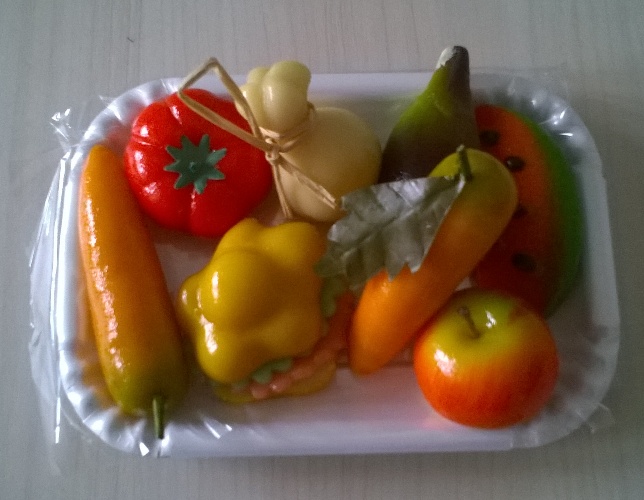
They are, as regular readers will know, frutti di Martorana. They are made from pasta reale[almond paste] Legend has it that the first ever batch of Martorana fruit was made on the orders of the mother superior of the Martorana Convent in Palermo. She had wanted to impress her bishop during his visit so the nuns obediently prepared the “fruit” and hung it from the cloister trees; so “real” did it look that the bishop declared that a miracle had happened, as all the fruits had appeared in the same season!
On 2nd November, I Morti [the Day of the Dead] children receive Martorana fruit as presents from deceased relatives who still wish to watch over them. Some think that this tradition is morbid but it seems to help children to accept the transitory nature of this life. Sadly, the Martorana Convent has long gone but the Church of Santa Maria dell'Ammiraglio, of which it was a part, still stands and is often called the Martorana. It is part of this.
Yesterday in Siracusa I found myself near the Santuario della Madonna delle Lacrime [Shrine of Our Lady of Tears] and took the opportunity to revisit it. The Shrine is built on the site where a statue of the Madonna is believed to have shed real tears in 1953, hence its teardrop shape. I remember that, when I first visited the Shrine, shortly after its completion in 1994, I wasn't sure if I liked it. Now I rather think I do.
A copy of the Turin Shroud is displayed in the Shrine.
On Sunday evening a friend invited me to enjoy the festa del Sacro Cuore - the parish festival organised by the little church on the corner, which I hold in great affection - from her nearby balcony and I was delighted to accept.
The festa consists of special prayers and religious services and then, in the evening, the statue of Christ is carried around the district to joyous music and with a crowd following it. On the route, people put up charming little altars where the procession and passers-by can stop for a moment to pray or think. An hour or two later the statue is brought back to the church, to the accompaniment of even louder music but the celebrations are not finished yet! Christ is taken for three speedy turns around the square before he can rest! Then the fireworks begin and I must say, what Modica lacks in population it makes up for in producing noise on these occasions.
Luna Rossa, a Renzo Arbore cover band, played in the church courtyard throughout the proceedings and were still going strong when I left, just before midnight.
My friend, her family and I also enjoyed these magnificent pizze, from left to right, a wild boar sausage and rocket one [which I hadn't tried before and which was delicious] a Margherita and a capricciosa:
A cynical stranger might say,
"Is that it? A few stalls, a band and a statue being carried around?"
This, however, would be to miss the point, which, apart from the religious aspects of the event, is to be together.
The little Sacro Cuore Church and the whole community of Modica was very happy to welcome the relics of St Bernadette Soubirous of Lourdes on Saturday:
Body of St Bernadette Soubirous, which lies in a crystal coffin. Her hands and face have a light wax covering.
Image: Parrocchia Sacro Cuore Modica on facebook
St Bernadette Soubirous of Lourdes
The relics in the Sacro Cuore Church
Image: Parrocchia Sacro Cuore Modica on facebook
The Parish had produced an informative booklet about the life and visions of St Bernadette. The relics remained with us until Sunday evening, when they were taken on the next stage of their journey to visit other churches in the diocese.
Besides being the protectress of Lourdes, St Bernadette is a protectress of the sick, shepherds and shepherdesses, poor people and those who are ridiculed for their faith.
I have the following cards of Lourdes in my collection of old postcards and thought you would like to see them. Every time I come across the card showing the two ladies, I wonder who they were - mother and daughter, mistress and maid, friends? If one or both of them were ill, I hope Bernadette helped them.
Birthplace of Bernadette Soubirous
Anne Murray - Song of Bernadette
Chanson de Bernadette - Canzone di Bernadette
[from TV mini-series Lourdes, dir. Lodovico Gasparini, 2000]
The statue of Christ that is carried around Scicli at Easter
A day or so ago, some good folk in nearby Scicli, having heard several bloodcurdling screams coming from an apartment in their street, did what most of us would do and alerted the police. One can only suppose that they were relieved to learn that no burglary, murder or other crime had been committed and that the cause of the noise was.... an exorcism. Or perhaps they just shrugged their shoulders and uttered, "Pazienza", this supposedly being the second exorcism to which police had been called in their city in the past two weeks, a detail which the local press has been enjoying immensely.
It was first reported that this second "exorcism" was being carried out to help a teenage boy, but today the priest involved has denied this, saying that he had been asked to go to the apartment because the boy was in deep distress and that the Carabinieri were already there, along with an ambulance crew. The priest did his best to calm the boy and one feels for him and his parents.
As I understand it, in Catholicism exorcism of a person can only be carried out by a priest authorised to perform the "rite" and with the express permission of his bishop. There has to have been a medical examination to exclude the possibility that the person involved is mentally or physically ill.
A few years ago, someone did something bad to me and at that time I figured I needed all the help I could get. So when a religious friend brought round some holy water which had been blessed by a priest authorised to carry out exorcisms and started sprinkling it around my house, presumably to cast out any lurking demons, I decided to accept gracefully. Strangely enough, things have gone a lot better since then.
Christmas in Modica always really starts, for me, with our multilingual carol service. This year's event took place on Saturday evening and I am happy to be able to say that many communities and languages were represented. Some songs and readings were religious whilst others were not, but all meant something special to their readers or singers at this time of year, which is just as it should be. Let's have a look:
Vive le vent - a French version of Jingle Bells
The British, American and Canadian contingent give their Joy to the World
There was food from all the countries represented and I made and took along these chocolate crunchy thingamies, a version of "Rocky road", I suppose. The recipe is in the November edition of Good Housekeeping UK and they are very easy to make!
Sicilian sfinci sit alongside Lebanese food and British mince pies - an indication of the international flavour [in every sense] of the evening.
I would like to thank the indefatigable Mr Douglas Ponton for getting us all organised, for conducting and for all his hard work.
"....and damned if you don't." Thus might the thoughts of the priests of Palermo Cathedral have run last week, when they were subjected to much criticism because of a prominent "WC" sign in a side chapel. Where is the loo in question? Directly behind the altar, a fact which has astonished locals and tourists alike.
One of the priests has said it was the only place in the cathedral where they could have put a toilet facility and that it is needed because there are no public conveniences, or other premises with toilets, nearby. He also said that the general feeling among his colleagues is that it is better to offer the facility than not and emphasised that the altar in question is not used for Mass or to store the host and wine.
What do you think? Would you expect to find a toilet in a cathedral?
All roads certainly led to Rome on Sunday and, whilst the eyes of the world were upon the rejoicing city, a little town in Sicily was remembering a miracle which happened there and which played a largely unpublicised part in the great events of the day:
In May 1967 Giovanna La Terra Majore was 54 years old and had been bedridden for 23 years in her home town of Chiaramonte Gulfi. A friend who had visited Rome had brought back a picture of Pope John XXIII for Giovanna and advised her to use it to help her pray. Giovanna did so but what she actually prayed for was death, to release her from her pain. On 13th May Giovanna had received the last rites. Suddenly, she felt the bed shake and a kind of pressure on her spine, as though someone was trying to push her up. Then, feeling as if she were being supported by two strong hands, she seemed to be propelled to the middle of the room - and she was standing, watching her own shrivelled feet uncurling. The next day, the "Good Pope" appeared to her in a dream and told her that she could now walk without fear.
Giovanna and her fellow-Chiramontani had no doubt that a miracle had taken place and to whom it should have been attributed. Although the event was considered during Pope John's beatification cause, it was excluded from his canonisation process. However, Suor Caterina Capitani, whose recovery from terminal illness was officially attributed to the intercession of Pope John XXIII, visited Chiaramonte Gulfi several times and met Giovanna. In a nice postscript to the story, the two women later visited Rome together and received Holy Communion from the hands of Pope John Paul II.
There is only one performance that everyone in Italy is talking about this week, and it is this one by Ursuline nun Suor Cristina on The Voice of Italy talent show. All I can say is, "Wow!" and I am sure you will, too. I am doubly wowed by the fact that Suor Cristina is Sicilian, from Comiso.
She chose the rapper J-Ax as her mentor as he was the first of the panel to turn round. He told Suor Cristina,
"If I'd met you when I went to Mass as a child I'd be Pope by now!"
When asked why she wanted to try her luck on The Voice, Suor Cristina said,
"Because I have a gift and I offer it to you."
As to what the Vatican might have to say about her appearance on the programme, Suor Cristina said she was expecting a phone call from Pope Francis. There is no word yet as to whether this has happened, but I, for one, believe that it will and that he will be delighted.
I'm a sort-of retired language teacher from Cardiff, Wales, UK, now trying to make a new life in Sicily. I'm not growing vines, making olive oil or restoring a palace stone by stone!