This evening I thought I would share with you some of my favourite reading about Sicily – not travel guides, and certainly not tomes of the“how I rebuilt a castle then lorded it like an Englishman and never learnt the local lingo” genre, but well-written, informative works by people who have made their homes here and committed themselves to Sicily; people whose love for the island shines through in every word they write.
The first book is A House in Sicily by Daphne Phelps. In 1947 Phelps inherited, then surprised herself by deciding to remain in Sicily and maintain, the beautiful Casa Cuseni in Taormina. She had to struggle to hold on to the house in the early days and I can identify with her brushes with Italian bureaucracy at that time. Phelps tells us of the ups and downs of running the property, the characters who work for her, the townsfolk she meets and regales us with tales of some of the people she entertained at Casa Cuseni, among them Bertrand Russell, Caitlin Thomas and Roald Dahl. And all the time you can sense her falling in love with Sicily. There is also an hilarious chapter detailing her encounters with the head of the local Mafia! Daphne Phelps died in 2005 at the age of 94.
Regular readers will know that I regard Mary Taylor Simeti’s Sicilian Food as the most authoritative work available on the subject but she is also the author of another favourite of mine: it is On Persephone’s Island, a journal which takes us through the seasons in Sicily. Simeti brings to life the harvesting of crops, fauna, festivals and the island’s history and, like me, she is fascinated by the myth of Persephone and feels the latter’s presence in her everyday life:
“ Perhaps it was my growing interest in calendars: the story of Persephone’s descent into the Underworld each winter and her return four months later was perhaps the earliest attempt to divide the year into seasons and to explain its rhythms.”
Simeti explains the Italian – and especially Sicilian – love of the festa thus:
“The Italian words [for eating plentifully] have behind them centuries of hunger interrupted only by famine. To eat all one wants and more, in one glorious and wasteful feed, is to consecrate the feast day by distinguishing it from the careful measuring out of the daily bread.”
I am now reading this book for the third time, so that is an indication of how much I value it.
Finally, I have just read another Simeti: In 1185 Constance d’Hauteville, daughter of Roger 11 of Sicily and heiress to the Sicilian throne in her own right, set out, with her entourage and the greatest dowry ever seen in Europe, for Germany where she was to be married to Henry, son of Frederick Barbarossa. Travels with a Medieval Queen is the story of Simeti’s attempt to retrace Constance’s year-long last journey home to Sicily in 1195. Aged 40 at the time and childless, Constance discovered, en route, that she was pregnant and gave birth to the future Frederick 11 in Jesi [Ancona]. Now, much of the book is conjecture, as Simeti freely admits, for very little was documented about this journey; sometimes, in my reading, I felt I was being bumped along slowly in a litter, like Constance. Yet here and there Simeti gives us fascinating glimpses of the medieval world and, having recently read Italy – The Enduring Culture by Jonathan White , I am convinced that the Renaissance was no historical “accident”: its foundations were already laid in the 11th, 12th and 13th centuries. In this book Simeti is well aware of the dangers of interpreting a medieval character through modern eyes and among fascinating questions which she raises are: Was there any concept of “self”, as post-Renaissance man understands it? How attached were mothers to their children? Were they afraid to love them because the infant mortality rate was so high? How was colour perceived? It was, Simeti says, an “urban phenomenon” and mostly available only to the rich, as dyes were expensive. Ordinary folk saw bright colours only in church. How did Constance feel in the muted light of Germany after being brought up in the magnificence of Palermo? How did she feel as the landscape changed as she reached the south once more? Here, too, I found echoes of my own cultural ambivalences, and began to ask myself whether a northern person is ever truly at home in a hot land and conversely whether, having lived in the Mediterranean, one can ever settle happily in the north again? And I was interested in the way that Constance's status changed once the precious heir was born. For childless women are still often made to feel , if not inferior, “different”, even in western cultures. I came to rather like Constance and am glad that Dante puts her in Paradise:
The first book is A House in Sicily by Daphne Phelps. In 1947 Phelps inherited, then surprised herself by deciding to remain in Sicily and maintain, the beautiful Casa Cuseni in Taormina. She had to struggle to hold on to the house in the early days and I can identify with her brushes with Italian bureaucracy at that time. Phelps tells us of the ups and downs of running the property, the characters who work for her, the townsfolk she meets and regales us with tales of some of the people she entertained at Casa Cuseni, among them Bertrand Russell, Caitlin Thomas and Roald Dahl. And all the time you can sense her falling in love with Sicily. There is also an hilarious chapter detailing her encounters with the head of the local Mafia! Daphne Phelps died in 2005 at the age of 94.
Regular readers will know that I regard Mary Taylor Simeti’s Sicilian Food as the most authoritative work available on the subject but she is also the author of another favourite of mine: it is On Persephone’s Island, a journal which takes us through the seasons in Sicily. Simeti brings to life the harvesting of crops, fauna, festivals and the island’s history and, like me, she is fascinated by the myth of Persephone and feels the latter’s presence in her everyday life:
“ Perhaps it was my growing interest in calendars: the story of Persephone’s descent into the Underworld each winter and her return four months later was perhaps the earliest attempt to divide the year into seasons and to explain its rhythms.”
Simeti explains the Italian – and especially Sicilian – love of the festa thus:
“The Italian words [for eating plentifully] have behind them centuries of hunger interrupted only by famine. To eat all one wants and more, in one glorious and wasteful feed, is to consecrate the feast day by distinguishing it from the careful measuring out of the daily bread.”
I am now reading this book for the third time, so that is an indication of how much I value it.
Finally, I have just read another Simeti: In 1185 Constance d’Hauteville, daughter of Roger 11 of Sicily and heiress to the Sicilian throne in her own right, set out, with her entourage and the greatest dowry ever seen in Europe, for Germany where she was to be married to Henry, son of Frederick Barbarossa. Travels with a Medieval Queen is the story of Simeti’s attempt to retrace Constance’s year-long last journey home to Sicily in 1195. Aged 40 at the time and childless, Constance discovered, en route, that she was pregnant and gave birth to the future Frederick 11 in Jesi [Ancona]. Now, much of the book is conjecture, as Simeti freely admits, for very little was documented about this journey; sometimes, in my reading, I felt I was being bumped along slowly in a litter, like Constance. Yet here and there Simeti gives us fascinating glimpses of the medieval world and, having recently read Italy – The Enduring Culture by Jonathan White , I am convinced that the Renaissance was no historical “accident”: its foundations were already laid in the 11th, 12th and 13th centuries. In this book Simeti is well aware of the dangers of interpreting a medieval character through modern eyes and among fascinating questions which she raises are: Was there any concept of “self”, as post-Renaissance man understands it? How attached were mothers to their children? Were they afraid to love them because the infant mortality rate was so high? How was colour perceived? It was, Simeti says, an “urban phenomenon” and mostly available only to the rich, as dyes were expensive. Ordinary folk saw bright colours only in church. How did Constance feel in the muted light of Germany after being brought up in the magnificence of Palermo? How did she feel as the landscape changed as she reached the south once more? Here, too, I found echoes of my own cultural ambivalences, and began to ask myself whether a northern person is ever truly at home in a hot land and conversely whether, having lived in the Mediterranean, one can ever settle happily in the north again? And I was interested in the way that Constance's status changed once the precious heir was born. For childless women are still often made to feel , if not inferior, “different”, even in western cultures. I came to rather like Constance and am glad that Dante puts her in Paradise:
Quest'è la luce de la gran Costanza
che del secondo vento di Soave
generò 'l terzo e l'ultima possanza.
This is the splendour of the great Constance
who from the Swabians' second gust engendered
the one who was their third and final power.
- Paradiso, Canto 111, 119-120
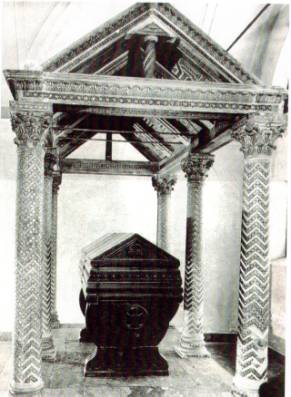
She is buried in this tomb in Palermo Cathedral. Next time I am there I will do what Simeti has vowed to do: I will take the Empress some flowers.
She is buried in this tomb in Palermo Cathedral. Next time I am there I will do what Simeti has vowed to do: I will take the Empress some flowers.