Showing posts with label war. Show all posts

Monday, November 04, 2024

DONA NOBIS PACEM 2024 - HOLD THE LIGHT


At times like these, when peace seems to be further away than ever, it can be very hard to write about it. Yet this is the time when it is most important to do so, to "hold the light", because we have to show that peace is possible, peace is desirable and that peace is essential, even and especially when we are being confronted with horrific images of war in our time every day and evening of our lives.

My generation, the "luckiest ever", some say, saw our first live images of combat and its effects during the dreadful conflict that was the Vietnam War and no one could say, from that period on, that they "didn't know" about it. Even at the time of the Kennedy assassinations, we had not been able to receive live reporting on them in Britain and most people there had not even gathered around a television set before the Coronation of Elizabeth II. The danger, once we were able to see those live images of horrifying events, was that we would lose our capacity to be shocked, become inured to it all. I don't think that most of my generation did, because from us sprang numerous peace movements; we wrote about peace, we studied peace, we campaigned for peace and we sang about peace.

What, then, can we do almost half a century after the fall of Saigon and all the conflicts in between, as we watch, day after day, shocking scenes of a population who are constantly being told to move on but have nowhere to go? A population with no adequate sanitation or access to healthcare, a population that is starving. No one is suggesting that the event that gave rise to all this was not also terrible, but when faced with human cruelty, do we also have to lose our humanity? 

We can protest, we can become part of a peace movement such as this and those of us who live in democracies can convey our concerns to those in power. In countries like the UK, where citizens have direct access to their elected representatives, we can write or speak to them and make our feelings known. Do you think they will not care? I assure you, they will care when they want your vote - which brings me to the matter we are all probably pondering, which is that so much will depend on what happens in the US tomorrow. Those of us in other countries can only hope that there will be light.

Light breaks where no sun shines, wrote the Welsh poet Dylan Thomas. And to "hold the light" we have first to see it, so we must not look away from the harrowing scenes on our many devices or from the possibilities for doing something about them. We have to unite in peace, for peace and for the light.


With thanks as always to the wonderful, indefatigable Mimi Lenox, who continues to inspire us to blog for peace.

BlogBlast4Peace on X.


Friday, November 03, 2023

DONA NOBIS PACEM 2023 - WALKING IN PEACE


In the midst of a situation so horrendous that most of us cannot bear to look at the images, an eighty-five-year-old Israeli woman who has just been released turns and holds out her hand towards (I am choosing my words carefully here) a member of the organisation that had held her captive.

During a press conference held later Yochevid Lifshiz said she had done so because the man, a paramedic, had treated her kindly and, with others, had attended to her physical needs. She has been criticised for her gesture, but from what I have read since, I gather that the criticism was really directed at the way in which the press conference was handled. Mrs Lifshiz may also have been thinking of her husband, still being held as far as we know, or she may have taken pity on the man's youth. Or perhaps she was simply offering a gesture of humanity in an absurd situation, and I mean “absurd” in the horrific sense.

It has always interested me that in English we talk of a “theatre” of war to denote geographical location and that we also understand the concept of the “theatre of the absurd”. Is there not a connection? Is it not absurd that in the twenty-first century, with the tragedy of World War II still (just) in living memory, we resort to war to attempt to resolve our differences? War – in which the innocent are always hurt. War, in which there are always terrible deeds because war itself is terrible. There has been much talk in recent weeks about the “rules of war” and surely if we can have rules of war, we can have “rules of peace”, rules to which all nations would adhere? Yet we who are fortunate enough, thus far, not to have experienced war in our homelands cannot know what we would do and for the moment we just look at our many screens and wish that it would stop around the world.

My own interest in the theatre of the absurd began with the study of French literature and it is to France that I turn now to bring to your attention an article, about a “theatre of war” from long ago, posted by the BBC on 27th August this year. At the time, the events recounted in it stopped me in my tracks but I certainly did not expect it to seem so relevant just a few weeks later: Near the town of Meymac in Corrèze, central France, a ninety-eight-year-old former Resistance fighter, as the last surviving witness, recently decided to speak out about the mass execution there of German soldiers by the Resistance. This was because a German army division had killed ninety-nine hostages in Tulle and 643 civilians in the village of Oradour-sur-Glane in retaliation for a Resistance uprising. (Preparations for D-Day had been underway.) The soldiers were made to dig their own graves and afterwards faced the firing squad bravely. Coins, bullets and other objects dating from the period have been found at what was the execution site but no human remains have yet been located. The Corrèze prefecture and Mayor are determined to find the remains of the soldiers, exhume them and, presumably, bury them in a fitting way. In war, says the Mayor, “You can be on the side of the righteous and still carry out what is morally wrong” and this is the sentence that so impressed me in August. As I have said, all sides carry out terrible deeds in war because war itself is terrible.

Do I have an answer for this? No, and neither do presidents, prime ministers, generals and diplomats who are much more knowledgeable than I am. I can only say that peace must be not only the outcome, but peace must be the way.

Of course, no one can negotiate with a tyrant or a fanatic but sometimes, perhaps, it is possible to offer a gesture of humanity: On October 23rd, an eighty-five-year-old Israeli woman who had just been released turned and held out her hand towards a member of the organisation that had held her captive. That day, she walked in peace.


With thanks, as always, to Mimi Lenox, who inspires us all to blog for peace.


Sunday, November 06, 2022

DONA NOBIS PACEM 2022

 BLOG4PEACE - NO FREEDOM, NO PEACE

On New Year's Eve 1999 I was having dinner with friends back in Cardiff, Wales. When the clocks struck midnight, we took our glasses of champagne outside, clinked them, watched the spectacular fireworks our hosts had provided, then hugged and kissed and went indoors to drink a toast, proposed by my friend's husband:

"Here's to the new century and we drink this toast in the hope that you young people who are with us tonight will enjoy good things to come, without the kind of horrible events that your grandparents' and, to some extent, your parents' generations had to live through. It seems that you might be lucky."

There is always conflict somewhere and there were conflicts going on even as he spoke, but we all knew that he meant those words sincerely. Then 9/11 happened, less than two years later and the threat of terrorism was everywhere in our daily lives.

As if that were not enough, in 2020, all over the world, we found our peacetime freedoms limited in ways we could never have imagined because of the pandemic and here in Italy we suddenly found ourselves living under a curfew. Every one of us lived in fear of our lives and those of our families and, apart from following the rules, there seemed to be nothing we could do about it. Has this made us better placed to imagine how it feels to have your freedom restricted by war? Perhaps.

On 8th September this year Her Majesty Queen Elizabeth II died and on the day of her funeral the world witnessed the passing of an era. As a British person, I watched in sadness but also in awe at the splendour of the uniforms and the precision of my country's military. Yet a part of me was in despair for how, I asked myself, could there ever be a mentality of peace when we carry our revered dead monarchs on gun carriages to the sound of gun salutes and have woven the iconography of war into that of the nation? 

I am very aware that I am writing this one week before Remembrance Sunday in the UK, when the fallen and injured of all wars are commemorated, and I mean no disrespect. My own grandfather was blinded in World War I and I am profoundly grateful to him and to all who have fought for my freedom. I just wish there was another way of obtaining it, as, I am sure, do many soldiers. "No one abhors war more than someone who has been in one", my grandfather used to say. And it was that old warrior Sir Winston Churchill who said,


The one image of the war in Ukraine that I cannot get out of my mind is from the beginning of the conflict, when a young Russian soldier - a child, in fact, for he couldn't have been older than 19 - was captured in a village. The Ukrainian villagers were feeding him and being kind and even helped him to call his mother, at which point he began to cry. Is this what we want? Is this fair, that the old send the young into battle to try and resolve the messes that the former have made? Of course we do not want it and of course it is not fair. Where is the freedom for this young man and others like him to finish his education if he wishes, to have the joy of family, to live? No Freedom, No Peace.  


My thanks, as always, to the indefatigable Mimi Lenox, who inspires us all to blog for peace.


Sunday, March 27, 2022

BLOG4PEACE - UKRAINE


This evening, Michelle and I will do what I know every parent in America will do, which is hug our children a little tighter,

said President Obama following the Sandy Hook shooting in 2012.

Although the President was referring to a very different situation from the one the world is trying to respond to today, these are words that have stayed with me, for any one of us, through a combination of geographical position and politics, could find ourselves caught up in a war and having to flee. We think it is so far away, and yet it is so near.

Yesterday I read some extracts from the diaries of Ukrainians in Mariupol, and I cannot get out of my mind the distress of a journalist who had finally pushed her beloved dog down the stairs and out of her building, presumably in the hope that the dog would find a way to survive. That could be any dog-owner too, in a sudden change of circumstances.

When Mimi Lenox, the indefatigable founder of Blog4Peace, decided to launch a special Ukraine edition of the project this weekend - we usually do it in November - I, like many bloggers around the world, wondered how I could do it, although I desperately wanted to. How could I put my hands on the keyboard and write about the tragedy in Ukraine when experts on that country and Russia also find their fingers paralysed by horror? But Mimi is right - this is exactly the moment when we must start typing, to show that words matter, that people matter, that peace matters to us all.

My first reaction to the escalating situation a few weeks ago was, "Have we learnt nothing?" but of course it is a myth that we have had continuous peace in Europe since 1945. Man just isn't that wise! And every time, I ask myself, over and over again, "Why?" Every time I see that leaders on both sides of a conflict have at least got themselves round a table, I want to yell, "Keep talking, keep talking! If you can declare a truce for an hour, you can declare a truce for a day, a week, a month, a year or forever. And if you can agree thus far, you can agree to stop it. So stop it!"

I do know it is not as simple as that and I have no idea how you can begin to reason with a tyrant. Yet I imagine that one man does have an idea and that, of course, is President Zelenskyy, for who can fail to admire this brave and inspiring man? Derided at the beginning as "just a comedian", he has defied all the odds. "Just a comedian?" No one is better placed to understand tragedy than someone who has an understanding of comedy, for the two are intrinsically linked. Even in Shakespeare's tragedies, there is often a fool or a clown and much comedy hinges upon a point at which tragedy is (only just) avoided; for example, girl almost marries the wrong man, then something happens that enables her to marry the right one and, to bring Shakespeare into things once more, "All's well that ends well."

Comedians, then, certainly have a role to play, as do the protests of ordinary people and an example of the latter has given me hope today: In the occupied town of Slavutych (Northern Ukraine) citizens continued to protest peacefully as sten grenades and bullets whizzed across the sky above them. They demanded a Russian withdrawal and the release of their imprisoned Mayor. In the end, they got both. Words matter, people matter and peace matters to all of us.

And tonight I will hug my dog a little tighter.


Tuesday, March 08, 2022

INTERNATIONAL WOMEN'S DAY 2022


March 8th, La festa della donna, is widely celebrated in Italy and you see mimosa blossom everywhere. Here's why it is a symbol of this day. Arrangements such as those in the photo above are sold in supermarkets and in the streets (the one on the left containing artificial mimosa, of course but it's a pretty idea) and I bought the one below this morning:


Also this morning in my favourite bar all breakfasts and coffee consumed by women were paid for by a local business and we were each given little gifts of flowers - something to brighten our day after two years in which we haven't really been able to celebrate this day.


The dark times, as we know, continue and my thoughts today are with all the women who cannot celebrate International Women's Day in their own homes or even in their own country and who, unlike me, have had no choice in the matter. I'm sure you will join me in wishing them peace.

Thursday, January 27, 2022

HOLOCAUST MEMORIAL DAY 2022

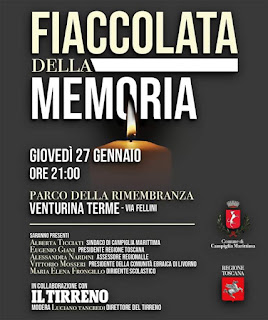
 A young person asked me today what I thought about this commemoration. I replied that I thought it was essential, as an event in Italy this week has sadly shown us: On Sunday in Venturina Terme, a hamlet of Campiglia Marittima in the Province of Livorno, Tuscany, a twelve-year-old boy was bullied, called names, kicked and spat upon by two teenage girls simply because he is Jewish. They also, appallingly, told him that he should "die in an oven."  The worst of it, perhaps, is that onlookers did nothing. Nothing. And that, as history, we would have hoped, had taught us, is where it begins - when onlookers do and say nothing.

Long ago, as a French and Italian student, I studied what happens under occupations and totalitarian régimes and what defines "collaboration" in such circumstances. We would all like to think we would have been heroes but the truth is that very few of us would have been. Some citizens "collaborated" to keep their jobs and feed their families but on the everyday level of simply keeping their heads down. Others went further and actively helped the oppressors. By this time, of course, the bullies were the ones in power, but how did they get there? They got there because reasonable people let them, listened to their propaganda and cheered them on, even in the most cultured of countries. They did not notice as their freedoms were eroded little by little. They noticed when it was too late and now the bullies were the ones holding the guns. And they were holding the guns because the small incidents were not called out.

Alberta Ticciati, the Mayor of Campiglia Marittima, though, is calling it out. Shocked when the boy's father reported the incident to her and to the police, she has written on Facebook,

"I am a public administrator but first I am a person, a woman and a mother... I understand how complex and difficult it is to bring up a child and guide them as they grow. But there are no excuses. There can be no justification."

No justification and regretfully no surprise. Liliana Segre, the Italian Holocaust survivor and Life Senator said that this kind of incident does not surprise her as unfortunately she is used to it. 

Tonight a torchlit Memorial Procession is being held in Venturina Terme and among those attending is the Governor of Tuscany. Let us hope that the boy and his family are able to take some comfort from the genuine solidarity being offered here.


Depressingly it has been reported that 2021 saw the highest number of reports of antisemitic incidents worldwide - an average of ten per day - in a decade and shamefully Europe accounts for 50% of these. Many more go uncalled out and unreported.

I told my young friend that there are few Holocaust survivors alive today; Liliana Segre, who has spent her life educating young people about it, no longer feels able, at ninety-one, to travel the country to speak in schools; and my generation, whose parents lived through World War II and who conveyed the horror of the Holocaust to us, will soon be gone too. Now it is up to my eighteen-year-old friend's generation to keep the memory alive, call the small incidents out so that they do not become massive ones and, if I may paraphrase a much decried British Prime Minister who did, however, get several things right, "Educate, educate, educate".


Monday, August 16, 2021

A VERY LARGE DROP IN THE OCEAN

As most of the world watches, seemingly helplessly, events in Afghanistan today, Italy mourns the loss of a very rare man, someone who, seeing suffering and seeing need, was determined and able to do something about it - the humanitarian and surgeon Gino Strada, who died on 13th August at the age of 73.

After becoming a heart-lung transplant surgeon, Gino Strada worked with the International Committee of the Red Cross before founding, with his wife and colleagues, the medical humanitarian organisation Emergency in 1994. He wanted to help not only direct victims of war, but also those who, because of war, had no access to healthcare and therefore became medically vulnerable. He saw access to free healthcare as a human right. His first project with Emergency was in Rwanda during the genocide and he spent seven years in Afghanistan, opening a much-needed maternity centre there which was recognised by the Afghan Ministry of Health. He also opened a cardiac surgery centre in Khartoum (Sudan) and worked on many other projects in numerous countries. 

Gino Strada continued to speak out and demonstrate against fascism even in his last years and the people of Afghanistan were in his thoughts until the end. Of war he said,


In his book Pappagalli Verdi, Gino Strada wrote,

Quel che facciamo per loro, noi e altri, quel che possiamo fare con le nostre forze, è forse meno di una gocciolina nell’oceano. Ma resto dell’idea che è meglio che ci sia, quella gocciolina, perché se non ci fosse sarebbe peggio per tutti.

What we, and others, do for them, what we can do with the strength that we have, is perhaps less than a small drop in the ocean. But I still believe that it is better that this small drop is there, because if it wasn't the situation would probably be worse for everyone.

- A very large drop, in my opinion, Doctor Strada.


Gino Strada

21 April 1948 - 13 August 2021

Friday, July 02, 2021

ARANDORA STAR 81

Today is the 81st anniversary of the Arandora Star tragedy and I again post part of an article I wrote about it in 2009. I do this in memory of the victims and in solidarity with their families but also because, sadly, the story is a much-needed reminder of what can happen when we designate immigrant communities as "the others". 

At the outbreak of World War 11 "enemy aliens" living in Britain were divided into three categories: those in class A were deemed to represent a high security risk and were interned; those in class B were "doubtful" and were subject to some restrictions; and those in class C were thought to pose no security risk at all. However, following the Fall of France in 1940 Churchill decided, in his own words, to "collar the lot" and the majority of class B aliens were interned. When Italy declared war on Britain and France on June 10th the internment of Italian males was ordered. Many of the Germans interned had opposed the Nazis or were German Jewish refugees. Most of the Italians interned had lived in Britain virtually all their lives and many had sons who were serving in the British military. Others were in Britain because they had opposed Mussolini and later fled their country in fear of their lives. The majority of the men were detained in internment camps on the Isle of Man or Orkney, where they were treated inhumanely.
A policy of deporting internees was in place and on 1st July 1940 the SS Arandora Star, a converted cruise liner, sailed from Liverpool for Canada with 1,864 people on board. Of these 734 were Italian internees, 479 were German internees, 89 were German prisoners of war and the rest were guards and crew, 80% of the crew having been newly signed on that morning. The internees were forced to sail in appalling conditions, packed onto a ship built to carry only 250 passengers and extended, in wartime, to carry 200 more.
The ship was painted battleship grey, making her look like a troop carrier, and displayed no Red Cross flag, which would have distinguished her as a vessel carrying civilians. On her second day out from Liverpool the ship was torpedoed by a German submarine off the west coast of Ireland. There had been no lifeboat drills, the rafts were immovably strapped to the sides of the ship anyway, and few lifejackets had been issued. In addition, the decks and the lifeboats were separated by walls of barbed wire - a measure which the Captain had protested about before sailing. Most of the Italians did not stand a chance , as they had come from mountainous areas of Italy and had never learnt to swim. Those few who did survive the freezing sea were again harshly treated after being rescued and some were then deported to Australia.
When the British media reported the tragedy, the public were told that Nazis on board had dashed for the lifeboats knocking everyone else out of the way. No mention was made of the fact that respectable people who had made positive contributions to British society had been on board, along with refugees who had risked their lives, in their own countries, for the very freedoms the British now claimed to be fighting for.

No apology has ever been made by a British government.

Tuesday, April 11, 2017

AN IRONY AND AN INITIATIVE - A MIGRATION POST

If I have been absent from this blog again, it is because, just like most of you, I imagine, the news of the past week has found me glued to my television screen and not in any positive way. Millions of words have been written about the shocking events themselves but I have seen little acknowledgement of the irony of wringing our hands over the treatment of children in a war-torn country and the refusal of many of our own countries to take in those very children - which brings me, again, to the theme of migration in the Mediterranean and its subsequent tragedies, which can only increase given the current situation.

On Friday 7th April the SOS Méditeranée ship Aquarius brought 432 migrants, including 77 minors, six of whom were aged between one and four and 59 of whom were unaccompanied, to Catania. The migrants had been saved by Aquarius and other ships from four migrant boats which had got into trouble off the coast of Libya.  Later the Italian Coast Guard ship Dattilo brought 1,131 migrants, saved in eight operations, to Catania along with one body. 

The above figures represent only a proportion of the migrants rescued in the Mediterranean every day and it is not unusual for as many as 3,000 to be saved in just 24 hours.  To the Italian Coast Guard, Navy and NGOs such as SOS Méditerranée falls, too, the tragic task of recovering and bringing into port the bodies of those whose journey of hope brought them, not to their hoped-for destination, but to death and I have chronicled the sad numbers over the years.

There is, however, some good news for migrants in a world that doesn't seem to care about them and this news comes from Italy where, on 29th March, Parliament passed a law to protect unaccompanied child migrants: from now on their treatment should be consistent all over Italy, they cannot be deported, will be appointed individual, trained guardians and will have the same rights to healthcare, education and other services as Italian children. UNICEF has called it "a historic law" and you can read more about it here.  Well done, Italy, for shining a light amid so much darkness.

According to figures released by the Italian Ministry of the Interior, 25,845 unaccompanied child migrants reached Italy in 2016 and 4,000 have arrived here since the beginning of 2017. This article reports that in 2016 one person in every 113 in the world was a refugee, internally displaced or seeking asylum - not a figure we can be proud of in the 21st century.

I ask again and I direct my question to the men and women in power:  how can the world express horror at what is happening to civilians in a war zone and, at the same time, attempt to push them back when they flee for their lives?

Friday, November 04, 2016

DONA NOBIS PACEM 2016

As thousands continue to die in the Mediterranean trying to flee war, working for peace is more important than ever.

Thank you, Mimi Lenox, for inspiring #blog4peace and for all that you do.


Thursday, July 02, 2015

ARANDORA STAR 75

Today is the 75th anniversary of the Arandora Star tragedy, one of the most shameful episodes in British wartime history and about which I first wrote on this blog in 2009. Since then, due to the tireless work of campaigners, memorials have been unveiled in Cardiff and Glasgow and public awareness has been raised but no British government has ever apologised.

Today, in memory of those who died and their loved ones , I am re-posting this:


At the outbreak of World War II "enemy aliens" living in Britain were divided into three categories: those in class A were deemed to represent a high security risk and were interned; those in class B were "doubtful" and were subject to some restrictions; and those in class C were thought to pose no security risk at all. However, following the Fall of France in 1940 Churchill decided, in his own words, to "collar the lot" and the majority of class B aliens were interned. When Italy declared war on Britain and France on June 10th the internment of Italian males was ordered. Many of the Germans interned had opposed the Nazis or were German Jewish refugees. Most of the Italians interned had lived in Britain virtually all their lives and many had sons who were serving in the British military. Others were in Britain because they had opposed Mussolini and later fled their country in fear of their lives. The majority of the men were detained in internment camps on the Isle of Man or Orkney, where they were treated inhumanely.
A policy of deporting internees was in place and on 1st July 1940 the SS Arandora Star, a converted cruise liner, sailed from Liverpool for Canada with 1,864 people on board. Of these 734 were Italian internees, 479 were German internees, 89 were German prisoners of war and the rest were guards and crew, 80% of the crew having been newly signed on that morning. The internees were forced to sail in appalling conditions, packed onto a ship built to carry only 250 passengers and extended, in wartime, to carry 200 more.

The ship was painted battleship grey, making her look like a troop carrier, and displayed no Red Cross flag, which would have distinguished her as a vessel carrying civilians. On her second day out from Liverpool the ship was torpedoed by a German submarine off the west coast of Ireland. There had been no lifeboat drills, the rafts were immovably strapped to the sides of the ship anyway, and few lifejackets had been issued. In addition, the decks and the lifeboats were separated by walls of barbed wire - a measure which the Captain had protested about before sailing. Most of the Italians did not stand a chance , as they had come from mountainous areas of Italy and had never learnt to swim. Those few who did survive the freezing sea were again harshly treated after being rescued and some were then deported to Australia.
When the British media reported the tragedy, the public were told that Nazis on board had dashed for the lifeboats knocking everyone else out of the way. No mention was made of the fact that respectable people who had made positive contributions to British society had been on board, along with refugees who had risked their lives, in their own countries, for the very freedoms the British now claimed to be fighting for.

In total 486 Italians lost their lives in this tragedy.  No apology has ever been made by a British government.


Saturday, April 25, 2015

SABATO MUSICALE

Today is the festa della Liberazione.

Gruppo popolare e solisti dell'Oltrepo Pavese - Bella ciao


Wednesday, February 18, 2015

A RESCUE AND SOME THOUGHTS

Italian naval, Coast Guard, Guardia di Finanza and merchant vessels succeeded in rescuing over 2,100 migrants in the Mediterranean on Sunday night and in the early hours of Monday. The migrants were rescued from 13 dinghies that had sailed from Libya and the news that Italian coast guards were threatened by gunmen during the operation has made world headlines:  it seems that four armed men on a speedboat threatened the coast guards, who go out to rescue operations unarmed, and ordered them to leave the migrant boat they were dealing with alone once it had been emptied of its human cargo. In the interest of saving human life, the coast guards did so.

The rescued migrants have been taken to safety on Lampedusa and in Pozzallo, where one of them, a young man with gunshot wounds, said that people traffickers had caused his injuries whilst forcing him onto a departing boat.  

There have been many calls since Monday for migrant departures from Libya to be stopped but no one knows how this could be done. One suggestion is that blocking the departures would be a by-product of any Italian military action in Libya but Prime Minister Renzi has firmly said that such an intervention would be a matter for the UN.  I must say that I perceive a lack of logic in the West's attitude to the crisis: if we are all agreed upon the horror and barbarity of certain régimes and organisations, then how can we blame people for trying to escape them?

Fear is also raising its head here as rumours of  missiles in Libya being pointed at Sicily spread and I was glad to read some sense in an interview in today's Giornale di Sicilia with Andrea Margelletti, president of the Centro Studi Internazionali-Ce.S.I. and a former adviser at the Ministry of Defence, who says that these missiles do not exist. I would add that everyone seems to have forgotten that Sicily has Sigonella!

Another worry that is receiving a lot of press coverage is that there might be extremists among the migrants attempting the dangerous crossing. It would be naive to think that this is impossible but the British experience shows that extremism is more likely to flourish amongst those who find no hope in the West, whether they were born here or have immigrated. The table in this article would appear to show that Italy has a good record in looking after migrant arrivals, but the figures are misleading and probably reflect the fact that few migrants wish to stay in Southern Europe. I will end by quoting Andrea Margelletti again:

"They [the migrants] come ashore in their underwear. What harm can they do?"

Monday, August 04, 2014

A CANDLE IN SICILY

Father and son - Richard and Arthur Eggleton


In one hour from now, the lights will go out all over my own country to commemorate the moment, one hundred years ago, when Britain entered the First World War. The ""Lights Out"  initiative is also intended as a mark of respect for those who were killed or maimed in that terrible conflict. Households are asked to leave just a single candle burning for one hour and that is what I am going to do here in Sicily, although Italy entered the war the following year.

During that hour, like people all over Europe and beyond, I will reflect upon those killing fields, some so near Britain that the guns could be heard there and yet so far away in terms of their unimaginable conditions and brutality. And my mind will also turn to a Welsh naval officer who never saw his son. The officer was blinded in the Battle of Jutland in 1916 and his son was my father, born three years later. 

Chief Petty Officer Richard Eggleton could not have known, during the long months of coming to terms with the loss of his sight, that there was still happiness in store for him, but one day, while he was in rehabilitation at St Dunstan's [now Blind Veterans UK ], a friend of his brought another friend along to visit. This was my future grandmother, Mary. Richard and Mary were not young when they married, so when Mary stopped menstruating and began to put on weight, she assumed it was the menopause. When my dad decided to pop into the world one summer afternoon it was a complete surprise to her.

War, as we all know, hurts the innocent and it hurt my dad in indirect ways: Mary had developed a severe hearing impairment and my dad was a bit rebellious so, with his best interests at heart, Mary and Richard sent him to a boarding school which had iron discipline and [unknown to them] a very cruel régime. My dad never forgot it. This may seem nothing if we compare his suffering to that of the frightened children of a faraway war taking place at this very moment, but I can remember my dad shivering every time we passed his former school when I was a little girl.

The starving German children of 1918 grew up to want revenge and got it and I wonder whether those waging war so mercilessly now ever stop to think about what could one day be unleashed upon their children and their children's children.

No one despises war more than someone who has fought in one and Richard Eggleton, while of course respecting the memory of all who had fought with him, wanted his son to grow up in a world at peace. 

As I sit by the light of a single candle in Sicily tonight, I silently thank a grandfather I never knew for choosing to go on living, despite the moments of deepest despair that he must have gone through, and for the little boy who became my dad.


Wednesday, April 30, 2014

SPRING TIDES - 5

More "boatloads of sorrow" unsurprisingly arrived over the Easter weekend, when at least 2,000 desperate souls were brought to safety as part of Operazione Mare Nostrum, and it is estimated that a similar number arrived last weekend.

Among these were 395 migrants, including 12 newborn babies, who were rescued by the Italian military and Coast Guard and brought to Pozzallo on Friday. The reception centre at Pozzallo is full, despite the fact that transfer flights to other parts of Italy for some of the migrants have been operating. The centre remains full because others just keep coming. The Mayor of Pozzallo has expressed his exasperation at the lack of response from central government and has called upon Premier Renzi to intervene.

Also on Friday, a pregnant woman who was taken from one of the boats to hospital in Siracusa, where she gave birth to a baby girl, found care, kindness and solidarity:  realising that she had no baby clothes or other necessities for her daughter, the staff decided to collect what they could. Another mother on the ward immediately gave the woman the blankets she had brought for her own baby and, inspired by this gesture, all the other mothers gave the little one sheets, clothing, shoes and other items. I am happy to be able to tell you that both mother and baby are now fine and they have been discharged from hospital.

In a statement issued a few minutes ago by the Viminale, the seat of the Italian Interior Ministry, it is estimated that 800,000 migrants are now waiting to sail for Sicily from Libya. One solution that was put forward by concerned agencies on Tuesday was the idea of sending a European task force to Libya, to stop the departures in the first place. I am no politician so I do not know what the chances would be of obtaining agreement for such a project from inside Libya, but I should have thought they were slight. The second problem is one I have mentioned before: people will always attempt to flee hunger, war and persecution and their right to do so is surely enshrined in the Universal Declaration of Human Rights, which talks about its "recognition of the inherent dignity and of the equal and inalienable rights of all members of the human family." 

At the moment I am reading Claude Lanzmann's memoir, The Patagonian Hare. His chapters about the Second World War are a timely reminder of the kind of régimes people might be fleeing.


Monday, November 04, 2013

DONA NOBIS PACEM 2013


Without peace, there is no hope 
and no one can live without hope.

Posted as part of blog4peace 2013, with love and thanks to the indefatigable and wonderful Mimi Lennox, whose initiative this is.

Wednesday, August 28, 2013

MONDO IN ATTESA

Today the world waits:  with the USA, UK and France seemingly ready to launch missile strikes on Syria, the Italian government said yesterday that they will not allow Italian bases to be used in connection with this plan without UN agreement.  Even in this unlikely event, Foreign Minister Emma Bonino has added today, Italy will not automatically lend its support to any strikes. Meanwhile NAS Sigonella in Sicily is on standby.

I can only quote Churchill:

"To jaw-jaw is always better than to war-war."

Quite what you do when one party refuses to "jaw-jaw" or, as it appears in this case, has crossed a humanitarian red line, no one has yet worked out, though a solution short of war ought not to be beyond our power in the 21st century.

"The old Lie; Dulce et Decorum est 

Pro patria mori",


wrote Wilfred Owen.  What worries me is that new lie of modern warfare, the idea that war, once unleashed, can somehow be contained and sanitised;  that civilians will not be hurt;  and that terrified people will not attempt to flee. War creates injuries, it creates widows and orphans and it creates refugees.


At dawn this morning a migrant boat containing 191 desperate souls, all of whom declared themsleves to be Syrian, was intercepted by the Italian Coast Guard 60 - 70 miles south of Siracusa.  Among the 51 women, 48 children and 92 men the coastguards found a newborn baby girl with part of her umbilical cord still attached.  She and her mother were immediately transferred to hospital, where both are said to be doing well.  


The baby girl, said the captain of the Siracusa Coast Guard, is "more proof that life always triumphs."  Let us hope so as the world continues to wait.

Wednesday, July 17, 2013

A TALE OF KINDNESS


Visualizza Mappa porti e approdi di Sicilia/Ports and harbours of the Sicily map in una mappa di dimensioni maggiori


From yesterday's sorry tale of Italy at its worst to a story that shows the country at its best. I'm particularly happy to be able to tell you that this is happening in Sicily:

On Friday afternoon a 13-year-old Somali boy landed at Portopalo [Siracusa Province] from a migrant boat. He was alone, confused and very frightened. The right side of his face was disfigured, he had lost an eye and his jawbone had been crushed by a shell which had exploded in his face in an ambush in which his father was killed.

The boy was immediately airlifted to the Cannizzaro Hospital in Catania. There, he has won the hearts of all who work in the Paediatrics Department and staff have been buying him clothes and necessities with their own money. He is currently undergoing treatment with antibiotics but needs an initial operation to reconstruct the right side of his face. As he is a minor with no one to give permission for him to have surgery, a local court will shortly appoint a guardian. A scan has revealed that a shell splinter remains in the boy's cranium and doctors are evaluating the possiblities of removing this. He will also need reconstructive surgery on his jaw.

Cultural mediators have been brought in to help the boy communicate and he is said to be happily watching television and playing games with other young patients. Nothing is yet known of the boy's journey as those treating and helping him believe he is still too traumatised to be asked about it.

This poor boy must have suffered unimaginable horrors and I know you will all join me in wishing him well. The island of Sicily has once again demonstrated its capacity for kindness and for taking a stranger to its great heart.


Wednesday, July 10, 2013

REMEMBERING OPERATION HUSKY


Seventy years ago, on the night of 9th - 10th July 1943, the Allied invasion of Sicily began, with the landings from the sea beginning at dawn on the 10th.  Codenamed Operation Husky, the landings involved the 7th US Army under General Patton [the "Western Task Force"]  and the 8th British Army under General Montgomery including the 1st Canadian Infantry Division [the "Eastern Task Force"].  It is worth noting that, with seven divisions, this was a bigger force than that which landed on the beaches of Normandy on D-Day [1944].  The beaches at Pachino were stormed by 25,000 Canadians and, whilst the Americans made rapid progress in the West, the British and Canadian soldiers met with fierce Italo-German resistance in the East. In the campaign, 562 Canadian soldiers lost their lives.

It is in memory of these soldiers in particular that commemoration ceremonies in Sicily have been organised by Canada Company during this month and volunteer marchers are retracing the route of the original march by the Canadian soldiers. There has already been a commemoration ceremony at Pachino and on Friday it will be Modica's turn. Among the visiting Canadians will be 92-year-old veteran Captain Sheridan ["Sherry"] Atkinson who more or less accepted the surrender of Modica. You can read the thoughts of another veteran, Charles Hunter, on the Canada Company website. On July 30th a morning roll call for the Canadian soldiers who lost their lives will be held at the Canadian War Cemetery at Agira.

In January I visited the Allied Landings Museum [Museo dello Sbarco] in Catania and tonight I would like to tell you that there is a smaller, but very lovingly curated, museum on this theme in Modica:  The brainchild of Andrea Blefari and Antonino Montalto, the museum has a well annotated collection of uniforms, medals, unpublished and personal documents, arms, military equipment and photos.  Andrea and Antonino's aim is not only to keep the memory of Operation Husky alive but, in their own words, "to teach the young about the price that is sometimes paid for freedom."

You can visit the Museo della Memoria in Modica by appointment and you will find details on their website.

Andrea and Antonino have now collected so many memorabilia of the campaign that they need more space for their museum and this Commonwealth citizen hopes that the Comune di Modica will soon provide it.

The museum photos speak for themselves but my favourite is the enormous WW2 field kitchen. The second portable kitchen that you will see is from WW1.


A total of 14,864 soldiers from Italy, Germany, the USA and the Commonwealth lost their lives during the Allied Landings in Sicily.

Tuesday, March 12, 2013

ADDIO, TERESITA


Tonight Italy mourns Teresa Mattei, partisan, women's and children's rights campaigner and the last "mother of the Constitution".  

Born in Genova in 1921, Teresa Mattei graduated in Philosophy from the University of Florence and became an antifascist campaigner. During the Second World War she was known as Partigiana Chicchi.  In 1946 she became the youngest woman member of the Assemblea Costituente, the parliamentary chamber charged with drawing up Italy's Constitution, a document which she defended throughout her life.

It was Teresa Mattei who had the idea of making the mimosa blossom the symbol of International Women's Day [8th March] for the simple reason that the flowers are in season in early March and can be obtained at little or no cost. 

Of the potential of women in politics she said,

"Women, in contrast to men, seek knowledge, cooperation and solidarity. They are the bearers of new life. They do not see society as being divided into classes but as a multitude of men and women with the same problems. Women can bring this new spirit into politics, but we have to create the structures that can allow this to happen."

Referring to the Second Prodi Government and its six women ministers, of whom only two had portfolios, she went on to say,

"These poor women can have no influence, because a minister without portfolio is unable to do what a minister with portfolio can, that is, to use a budget to put a plan into action. This is a very serious situation."

I think that last but one sentence is a metaphor for women's powerlessness all over the world.

Teresa Mattei died in Lari [Province of Pisa] today at the age of 92.  I'm glad she saw this 8th March and, as she is laid to rest, the mimosa blooms for her all over Italy.


Counters


View My Stats