Showing posts with label racism. Show all posts

Thursday, February 03, 2022

SANREMO 2022 - AN ECLECTIC VIEW

How lovely it is to see the Sanremo Festival back this year with a live audience in the Ariston Theatre. This, of course, wasn't possible last year, when everyone did their best but presenters like Amadeus and Fiorello need the interaction which only a live audience can provide for them. More importantly, though, being able to watch the much-loved Festival in its usual format is giving Italians a sense of normality and goodness knows, all our psyches need that. 


So  what were the highlights and controversies of the first two evenings on Tuesday and Wednesday? Well, much will depend on how you view certain matters, for the always original Achille Lauro was the first contestant to get himself into a row and not any old row, but one with the Catholic Church because he appeared, bare-chested, barefoot and tattoed and performed a mock baptism. This led to accusations of blasphemy. The singer defended himself by saying that he had dedicated the performnce to his mother and that mothers give life and therefore renew us every day. Another person to defend him has been Carmelo La Magra, the former priest of Lampedusa, who asked if people only demonstrate their Catholicism when Achille Lauro sings. He also said that the singer is an artist whose job is to deliver messages and advised people to be scandalised about other things and to allow themselves to laugh now and then. Meanwhile the editor of the Vatican City newspaper, L'Osservatore Romano, wrote, 

"Sanremo is Sanremo. The Osservatore is the Osservatore...... They don't make sinners like they used to."

I rather think that those should be the last words on the controversy but I leave judgement to those more versed in religion than I am.

Like most of my contemporaries, I love a golden oldie type of song and Massimo Ranieri gave us one in Lettera al di là del Mare. I must admit to being rather cross with Mr Ranieri, though, for in a recent interview the singer, who will be 71 in May, talked about his desire to have a son. 

"Fortunately a man of a certain age can reproduce and I sincerely hope to do so."

He said he thought he would be an ideal dad - he has a daughter but he didn't recognise her until she was 24 - as he has the body clock of an artist and rarely goes to bed before 3 am. Therefore staying up with a crying baby would not bother him. It may be true, as he says, that 70 is not old these days and as I am just over that age too I am happy to believe him. However, I couldn't help thinking that if a woman of that age expressed her desire to become a mother, she would be widely vilified, as indeed many women twenty years younger have been. Anyway, I enjoyed the song, Massimo.

Next up on this blog is 82-year-old Sanremo veteran Iva Zanicchi, who looked fabulous and belted out a song called Voglio amarti. I must admit I didn't take much notice of the lyrics, as I spent her performance time with my nose almost pressed to the screen trying to work out exactly what shades of eyeshadow she was wearing so that I could copy them. When I heard the song again later, I particularly liked the lines,

E se un giorno scoprirò
Nel mio cuore una ruga in più… sarai tu

And if one day I find

Another wrinkle in my heart ... it will be you.

When Iva Zanicchi was placed last in Wednesday night's press and media vote, her reaction was,

"Well, at least they noticed me."

If I make it to 82, I want to be like Iva!

The singer in first place was Elisa, back at Sanremo after twenty years, with O forse sei tu. I, too, thought this was a beautiful song but the public votes which start on Thursday could change everything. 

Perhaps the most touching moment on Wednesday night was when co-presenter and actress Lorena Cesarini spoke about her experience of racism, quoting some of the cruel comments she has received on social media since the announcement that she would be co-presenting on Wednesday:

"After Amadeus's announcement I discover that, at 34, it isn't true that I'm an Italian girl like the the others - I'm black... But I keep asking myself, 'Why? Why are there people who have a problem with the colour of my skin?' "

I don't know, Lorena and I can't imagine how this must feel. I can only tell you to keep on being your brilliant self and to hope that we will emerge from the pandemic having learnt that we are all human and must stand together. 

I am not watching Sanremo tonight (Thursday) because Masterchef Italia requires my attention but I'll be watching tomorrow and on Saturday (the final night) and will probably take part in the public vote.


Thursday, January 27, 2022

HOLOCAUST MEMORIAL DAY 2022

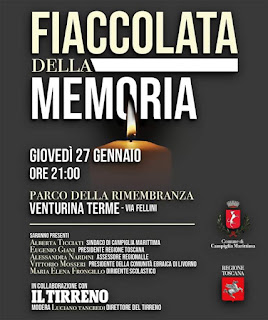
 A young person asked me today what I thought about this commemoration. I replied that I thought it was essential, as an event in Italy this week has sadly shown us: On Sunday in Venturina Terme, a hamlet of Campiglia Marittima in the Province of Livorno, Tuscany, a twelve-year-old boy was bullied, called names, kicked and spat upon by two teenage girls simply because he is Jewish. They also, appallingly, told him that he should "die in an oven."  The worst of it, perhaps, is that onlookers did nothing. Nothing. And that, as history, we would have hoped, had taught us, is where it begins - when onlookers do and say nothing.

Long ago, as a French and Italian student, I studied what happens under occupations and totalitarian régimes and what defines "collaboration" in such circumstances. We would all like to think we would have been heroes but the truth is that very few of us would have been. Some citizens "collaborated" to keep their jobs and feed their families but on the everyday level of simply keeping their heads down. Others went further and actively helped the oppressors. By this time, of course, the bullies were the ones in power, but how did they get there? They got there because reasonable people let them, listened to their propaganda and cheered them on, even in the most cultured of countries. They did not notice as their freedoms were eroded little by little. They noticed when it was too late and now the bullies were the ones holding the guns. And they were holding the guns because the small incidents were not called out.

Alberta Ticciati, the Mayor of Campiglia Marittima, though, is calling it out. Shocked when the boy's father reported the incident to her and to the police, she has written on Facebook,

"I am a public administrator but first I am a person, a woman and a mother... I understand how complex and difficult it is to bring up a child and guide them as they grow. But there are no excuses. There can be no justification."

No justification and regretfully no surprise. Liliana Segre, the Italian Holocaust survivor and Life Senator said that this kind of incident does not surprise her as unfortunately she is used to it. 

Tonight a torchlit Memorial Procession is being held in Venturina Terme and among those attending is the Governor of Tuscany. Let us hope that the boy and his family are able to take some comfort from the genuine solidarity being offered here.


Depressingly it has been reported that 2021 saw the highest number of reports of antisemitic incidents worldwide - an average of ten per day - in a decade and shamefully Europe accounts for 50% of these. Many more go uncalled out and unreported.

I told my young friend that there are few Holocaust survivors alive today; Liliana Segre, who has spent her life educating young people about it, no longer feels able, at ninety-one, to travel the country to speak in schools; and my generation, whose parents lived through World War II and who conveyed the horror of the Holocaust to us, will soon be gone too. Now it is up to my eighteen-year-old friend's generation to keep the memory alive, call the small incidents out so that they do not become massive ones and, if I may paraphrase a much decried British Prime Minister who did, however, get several things right, "Educate, educate, educate".


Sunday, December 15, 2019

A LETTER TO BRITAIN


Modica, Italy
13th December 2019

Dearest Britain,


A park in Norwich, Norfolk

I don't live in you now and, though I left you 15 years ago for another country that had captured my heart, that doesn't mean I no longer love you, for it was you that bore me, nurtured me, educated and made me and there will always be a British girl inside the continental me. I write now because what happened to you yesterday was shocking, devastating, frightening and deeply upsetting; its consequences cannot be foreseen at this juncture, but 24 hours on they seem bleak. I may still love you – I always will – but I no longer recognise you.

The country I left was far from perfect and our imperialist past was not something that most of us boasted about. Of course there was racism, as there is everywhere and I witnessed it myself, but it also seemed to me that it was generally understood that democracy means that you cannot impinge upon the freedom of others. When exactly did that change? When did people begin to believe that they could make whatever anti-foreigner, anti-gay, anti-woman, anti-elderly, anti-you-name-it comment they liked with impunity – in one of the most diverse and tolerant countries in the world? I am too far away to know and I doubt you know yourself but it has happened. Tolerance, it seems, has gone and soon it could be followed off our little group of islands by accountability in the “Mother of Parliaments”, the independence of the judiciary and perhaps even the constitutional monarchy.

When you see your own country from afar, you are unable to balance your pessimism regarding events there with a healthy dose of observation of your countrymen and women just getting on with their normal lives, but I would guess that what happened is simply that democracy is fragile and, having enjoyed it for so long, we took our eye off the ball. Then the 2008 recession gave the charlatans the opportunity they had been waiting for to exploit discontent. And you fell for it, my country. Not having known an occupation within living memory, you failed to see the danger when it came and you are failing to understand it now. This tide will turn, of course, whether peacefully or not I cannot say, and I certainly would not hazard a guess as to how long it will take.

So let us think back for a moment to a generation, that of my parents, who did recognise a serious threat to their freedom, for what I really want to talk about tonight are memories. Whenever I fly back to you, Britain, as the plane comes in over the Channel and Kent, I think first of Folkestone, a town of which I have no memory but to which I was sent at the age of eight weeks – to an orphanage there, because my natural mother couldn't afford to keep me. (Do you really want to go back to that, Britain? A narrow, judgemental state in which single mothers are forced to give up their children? It seems that you do, judging from remarks made by the now re-elected Prime Minister.) Seven months later, in the cold November of 1950, two kind, loving people who longed for a baby – a Bristol newsagent and his wife, both of Welsh origin – visited that orphanage in Folkestone and they drove back to Bristol with an extra passenger - me. My bond with the man who had just become my father was instant and I miss him to this day. I was told that I also went willingly into my mother's arms but took longer about it!

As the plane nears London, I look down and try to get my geographical bearings of that enormous city and its outskirts and I remember that somewhere down there I went to school, accompanied my big-hearted, generous but flawed dad to both casinos and Gamblers Anonymous meetings (somewhere near Buckingham Palace), became part-Londoner and grew up. Also down there his ashes mingled with my mum's, in the Ruislip Garden of Remembrance named after the only English Pope, Nicholas Breakspear. I only went back there once after their respective funerals (twenty years apart), on the 25th anniversary of my dad's death and I learnt that they were not there, for they are where I am. If I hadn't known that, I would have been unable to leave.


Westminster Abbey

They sat in their North London Garden, the girl and her dad, and he spoke to her sometimes in Latin, sometimes in French and he bequeathed to her his love and knowledge of books. Without him, she would not have become a linguist. He also bequeathed to her his humour, his quintessentially British irony and his gift for repartee. They served her well as a teacher and they serve her well now, when humour is all there is, she thinks, to help her deal with the situation.

Chronic illness had prevented dad from fighting (much to his frustration), so back in Bridgend, Wales, he had worked in the Arsenal, then in Bristol hosted American soldiers and joined the Home Guard. He and mum had been horrified by fascism and, like many of his era, he had, before what was always referred to as “The War”, been a member of the Communist Party because it was thought to be the only way to stop Hitler. Later, disillusioned, he left it and received threats for doing so. During the war and during our Bristol years he worshipped Churchill. That was a different kind of Conservatism, though – a party of the rich for the rich, yes, but there was a sense of decency and of responsibility for the fate of their fellow-Britons. In London during the Heath premiership, dad switched his allegiance to the Labour Party because, he said, they cared for the ordinary worker.


Dad (second from left) in the Bridgend Arsenal

My journey from the airport usually continues by coach and down we go, towards the South-West. I still have a sense of childish excitement when I see the motorway signs to “The South-West and Wales”. It's best before evening, when you can still see the green on either side, and as we near Bristol I muse that in some of these fields, cut through by the very road I am travelling on, the little girl and her dad used to go mushroom-hunting. Then she became a teenager and suddenly she was hurtling along the nearby country lanes in her boyfriend's car. She wept and wept when they left for London in the spring of 1965.

And now we come to the Bridge - the span across the River Severn which takes you into Wales. And Wales it is which gives me my real British identity. I grew up among its gentle accents, heard and sang its music every day, assimilated its culture and regarded it always as “home”. As you cross the Bridge you can still see the loading point for the old Aust ferry, which (if you were lucky) took you across before the miracle of the First Severn Bridge. (If you are unfamiliar with that part of Britain, you may be interested to know that the Severn has the third highest tidal range in the world. Hence the two bridges across it that now exist are true feats of engineering.) Sometimes you queued for hours, only to be told that they could take no more cars across that evening, either because of the current or because of the time, and then you had to get into Wales by driving “all around bloody Gloucestershire” as dad would bad-temperedly put it. Once in Wales, we were home and we stayed with my uncle and aunt or in the Cardiff Central Hotel owned by dad's cousin Frank. Years later, as a university student, I spent many drunken nights in its bar – Frank, the hotel guests and its staff had long gone – and later still it was all destroyed by fire. Wales was, and is, the sound of kindly, sing-songy voices, the land of the cwtch (cuddle - and believe me, there's nothing like a Welsh one), the aroma of Welshcakes cooking on a bakestone, a carpet of daffodils in March and April and the land of childhood warmth.


In Wales you'll find daffodils even when there aren't any!
Here, daffodil ornaments are on sale
 at Cardiff Christmas Market

But now I make another journey on these rare trips home: from Cardiff to Norwich, or sometimes straight from London to Norwich, another town of which I have no childhood memory, and yet it is where it all began. For that is where I was born and spent such a short time with my natural mother, who already had a three-year-old daughter called Jill, my sister. How we met after 64 years is a story I have told elsewhere but it is in Norwich that my British life comes full circle and yes, I do have a strange sense there, too, of coming home, of having been there before. Sadly I can only visit my natural mother at her graveside and I take her Welsh daffodils or, at this time of year, a little Christmas tree, and I hope she knows that Jill and I are there together. I have come to love Norwich in its own right, too – its lanes, the glory of its Cathedral, which I have found to be welcoming, and the peace of the nearby Broads.


A peaceful morning in Norwich


A Christmas tree for my natural mother
And on the way there I cross London again and remember other times, fashions and events, both in its life as a city and in my own.

To borrow from Rupert Brooke, all these things I have loved in you, Britain and, even though I do not recognise you now in your national life, they endure, for no politician can take my memories, though age may do so. Therefore I set them down now, for I want you to know that I have loved you, and I hope that you will come through this dark period as you have come through others – stronger, more determined to preserve what is good and, hopefully, kinder – and that if I do not live to see it, others will.

Friday, January 27, 2017

HOLOCAUST MEMORIAL DAY 2017


Today is Holocaust Memorial Day and I am sad to say that never has the danger of such horrors happening again been greater and never has it been more important for us to reflect upon the words below:

First They Came

First they came for the Communists
And I did not speak out
Because I was not a Communist
Then they came for the Socialists
And I did not speak out
Because I was not a Socialist
Then they came for the trade unionists
And I did not speak out
Because I was not a trade unionist
Then they came for the Jews
And I did not speak out
Because I was not a Jew
Then they came for me
And there was no one left
To speak out for me. 

-  Pastor Martin Niemöller

Monday, January 27, 2014

HOLOCAUST REMEMBRANCE DAY 2014


International Holocaust Remembrance Day
Giorno della Memoria
Journée internationale dédiée à la mémoire des victimes de l’Holocauste
Yom HaShoah


In the run-up to International Holocaust Remembrance Day this year, I have been following, on the Corriere della Sera site, a series of short films about the life of Vera Vigevani Jarach: This remarkable 86-year-old lady left her native Italy for Argentina in 1938 with her family, after the passing of the Italian Racial Laws which discriminated against them as Jews.  Her grandfather stayed behind and died in Auschwitz in 1944. 

In Argentina, Vera married and worked as a journalist but her only daughter, Franca, disappeared in 1976. It was only recently that Vera found out what had happened to her: detained for her militancy, Franca was pushed out of a plane on one of the "death flights" of the period.  Thus Vera has had no graveside at which to mourn either her grandfather or her daughter.

These two stories, in Vera's words, have made her into a militante della memoria. One of the founding madres de Plaza de Mayo, Vera believes that her role now is to bear witness and to do all she can to prevent such events ever happening again.

The two films in the series which struck me the most were the one in which Vera goes to talk to students at the Milan school which she herself, as a child, was banned from attending and the one in which, with an Auschwitz survivor, she visits platform 21 in Milan Central Station, the platform from which the trains bound for Auschwitz left.  [The platform now houses a Holocaust museum.] If you understand Italian, I urge you to watch these films.

Vera's story, "from the Shoah to the Disappeared" as Corriere entitles it, proves the truth of these words from the Stockholm Declaration:


“With humanity still scarred by genocide, ethnic cleansing, racism, anti-semitism and xenophobia, the international community shares a solemn responsibility to fight those evils.” 
“Di fronte ad un’umanità ancora segnata dal genocidio, dalla pulizia etnica, dal razzismo, dall’antisemitismo e dalla xenofobia, la comunità internazionale condivide una responsabilità solenne nella lotta contro questi mali.”

- The Stockholm Declaration / La Dichiarazione del Foro Internazionale di Stoccolma sull’Olocausto, 2000.

Wednesday, January 15, 2014

SPEECHLESS IN SICILY

It takes rather a lot to render me speechless, but that's what I am tonight after reading of a gaffe by Italian politician Jole Santelli on a television show today: Miss Santelli, a member of Mr Berlusconi's Forza Italia party and a former undersecretary at the Ministry of Work and Social Policies, rather undermined her argument that controlling immigration has nothing to do with racism by slipping in the comment that black people are more fortunate than others in Italy because they don't have to wear makeup. The Integration Minister, Cécile Kyenge, who was following the programme via video-link, has not reacted but, as you may imagine, the remark caused quite a twitter storm. 

Wednesday, August 14, 2013

A SERIOUS INSULT

Some years ago, I pointed out how insulted Sicilians felt when some British football supporters whose team was about to play Palermo donned T-shirts emblazoned with what were supposed to be humorous "Mafia" slogans.  This kind of insult - and it is an insult to all decent Sicilians - has never really gone away but I had hoped that it was happening less often and that this blog, in a small way, might have contributed to changing people's perception of Sicily abroad.

Therefore I was sad to read this evening that Fabrizio Ferrandelli, a Member of Parliament and vice-president of the Sicilian Antimafia Commission, found himself faced with this kind of tasteless "joke" whilst on holiday in Copenhagen. Dining out last night, he and his wife were upset and angry to see a "pizza mafioso" - the fools in the restaurant cannot even get their grammar right, because it should be "mafiosa"- and a "pizza Al Capone".

To the restaurateurs concerned and anyone else who thinks that this is funny I would like to say the following:

1.  There is nothing funny about the Mafia and there never has been.
2.  Many Sicilians, and other Italians, have died fighting the organisation and others continue to risk their lives doing so every day.
3.  Sicilians who come up against this type of "humour" will be not only justifiably angry but also genuinely hurt and I will be angry and hurt on their behalf. 
4.  Here is a short history lesson for you.

STOP IT. IT'S NOT FUNNY.

Notes:
The ungrammatical pizza seems to have disappeared from the restaurant's menu now but the "Al Capone" is still there.
Thanks to Alex for drawing my attention to the story on twitter.

Tuesday, July 30, 2013

MORE SHAME

Some of you may recall that earlier this month I wrote about some despicable racist remarks that had been directed, by someone who should have known better, at Italy's Integration Minister Cécile Kyenge.  To be fair to Italy, Senator Calderoli, who uttered the remarks, is now under investigation for defamation but that has not stopped others from insulting the Minister in a similar way.

In Cervia [Ravenna] on Friday - and I can hardly bring myself to write this -  bananas were thrown at Cécile Kyenge at a Democratic Party festival. It is not known who the instigators were but politicians from both Left and Right were quick to express their disgust. Ms Kyenge responded to the incident with dignity, lamenting the waste of food at a time when many people are starving and she has been praised for this, most notably by Maria Carfagna, spokesperson for Mr Berlusconi's Pdl Party in the Lower House. Ms Kyenge also later said that the solidarity shown towards her has made her proud to be Italian.

However, more insults were to come:  Yesterday, when Cécile Kyenge was about to enter the town council chamber in Cantù [Como] at the invitation of the Mayor, two Northern League councillors and a former councillor from their party walked out in protest at her presence.  

Today Ms Kyenge has said that, although the insults and threats will not cause her to resign, she is beginning to fear for the safety of her children. Calling upon Northern League Federal Secretary Roberto Maroni to put a stop to the insults she is receiving from members of his party, she has said that, if the situation continues, she will withdraw from a scheduled debate with Luca Zaia, the Leghista Governor of Veneto [who has also condemned the insults] at the beginning of August. Ms Kyenge also said that politicians with differing views should talk to each other about ideas, not insult each other or indulge in discourteous behaviour of the type exhibited at Cantù.

Italy is bound by EU anti-discrimination directives and, despite its economic problems, remains the fourth largest economy in the organisation. This is hard to believe at times!


Tuesday, July 16, 2013

SHAME UPON SHAME


I write tonight as a resident of a country in which a senator who has held ministerial office can make a disgraceful sexist and racist remark and, seemingly, get away with it. As a lover of Italy, this saddens me. 

Most of you will by now have read or heard that Lega Nord Senator Roberto Calderoli, who served as Minister for Legislative Simplification [quite what he simplified I am not sure] in the last Berlusconi Cabinet, insulted the current Integration Minister, Cécile Kyenge, on Sunday by saying that when he saw photos of her he "couldn't help thinking of an orangutan".  He also said that, although Cécile Kyenge had done well to become a minister, she should carry out this role in her own country [a reference to Miss Kyenge's Congolese origin].

To be fair, expressions of outrage quickly followed from all sides of the political spectrum and from all sectors of Italian society:  The PD [Democratic Party] has called for Mr Calderoli's resignation, President Napolitano has expressed his indignation and Prime Minister Letta has spoken of the bad press that Italy is receiving all over the world because of this episode.  Mr Letta has not called for Mr Calderoli's resignation but, in a strongly-worded statement, has urged Lega Nord Federal Secretary Roberto Maroni to "close this page quickly" - that is, to put an end to such racial slurs from members of his party. Meanwhile, petitions calling for Mr Calderoli's resignation are circulating on facebook and twitter. All this has caused Mr Calderoli to issue an apology, in which he said that the remark had been a joke, born out of his love for animals.

Miss Kyenge said today that it is not her place to call for Mr Calderoli's resignation but that she would ask people to reflect on the role of those who hold public office.

I would pose another question: disliking our politicians is one thing and disagreeing with them is a democratic right. However, being ashamed of them, time and time again, is quite another matter. What are you going to do about it, Italy?

Sunday, June 16, 2013

SENZA PAROLE

The story of the insulting sexist menu featuring a "Julia Gillard dish" went around the world last week and of course, as this Guardian report proves, it was neither the first, nor will it be the last, time that a woman politician has been the victim of sexism. [Our old friend Silvio naturally appears in the Guardian article.]

However, an appallingly sexist and racist comment aimed at Italy's first black cabinet minister, Cécile Kyenge, the Minister for Integration, did not make international headlines. A quick internet check revealed that the British Daily Mail and the Toronto Sun had the story but I did not find it elsewhere in English. I report it here because every now and then, in Italy, a public figure makes a remark which simply could not be uttered, much less written, in Britain and when I first read about it the incident rendered me speechless.

On Thursday Dolores Valandro, a Lega Nord Councillor in Padua suggested, on her facebook page, that Minister Kyenge should be raped, "so that she would know what it feels like."  [This was in response to an online article about crimes allegedly carried out by immigrants.]  Cécile Kyenge said that such language was an incitement to violence and that all Italians should feel ashamed. Prime Minister Enrico Letta quickly agreed with the Minister and condemned the remarks, as did  Dolores Valandro's own party, who said they would expel her. Laura Boldrini, the Speaker of the Camera dei Deputati [Lower House] also expressed her outrage and said that the original remark was made worse by the fact that it came from a woman with a political role.

Dolores Valandro has since apologised and her facebook page has been taken down. Cécile Kyenge, speaking from Genova's Suq [multicultural] Festival today, said that she would always meet the language of violence with the language of non-violence.  All Italians I have spoken to about the incident have expressed their shame that a remark such as the one made by Dolores Valandro on Thursday could be made by a public figure in their country.


Monday, July 02, 2012

REMEMBERING THE "ARANDORA STAR"

Today is the 72nd anniversary of the Arandora Star tragedy, the result of bigotry, racism and stupidity on a massive scale and one of the most shameful episodes in the history of World War II.  The information below is from a post I wrote about the disaster in 2009. Since then, a memorial to Welsh victims of the tragedy has been unveiled in Cardiff but there has still been no apology from a British government. A "facebook" group is campaigning for a major documentary about the tragedy to be made and shown on British television.


At the outbreak of World War 11 "enemy aliens" living in Britain were divided into three categories: those in class A were deemed to represent a high security risk and were interned; those in class B were "doubtful" and were subject to some restrictions; and those in class C were thought to pose no security risk at all. However, following the Fall of France in 1940 Churchill decided, in his own words, to "collar the lot" and the majority of class B aliens were interned. When Italy declared war on Britain and France on June 10th the internment of Italian males was ordered. Many of the Germans interned had opposed the Nazis or were German Jewish refugees. Most of the Italians interned had lived in Britain virtually all their lives and many had sons who were serving in the British military. Others were in Britain because they had opposed Mussolini and later fled their country in fear of their lives. The majority of the men were detained in internment camps on the Isle of Man or Orkney, where they were treated inhumanely.

A policy of deporting internees was in place and on 1st July 1940 the SS Arandora Star, a converted cruise liner, sailed from Liverpool for Canada with 1,864 people on board. Of these 734 were Italian internees, 479 were German internees, 89 were German prisoners of war and the rest were guards and crew, 80% of the crew having been newly signed on that morning. The internees were forced to sail in appalling conditions, packed onto a ship built to carry only 250 passengers and extended, in wartime, to carry 200 more.

The ship was painted battleship grey, making her look like a troop carrier, and displayed no Red Cross flag, which would have distinguished her as a vessel carrying civilians. On her second day out from Liverpool the ship was torpedoed by a German submarine off the west coast of Ireland. There had been no lifeboat drills, the rafts were immovably strapped to the sides of the ship anyway, and few lifejackets had been issued. In addition, the decks and the lifeboats were separated by walls of barbed wire - a measure which the Captain had protested about before sailing. Most of the Italians did not stand a chance , as they had come from mountainous areas of Italy and had never learnt to swim. A total of 486 Italians lost their lives and those who did survive the freezing sea were again harshly treated after being rescued. Some were later deported to Australia.
When the British media reported the tragedy, the public were told that Nazis on board had dashed for the lifeboats knocking everyone else out of the way. No mention was made of the fact that respectable people who had made positive contributions to British society had been on board, along with refugees who had risked their lives, in their own countries, for the very freedoms the British now claimed to be fighting for.

No apology has ever been made by a British government.


You can read personal stories regarding the tragedy here . The story is also told in Mary Contini's Dear Olivia and figures in a novel by Francine StockA Foreign Country.

Update, 2.7.12:
A memorial to the 241 London Italians who died in the tragedy was unveiled in St Peter's Italian Church in London yesterday.

Tuesday, March 15, 2011

MIGRATION UPDATE - AND A CONTROVERSIAL VISITOR

As the world's headlines focus on the tragic events in Japan, another tragedy continues to unfold not so far from here:   yesterday the island of Lampedusa saw its most difficult day yet in the current migration crisis,  with 800 North African migrants arriving during the day and  22 - 24 boats carrying migrants arriving during the course of Monday night.  The Cie [Identification and Expulsion Centre] on the island is operating at well over its official capacity.

Also on Monday a boat carrying 40 migrants and heading for Sicily from the Tunisian port of Zarzis capsized shortly after leaving the port.  Only five people have been rescued.

In addition, a ship carrying 1,836 migrants, most of whom were Moroccan but some  of whom were from other North African countries, left Tripoli on Sunday afternoon intending, according to its captain, to sail for Morocco where it would repatriate its human cargo.  The captain asked for permission to dock at the Sicilian port of Augusta in order to refuel but  the Italian government, fearing that the ship and its passengers would  remain in Sicily, refused it permission to enter Italian waters although ministers considered helping it to refuel at sea.

Into all this on Monday walked French politician Marine Le Pen, daughter of Jean-Marie and, since January,  leader of her country's extreme right Front National.  Mme Le Pen was accompanied by Lega Nord politician Mario Borghezio and  an attendant media circus.  The two had to be smuggled out of Lampedusa Airport via a concealed exit and their presence on the island at this sensitive time did not make the job of the Italian authorities, already working at full stretch around the clock, any easier.

Mme Le Pen had ostensibly come to assess the situation at the Cie  - although for security reasons she did not speak to any of the migrants there and made the hardly helpful suggestion that Italy, instead of allowing the migrants to land, should take food and water to them at sea.  Oh yes, and what are the poor souls supposed to do then, chère madame? Float around on the high seas forever?

Anyone with a knowledge of French politics can work out that Mme Le Pen did not visit the island out of concern for the migrants, Italy or even the EU as a whole, but to ascertain whether there was any "threat" of some of the migrants landing in France.  At a time when Italy is asking the EU for help in the situation and on the very day when the country at last secured a promise of support from the President of the European Commission, José Manuel Durao Barroso, Mme Le Pen said that the EU is "demonstrating its powerlessness in the situation" and cannot help all the migrants because of its own unemployment rate.  The people of Sicily are well aware of the unemployment situation in the EU, Mme Le Pen, and do not need you to remind them of it.  But neither they nor I can believe that 27 countries, making a concerted effort, could not solve this crisis.

Please stay away, Mme Le Pen, and keep your abominable opinions to yourself.

Thursday, January 27, 2011

HOLOCAUST MEMORIAL DAY


"All that is required for evil to prevail is for good men to do nothing."

Edmund Burke


"They couldn't fail to notice us, to know where we came from: our striped garb, the scarves hiding our shaven heads, our thinness betrayed our origins.  When they went out walking, they were not forbidden to pass by the camp of Birkenau, whose sinister appearance hardly concealed its function.    Did they think that those five chimneys, with their sickening smoke, were for the central heating?  What exactly was I asking for? That this little town of five or six thousand inhabitants shoulod revolt, that its Germanic population, resettled there since the German victory, should rise up and liberate the camp?  Why should they have felt responsible for us?  A sudden surge of violence sent the blood into my head:  they were all responsible!  All men were.  The indifference of a single one was our death sentence."


- Fania Fénelon, "Playing for Time".


To those misguided people who saw fit to "decorate" walls in Rome and other cities with anti-Semitic graffiti last night, I would like to point out that their actions are one of the reasons why we need Holocaust Memorial Day and to quote the following:


"No one is safe when religious or ethnic prejudice is tolerated, when racism is rife and when decent, well-meaning people keep quiet because it is prudent."

- Rabbi Hugo Gryn, "Chasing Shadows".

Monday, January 11, 2010

THOUGHTS ON AN UGLY WEEK

There have been some ugly scenes in Italy during the past week and this is my reaction:

First they came for the Communists, but I was not a Communist so I did not speak out. Then they came for the Socialists and the Trade Unionists, but I was neither, so I did not speak out. Then they came for the Jews, but I was not a Jew so I did not speak out. And when they came for me, there was no one left to speak out for me.”
- Dietrich Bonhoeffer [1906 - 45].

Only this time, Italy and the world cannot plead ignorance as an excuse.

Update - 14.1.10: Thanks to jams at The Poor Mouth, who corrected the attribution of this quote. It is, in fact, by Martin Niemoller. Apologies.

Thursday, October 18, 2007

PRIDE AND PREJUDICE

A Sardinian man resident in Germany has received a reduced sentence for rape - because he is Sardinian. The man, who was insanely jealous, tortured his Lithuanian girlfriend for 3 weeks, forced her to take heroin and to sleep with him and another Italian at the same time. The details are here in English.

The German judge made the ruling almost a year ago but the Italian documents have only just been released. Reducing the possible sentence from 15 years to 6, he gave as a reason "a different cultural and ethnic background ". As you may imagine, politicians, feminist groups and most Sardinians are up in arms and even the man's mother, to whom he has declared, "I only hit her" has said that if her son committed this crime, he didn't deserve a reduced sentence.

As for the girlfriend, I am sad to have to tell you that she wrote in her diary that she still loved her abuser: this is not love but obsession and it is a sentiment indicative of a woman who feels powerless.

Now the man, who has been beaten by other prisoners in the German jail, has asked to serve his term in Italy and the German President of the Tribunal has remarked that all circumstances had had to be taken into acount when sentence was passed: the man had a history of drug use, might have been at some risk medically, he had confessed and had no previous criminal record in Germany. Could it be that the original judge erred on the side of a strange interpretation of political correctness, then? The Tribunal President says that, in cases of jealousy, nationality is not an issue because relationships founded upon it exist in all countries.

But what on earth did the sentencing judge think or know of Sardinians? Did he research them or call in experts? It doesn't look that way to me: it looks as if he based his decision on age-old misconceptions. These may have been founded upon racism or ignorance; they certainly were not founded upon any sense of justice.

Tuesday, July 10, 2007

RACISM OR BUREAUCRACY?

Fifteen schoolchildren from a group of thirty-eight were refused free admission [normally accorded to EU citizens under eighteen or over sixty-five] to the Valle dei Templi in Agrigento on Thursday. The fifteen were all children of non-EU immigrants but were Italian citizens. The clerk at the entrance seems to have been over-zealous in applying the regional rule that those wishing to have free admission should be in possession of proof of nationality. The Minister of Social Solidarity has condemned the decision outright as an act of racism. The administrators of the Valle are obviously very embarrassed and have offered to pay for another trip for the children but the hurt has been caused and the damage done, as became clear when one of the children was interviewed on TV at lunchtime. How would these children set out again with anything like the excitement and anticipation they must have felt on Thursday? Would you blame the incident on Italy's bureaucratic procedures or do you agree with the Minister?

Counters


View My Stats