Showing posts with label Agrigento. Show all posts

Tuesday, April 04, 2023

AGRIGENTO 2025


Young people I talk to often ask what my favourite cities are and I always reply that in Italy, they are Agrigento and Florence because both literally took my breath away when I first saw them. I add that in the UK, London has to be on my list, for the simple reason that Dr Johnson was right and it has everything, while Cardiff has to feature because it is the city where I have lived longer than anywhere else, and Bath because it is so easily walkable and has homogenous stone which, like that of Noto (another Sicilian favourite) glows light amber in sunlight. But Agrigento lifts my heart, reminds me why I came to Italy and retells the story of Western European culture.

I was very pleased, therefore, to read last week that Agrigento has been chosen as Italian Capital of Culture 2025 for it is an honour it has long deserved. Gennaro Sangiuliano, Italy's Minister of Culture, said on Friday that the (cultural) wealth and interconnectedness of so many places, cities and villages in Italy are unique in the world and something that only Italy has, making the country a cultural superpower. Every town, even the smallest, he said, is a treasure trove. 

The Commission awarding the title was impressed by the fact that Agrigento included in its application the cultural importance of the island of Lampedusa and other towns in Agrigento Province, and stressed the importance of the relationship between the individual, his or her neighbours and nature. The concepts of welcome and access were also at the heart of the dossier.

Francesco Miccichè, the Mayor of Agrigento, said that Agrigento and Sicily had not really won because the real winner is Italy, and to have written and promoted this application in this historic political period, focussing on cultural exchange between peoples and the diverse ethnicities of the Mediterranean, was a great act of courage and sensitivity on behalf of the judges and all the institutions involved. He then issued an invitation to all the mayors who had participated in the competition to help create a tourist network from Aosta (in the Alps) all the way down to Agrigento, uniting all of them by being Italian.

As a lover of Agrigento, I feel very proud of her myself and I have written before on this blog about how I think its Sagra del mandorlo in fiore (Almond Blossom Festival) unites young people in particular and of how, on my first visit to Sicily, I managed to find and visit the birthplace of the writer Luigi Pirandello, which you, too, may like to do if you are interested in literature and find yourself in Agrigento. The city itself is also welcoming and pleasant, and you should not miss an opportunity to visit the 13th century church of Santa Maria dei Greci (built on the site of a Greek temple, hence the name).

However, Agrigento's main attraction for tourists is, of course, its Valle dei Templi and it really does have to be seen to be believed (in a good way). The last time I was there was on a sunny spring day in 2018 and it looked, as it always has, glorious.


The Culture Minister also said that from 2024 there will be, in addition to an Italian Capital of Culture and an Italian Capital of Books, an Italian Capital of Contemporary Art and a European Capital of the Mediterranean.

Wednesday, August 15, 2018

BUON FERRAGOSTO 2018

I wish all Italians, and all who, like me, are Italian in their hearts, a happy Ferragosto evening, wherever you are.  I am also thinking, tonight, as I'm sure you are, of those for whom this will be an unimaginably sad Ferragosto following the terrible tragedy in Genova on the eve of the holiday. Please know that our thoughts are with you.

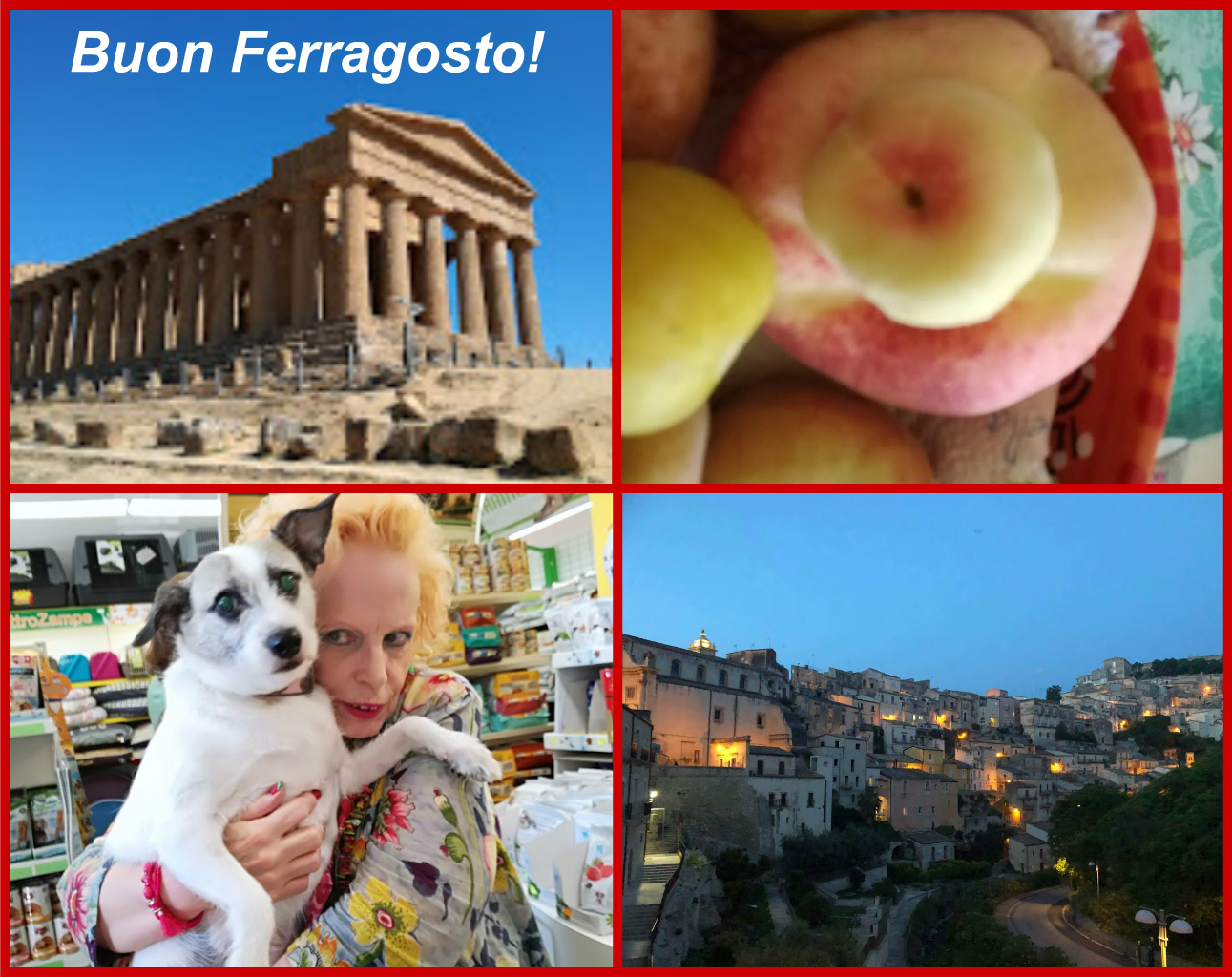
Left to right: Tempio della Concordia, Agrigento; a somewhat pregnant pesca tabacchiera; us; Ragusa Ibla at dusk.


Oh, and I thought you'd like to see my seasonal anguria (watermelon) nails as well:


Wednesday, June 28, 2017

LOOKING FOR LUIGI

Casa natale di Luigi Pirandello

As a French and Italian undergraduate back in the late sixties and early seventies, one of the authors whose work was to have a lasting effect on me was Luigi Pirandello, born 150 years ago today. Although or perhaps because his works were complex and posed questions rather than answering them, they immediately appealed to me. A recurring theme in the works of Pirandello is the nature of truth, probably most famously explored, for British and American audiences, in the play Sei personaggi in cerca d’autore (Six Characters in Search of an Author) but my favourite has always been Enrico IV (Henry IV). The title refers to Henry IV of Germany, Holy Roman Emperor and the plot centres around an actor who believes himself to be Henry in “real” life – or does he?

It is always difficult to justify a liking for authors whose political views you abhor and Pirandello, although declaring himself apolitical,  initially supported fascism.  However,  in 1927 he tore up his party membership card in front of fascist leaders and was thereafter watched closely by the régime’s police.

I knew that Pirandello had been born in the Agrigento or Girgenti countryside, but I never thought I would visit his birthplace or dreamt that Agrigento would become one of my favourite cities.

No one, then, was more surprised than me when, on a hot October day during my first visit to Sicily in 1992, I found myself standing outside the 
Casa Natale di Luigi Pirandello (Pirandello Birthplace) at 12.55 pm., five minutes before it was due to close. I had left Modica at 5 am in order to catch a bus to Gela, where I had despaired of the connecting bus to Agrigento ever arriving, let alone leaving. Once I arrived (late) in Agrigento, it had taken the rest of the morning to find the stop for the local bus that would take me, via a circuitous route on which it seemed to call in on every housing estate in the city's suburbs, to Luigi. I explained what had happened to the custodian and she kindly let me in and went out of her way to explain the exhibits. Then I walked down to the author’s grave under a pine tree, from which you can see the sea and, on a clear day, the coast of Africa.  Pirandello had written,

Take my urn to Sicily and place it under a stone in the Girgenti (Agrigento) countryside, where I was born." 

I, less eloquently, said, 

Luigi, I’ve come to see you. It’s taken me a long time and you weren’t always easy to study, nor were you easy to find today. But you taught me to look at life from many different angles and, although at times I've cursed you for it, today I'm here to thank you."


A page from my postcard album


Luigi Pirandello:  Agrigento, 28 June 1867 - Rome, 10 December 1936

Wednesday, March 08, 2017

MIMOSA AND MOTIVATION

Mimosa blossom is very much the order of the day for the festa della donna [International Women's Day] so it was nice to be presented with a sprig of it with my Sicilian orange juice in the bar this morning and lovely to receive the gift on the left from a friend:


I thought it would be appropriate, on this day, to tell you about ten Italian women who have inspired me - well, more than ten, really, as there are whole convents of nuns involved - but it started at ten!

Teresa Mattei
Firstly, if you are wondering why the mimosa is the symbol of International Women's Day in Italy, it was the idea of one Teresa Mattei , activist, partisan and one of the "mothers of the Italian Constitution".  

The other great ladies on my list come in no particular order and I make no apologies for the fact that several of them are writers. I'm just made that way.

Oriana Fallaci has fascinated me since my student days and I learnt only recently that the woman once known as "Italy's most aggessive journalist" could be just like the rest of us when she fell in love!

Elsa Morante was another writer whose work I started reading as a student and in my opinion her greatest novel remains La Storia or History. Of that other literary lady who is so popular both here and in Britain, namely signora Ferrante, I have read only one volume, so I am reserving judgement for now.  If I get hooked you'll be the first to know!

The works of Natalia Ginzburg were a comfort to me in my student days and they are a comfort to me now.

Rita Levi Montalcini, who left us almost five years ago, was a scientist and Nobel laureate who, even at the age of 100, had a special empathy with the young, whom her achievements and words continue to excite. The world is poorer without her.

Rita Levi Montalcini depicted in flower petals at the Noto Infiorata, 2011
Franca Viola

No woman living in Sicily can forget Franca Viola, whose determination not to submit to bullying changed Italian law.  She lives happily today in Alcamo.

Maria Grammatico, Ericean pastry cook who told her story to Mary Taylor Simeti in Bitter Almonds, was brought up in a convent, where she learnt to make pastries. I have yet to achieve my ambition of visiting her pastry shop in Erice.

There are still convents in Sicily where the nuns make and sell pastries to raise funds for maintenance or good causes and I'll never forget the day I bought these, through a grille, from a convent in Agrigento. You have my admiration, dear sisters:


The story of Daniela Spada is one I read recently and who could not be inspired by this lady's courage and the determination with which she fought her way back from devastating illness? I learnt so much from this book.

Artemesia Gentileschi is a woman I've admired since the first film about her came out in the 1990s. More talented than her father and brothers, if ever a woman literally suffered for her art, it was she. Artemesia continued painting, against all the odds, and was the first woman to become a member of the Florentine Accademia di Arte del Disegno.

Finally, the word pazienza is not in my vocabulary and I've often said it should be banned in Italy as it is too often used to excuse inefficiency by the very victims of that inefficiency. However, when pazienza is employed to create great or small works of art, I wish I had it so, as we are coming up to Easter, I would like to express once again my admiration for The Palm Lady.

I hope you've all had a wonderful festa della donna!


Saturday, February 04, 2017

A WELL-DESERVED AWARD

It is always good when hard work is rewarded and no oganisation deserves recognition more, in my opinion, than the Italian firefighters, who, on 27th January in Ulm, were awarded the Conrad Dietrich Magirus Award 2016 as the best firefighters in the world. They were chosen from a shortlist of firefighters from nine countries by a specialist international jury.

Receiving the prize on behalf of firefighters throughout Italy were four representatives, including two from Agrigento. The prize was awarded to the Italian corps for their incredible work following the earthquake of 24th August 2016 in Central Italy, when they tirelessly pulled humans and animals from the wreckage, made people safe and comforted them. The important work of their colleagues from Genova and Imperia, who took photographs documenting the events of that terrible day and its aftermath, was also recognised, as were the organisational skills of national coordinators, who sent firefighters and equipment to the scene from all over the country within hours.

As well as winning the Conrad Dietrich Magirus statuette, a team of Italian firefighters will visit the world-famous New York Fire Department but I am sure that they would say that their reward is in the number of lives saved.

Congratulations to these wonderful men and women.

Tuesday, July 05, 2016

THE PROUD EUROPEAN CHALLENGE


"The Proud European Challenge:  Post five photos that make you proud to be European and show what that means to you."  

This was a friend's suggestion on facebook and I thought it was a good idea. Here is what I wrote and the first collage shows four of the photos I posted. In these I am in Montpellier, France in 1970 [yes, I know we joined the EU in 1973 but we were on our way in and things were already getting easier];  in Messina in 1998; on my way to Elba in 1977 and in Legnano [Milan] in 1996. 
"Freedom of movement has allowed me to study and work in several European countries, where I have been lucky enough to meet people from all over the world. If the barriers go up again, we will all be the poorer, in every sense, for it."


But of course I didn't want to stop at five photos so I'm posting some more here. Below is the Charles Bridge in Prague, which became one of my favouite haunts in that lovely city; in 2009 I am being interviewed in Buggiano [Tuscany] about my translation of the poet Antonio Lonardo's book; I have very happy memories of my 45th birthday in Modica in 1995; and Prague again with colleagues in 2003 [the 5th photo I put on facebook].


Then there is what being in Sicily means to me:  it means being in a particularly fascinating, culturally mixed, part of a country I've loved since I was 19. Sicily for me is the purple sea at Eloro, the bread arches of San Biagio Platani and having the opportunity to share a little of my own culture with Sicilians, for whom I always make Welshcakes on St David's Day. The island is also rich in the Greek heritage from which culture as we know it in the West first blossomed. When I'm feeling low, I remember Agrigento and am reminded why I am here.


Being in Sicily also means looking across the Strait of Messina to the Calabrian coast, the beginning of a journey to the New World for so many in the last two centuries. They were economic migrants trying to make a better life for themselves and their families, a perfectly natural desire that is being derided these days. They weren't caged and beaten before they left, killed on board ship for asking for a drop of water or thrown overboard when they grew weak but their journey was long and arduous, as was their path to work and acceptance at their destination.


I, too, am a migrant, albeit from choice and I am here to understand.  I want to be part of a Europe of opportunity, not a Europe of barriers and I want the country that made me to be part of that too.

Thursday, May 05, 2016

TOWERING COMPETITION

At the beginning of April I wrote that Sambuca di Sicilia in Agrigento Province had, in a TV poll, been named the most beautiful village in Italy, much to the consternation of the inhabitants of Cervo [Liguria], whose beauty I am able to vouch for.

The towers of  San Gimignano


Three weeks after this announcement, however. the Spanish newspaper El País ran its own poll and named San Gimignano in Tuscany as the most beautiful borgo in Italy. I have been to San Gimignano two or three times and it is certainly impressive but I would say it is more majestic than pretty. It also has a torture museum which caused me several sleepless nights after my last visit!

Not having been to Sambuca di Sicilia - a state of affairs I hope to put right in the near future - I couldn't say which of the three villages is the loveliest but the competition, like the Sicilian weather, seems to be hotting up.

Me in San Gimignano in the 1970s - sorry about the fashion!


San Gimignano has been the setting of, or has featured in, several well-known films, notably Tea with Mussolini in 1999:

Wednesday, April 20, 2016

SICILY SCENE REVISITED - AROUND THE ISLAND

Continuing my nostalgic journey through Sicily Scene's archives, I began to think about the many lovely places I have visited on this ever-fascinating island.  I have no doubt about my favourite - it is the Valley of Temples in Agrigento and I especially enjoyed this visit.  One of the most unusual events I have attended was the annual Easter display of "bread arches" at San Biagio Platani and I hope to get there again one day.  Then there is the Infiorata in Noto [coming up soon], which I try to attend every year and of course I love Catania! These are but a few of the island's treasures and there is always something new, somewhere, to discover.  But I think one of the most interesting trips I have taken was this early one, so I'll repeat the first of a series of posts on it here:

On the Nelson trail - 24th January 2007


About 37 miles northwest of Catania, tucked away in the shadow of Etna, lies the town of Bronte, the dukedom of which was bestowed upon a certain Admiral Horatio Nelson by a grateful King Ferdinando [III of Sicily and IV of Naples] in 1799. A little further on still is Maniace, where the former Benedictine Abbey became known as Il Castello dei Nelson. And that is where I have been today. It is a lovely and impressive place, as I hope the photos will show - much lovelier than I had anticipated. I should like to be able to tell you that England's saviour lingered there in the sun with his Emma - and many Sicilians believe that he did - but, alas, he died without ever having seen it. The first of his descendants to arrive there was his niece Charlotte, who, reaching it after a truly nightmarish journey, decided that it was not to her taste and stayed only three days! [More the fool her!] It was later used by other members of the family but under agrarian reform in Italy in 1961 much of the land was redistributed. The Nelson family sold the castle and park to the Comune of Bronte in 1981.
There may, however, be another British connection: the Rev. Patrick Prunty or Brunty, father of another Charlotte plus Emily, Anne and Branwell, changed his name to Brontë in 1802. I like to think that he did it as a homage to Nelson then added the diaeresis for effect and the dates do tally. By the way, I am not of the Mrs. Gaskell school of thought with regard to Patrick Brontë for I do not believe that he was a monster: he saw that his children were educated, encouraged them to write and cared for Branwell tenderly during the latter's last illness. I am also of the opinion that the main reason for his opposition to the Bell Nicholls marriage was concern for Charlotte's health, and in this he was, tragically, proved right. But I digress. Let us at least hope that poor, bereaved Mr. Brontë found some comfort in his name in the winter of his life. I wonder what, if anything, he knew of the little town in faraway, sunny Sicily? He was a well-read man, so it is possible that he knew something....
I now have to confess that I made this trip the lazy way. It would not be possible to get to Bronte and back in a day using public transport, so I hired a car and a driver. This is not a particularly cheap thing to do in Sicily but it was cheaper than staying in a Catania hotel overnight and, more importantly, saved me kennelling Simi for a night. ["And I should think so, too!" she is saying as she sits beside me, waiting for her walk.] This, again, is something the Sicilians need to sort out: no one will use Modica or anywhere else as a base if they can't get around. Not everyone wants to hire a car, as even if you are used to driving in Italy, to do so here is, at the very least, challenging! The best thing that towns of Modica's size could do to encourage tourism would be to organise escorted trips to places of interest such as Bronte.
But let us return to our hero. Nelson, me old hearty, I've always thought you looked terribly lonely all the way up there on that column. So next time I'm in London, I'll sit in the National Gallery's restaurant, gaze across at you and tell you all about your Duchy of Bronte today. How's that?
More photos - and more, and more - in a minute!

Here are links to the other posts about this visit:

On the Nelson trail - 2
On the Nelson trail - 3
On the Nelson trail - 4
On the Nelson trail - 5
On the Nelson trail - 6
On the Nelson trail - 7


I hope you enjoy them.

Friday, April 01, 2016

A TALE OF TWO VILLAGES

The Sicilian village of Sambuca di Sicilia [Agrigento Province] had an extra reason to celebrate at Easter when it was named the most beautiful village in Italy in the TV Borgo dei Borghi competition. This result represented a hat trick for Sicily as Gangi had won the title in 2014 and Montalbano Elicona in 2015.

Situated near Sciacca, Menfi and Selinunte and with 6,000 inhabitants, Sambuca di Sicilia was a Sicanian stronghold and boasts impressive churches, a still discernible Saracen district and the remains of a Roman aqueduct. Its "signature dish" is minni di virgini, little cakes in the shape of a woman's breast.   

I've never been to Sambuca di Sicilia but will take the word of honorary citizen Laura Boldrini, currently President of the Italian Chamber of Deputies [lower house] as to its charms. Laura Boldrini was elected to Parliament on a Sicilian list and also has links to Sambuca di Sicilia from her former role as spokesperson for UNHCR.  The village has been particularly welcoming to migrants.

By all accounts there was quite a party there over the Easter holiday, with everyone making plans for the expected influx of tourists following the poll result. The villagers' jubilation, however, was not shared by the inhabitants of Cervo Ligure in Northern Italy, a village which had been excluded from the competition at the last moment due to alleged irregularities in the decisive online vote.  I have been to Cervo a couple of times and can confirm that it is lovely.

Then today, less than a week after the competition result, this happens:  seven Mafia-related arrests in Sambuca di Sicilia. Oh, dear!  If I were a resident of Cervo, I think I would be even more unhappy and if I were the Mayor of Sambuca di Sicila I would be wondering how on earth I was going to get my village out of this one! 

It is easy to criticise so it is perhaps worth pointing out that Sambuca di Sicilia is to be admired for granting honorary citizenship to this brave lady too.


Me in Cervo, 1980s.

Saturday, August 08, 2015

SABATO MUSICALE

Tonight let's listen to a golden oldie from Mr Al Bano Carrisi, who is performing at the Valle dei Templi in Agrigento as I write.

Al Bano - Io di notte

Al Bano has said that his concert will be a homage to all those people who have reached Sicily and who will continue to arrive:

"When I see these people arriving by boat and fleeing poverty, war, hunger and oppression, I think of my friends who left for Northern Italy by train and of my uncles who left for Argentina. Then it was my turn  In 1961 I took the train of hope, looking for a better place, which I found in Milan. So when I see these poor souls fleeing hunger and war I understand them. The countries of the world should unite to find a way to manage the phenomenon, then perhaps the influx would decrease. But I can already see that all this is inevitable."

Note:  The singer is from Puglia, a region where he still has a home and which he continues to love. When he says " a better place", he means somewhere with more opportunities.
"

Saturday, February 21, 2015

SABATO MUSICALE

No surprises this week! Here are Il Volo with their worthy Sanremo winning song, Grande Amore:

Il Volo - Grande Amore

We're all especially proud down here because Piero Barone is from Agrigento!

Saturday, November 22, 2014

SABATO MUSICALE

This single has been released ahead of Gianna Nannini's new album, Hitalia, which comes out on 1st December. The video was shot in Agrigento, where the beauty of the scenery lends poignancy to the lyrics:

Gianna Nannini - Lontano dagli occhi

Wednesday, August 06, 2014

SHAMED INTO ACTION

The drone video below, of parking on Le Pergole beach in Realmonte [Agrigento]  was first posted by the environmental association Mareamico and at the weekend it went round the world. We probably all had a good laugh: yes, it's Italian anarchy at its most absurd and reinforces the stereotype of the Italian driver, but the disregard for the environment and for other people that it demonstrates is also tragic.

On Monday the police moved in to clear the beach of cars but the Mayor of Realmonte says that he just doesn't have the resources to regularly police both his town and the seven beaches that come under his jurisdiction.

The moral seems to be that in Sicily, what common sense won't do, shame will.


"Cu' nun avi russuri nun senti mancu 'i vastunati - He who does not feel shame [for the bad things he has done] does not feel the strokes of the cane either."
- Sicilian proverb

Wednesday, July 09, 2014

SUMMER TIDES - 5

The saddest news I have to report tonight is that, when the migrant boat involved in last week's tragedy was finally brought to Pozzallo, 45, not 27 or 30, bodies were found, jammed into the hold.  Four men have beern arrested by Sicilian police on suspicion of people trafficking.  Last Wednesday the front page of La Sicilia carried the headline "Mare Mortum".

On Sunday night around 100 migrants, including women and children, arrived on Ispica beach. It was the usual story: an inadequate boat carrying them had managed to elude patrols, brought them within sight of the beach, forced them into the water and then made a fast getaway.  Let us hope that no one drowned.

It is estimated that 2,600 migrants were saved by the Italian Navy and other Mare Nostrum operatives over the weekend. Premier Renzi has again said that the operation must continue but with EU support:

"It is not possible, in 2014, to let a ship full of children sink because we don't know whose jurisdiction it is in.  We save them."

The week has seen several protests in Sicily by both residents and migrants: The inhabitants of Siculiana [Agrigento] protested against the sheer numbers of migrants arriving in their small town but things seem to have calmed down for the moment now that the Mayor has had a meeting with Interior Minister Angelino Alfano, who listened to her concerns. Mr Alfano promised that the number of arrivals in the town would be carefully regulated and gave assurances regarding public health. He also said that the EU at last appears to be realising that Italy, and especially Sicily, cannot take sole responsibility for the migrants after they have been rescued.

Yesterday in Caltagirone, where 110 unaccompanied migrant minors have been living in overcrowded and quite insanitary conditions, the situation exploded. The young migrants destroyed furniture and broke glass in their centre, then set up street blocks nearby. Who can blame them? They say they cannot maintain personal hygiene in these conditions, that they do not have enough drinking water [temperatures in Sicily are reaching 40 C now ] and that their meals are served cold. They also say they do not have enough clothing and are not given any spending money - to which, as asylum seekers, they are entitled - or phone cards. They only want to be listened to but at the moment have no access to anyone who might understand their problems.

As I write, Sicily waits: a Libyan politician said last week that at least 3 million migrants are preparing to leave Libya in an attempt to reach Italian shores during the summer.

Thursday, April 17, 2014

HATS OFF TO MARCO

As a linguist, I'm always emphasising the importance of communicating with the people one is trying to attract to one's business, product or city in their own language and of making an effort to do it properly [which will probably involve employing a qualified, mother-tongue interpreter or translator, not using the awful translator sites]. 

Hats off, then, to Marco Zambuto, Mayor of the lovely city of Agrigento, for this advert in which he says a few words in Chinese himself at the end.  Mr Zambuto has not forgotten to invite the rest of us to "invade" his city as well!

Thanks to Corriere della Sera:

Friday, October 18, 2013

A HILLSIDE IN AGRIGENTO

If you travel through the Merthyr Vale in Wales and happen to glance up at a certain point, a sad sight awaits you, for you will see rows of pristine white, stone arches, each of which guards an immaculately tended grave. These are the graves of the majority of the victims of the Aberfan Disaster of 1966, an event which no one living in Wales at the time will ever forget, just as Sicilians will never forget the migrant tragedies of  3rd and 11th October of this year.

I was reminded of that faraway hillside this morning when I saw pictures in the Italian press of the hastily but carefully constructed stone chapels that now grace a hillside in Agrigento and contain the bodies of many of the lost migrants. Each chapel in the Piano Gatto Cemetery contains the bodies of up to 14 victims of the disasters and on the exterior walls the deceased are identified by numbers.  This is not only because many could not be identified  but has also been done to protect some of the families of the deceased from possible repercussions in their countries of origin. The Mayor and Vicar general of the Archdiocese of Agrigento brought wreaths for each chapel. The cemetery superintendent told the Corriere della Sera newspaper that he cannot erase from his mind the image of so many coffins arriving by lorry last Sunday.

Migrant burials have also taken place in other cemetries in Agrigento Province and in all cases the mayors of the towns involved have offered their full cooperation. In at least two of the cemeteries, interfaith funerals have taken place. In an extraordinary humanitarian gesture, two families offered to have three of the migrants - among them a mother and baby - buried in their own family tombs in Agrigento city's Bonamorone Cemetery and this has now happened. 

A state memorial service for all the migrants will take place on the San Leone jetty in Agrigento at 4pm on Monday, in the presence of government representatives. The Mayor of Lampedusa, Giusi Nicolini, is understandably upset about this, as she will be unable to attend herself due to a pre-scheduled meeting with President Napolitano and because she feels that the citizens of Lampedusa have a right to be involved in this service.

Meanwhile, some of the relatives of victims of the Sampieri tragedy of 30th September have been asking for repatriation of the bodies. They say that the Eritrean government is willing to take responsibility for such a transfer and that they do not understand why the Italian government will not give permission for it to go ahead.

Let us hope that the migrants buried in Agrigento Province find, in death, the serenity that was so cruelly denied them in life and, like the lost of Aberfan, may they sleep in peace.

Wednesday, April 18, 2012

AN AMBITION ACHIEVED

After our morning in San Biagio Platini on Sunday, it was onwards to Agrigento for a guided walk around the old town, culminating in a visit to the Church of Santo Spirito.  This church is not normally open to the public, as its convent is home to a semi-closed order of Cistercian nuns, but our guide had arranged for it to be opened for us.


The Church was built in the thirteenth and fourteenth centuries but those lucky enough to enter are surprised by a Baroque interior with sparkling white figures in stucco on three sides.  These are probably the work of the Palermitano sculptor Giacomo Serpotta [1656 - 1732].

Now to the cloister:


And my ambition? Ever since I first visited Sicily I'd wanted to be able to buy dolci made by nuns and exchange my money for them through a grille. On Sunday I finally did this at Santo Spirito.  Well, it wasn't really a grille - more of a hatch - and a lay assistant was taking the money.  It was nice, however, to catch a fleeting glimpse of a face peeping from a wimple as the tray of almond biscuits was pushed towards me. I assure you they are delicious:


Nowhere is the tale of how Sicily's nuns traditionally made dolci better told than by Maria Grammatico to Mary Taylor Simeti in the book,  Bitter Almonds.

Many thanks to the person who uploaded this onto youtube:

Tuesday, April 17, 2012

ARCHI DI PANE - BREAD ARCHES

About 38 kilometres north of Agrigento, nestling in hills even higher than the Valle dei Templi [which is not, of course, a valley at all] lies the little town of San Biagio Platani and that is where I headed with two friends on Sunday.

First of all, some views of the surrounding countryside:


These red flowers were everywhere and I'm not sure what they are but I think they might be wild red cyclamens:


But what was going on in San Biagio Platani, a town of 3,547 people?  What was so important that this nocturnal blogger was willing to get up at 4.30 am to see it?

Well, in the second half of the eighteenth century, the people of San Biagio Platani, who at that time numbered less than 1,000, began to make arches and pictures to celebrate Easter:  It was a chance to do something creative and produce objects of beauty in lives which consisted mainly of toil and preparing the decorations allowed the inhabitants to forget their poverty for a little while each year.  They used the materials that nature provided - grain, bamboo, willow, lentils and other pulses, beans and dates - and the women made bread dough and pasta which could also be used.  Rosemary was used as a symbol of death and remembrance, palms symbolised Palm Sunday and bay symbolised knowledge.  The arches and pictures as a whole represented Christ's triumph over death.

The tradition has continued to the present day and two confraternities, the Madunnara [representing the Madonna] and the Signurara [representing Christ] begin preparing the decorations months ahead.  There is no bitter rivalry:  those involved just want to create the most beautiful objects they can and all is unveiled on Easter Saturday morning when the images of Mary and Christ "meet" in the middle of the town's main street.  The Madunnara colour is blue while the Signurara's is red and each confraternity decorates their own half of the main street.  Whilst the overall theme remains the triumph of the Resurrection, a different artistic style is used for the arches each year.  This year it is oriental.


Confraternity banners outside the church


Now, without further ado, I'm going to let you enjoy the sights that we saw on Sunday. Remember that everything you see is made from natural materials or bread dough:


There were 33 of these white bread symbols on Christ's and on Mary's main arches, 
to symbolise the age of Christ at the Crucifixion.


Symbols of palm, rosemary and bay


And finally, who could resist this lovingly crafted bread, decorated with sesame seeds, to take home?


If you are coming to Sicily, the bread arches and other decorations in San Biagio Platini are on show until 1st May 2012.

Counters


View My Stats