Showing posts with label San Biagio Platini. Show all posts

Tuesday, July 05, 2016

THE PROUD EUROPEAN CHALLENGE


"The Proud European Challenge:  Post five photos that make you proud to be European and show what that means to you."  

This was a friend's suggestion on facebook and I thought it was a good idea. Here is what I wrote and the first collage shows four of the photos I posted. In these I am in Montpellier, France in 1970 [yes, I know we joined the EU in 1973 but we were on our way in and things were already getting easier];  in Messina in 1998; on my way to Elba in 1977 and in Legnano [Milan] in 1996. 
"Freedom of movement has allowed me to study and work in several European countries, where I have been lucky enough to meet people from all over the world. If the barriers go up again, we will all be the poorer, in every sense, for it."


But of course I didn't want to stop at five photos so I'm posting some more here. Below is the Charles Bridge in Prague, which became one of my favouite haunts in that lovely city; in 2009 I am being interviewed in Buggiano [Tuscany] about my translation of the poet Antonio Lonardo's book; I have very happy memories of my 45th birthday in Modica in 1995; and Prague again with colleagues in 2003 [the 5th photo I put on facebook].


Then there is what being in Sicily means to me:  it means being in a particularly fascinating, culturally mixed, part of a country I've loved since I was 19. Sicily for me is the purple sea at Eloro, the bread arches of San Biagio Platani and having the opportunity to share a little of my own culture with Sicilians, for whom I always make Welshcakes on St David's Day. The island is also rich in the Greek heritage from which culture as we know it in the West first blossomed. When I'm feeling low, I remember Agrigento and am reminded why I am here.


Being in Sicily also means looking across the Strait of Messina to the Calabrian coast, the beginning of a journey to the New World for so many in the last two centuries. They were economic migrants trying to make a better life for themselves and their families, a perfectly natural desire that is being derided these days. They weren't caged and beaten before they left, killed on board ship for asking for a drop of water or thrown overboard when they grew weak but their journey was long and arduous, as was their path to work and acceptance at their destination.


I, too, am a migrant, albeit from choice and I am here to understand.  I want to be part of a Europe of opportunity, not a Europe of barriers and I want the country that made me to be part of that too.

Wednesday, April 20, 2016

SICILY SCENE REVISITED - AROUND THE ISLAND

Continuing my nostalgic journey through Sicily Scene's archives, I began to think about the many lovely places I have visited on this ever-fascinating island.  I have no doubt about my favourite - it is the Valley of Temples in Agrigento and I especially enjoyed this visit.  One of the most unusual events I have attended was the annual Easter display of "bread arches" at San Biagio Platani and I hope to get there again one day.  Then there is the Infiorata in Noto [coming up soon], which I try to attend every year and of course I love Catania! These are but a few of the island's treasures and there is always something new, somewhere, to discover.  But I think one of the most interesting trips I have taken was this early one, so I'll repeat the first of a series of posts on it here:

On the Nelson trail - 24th January 2007


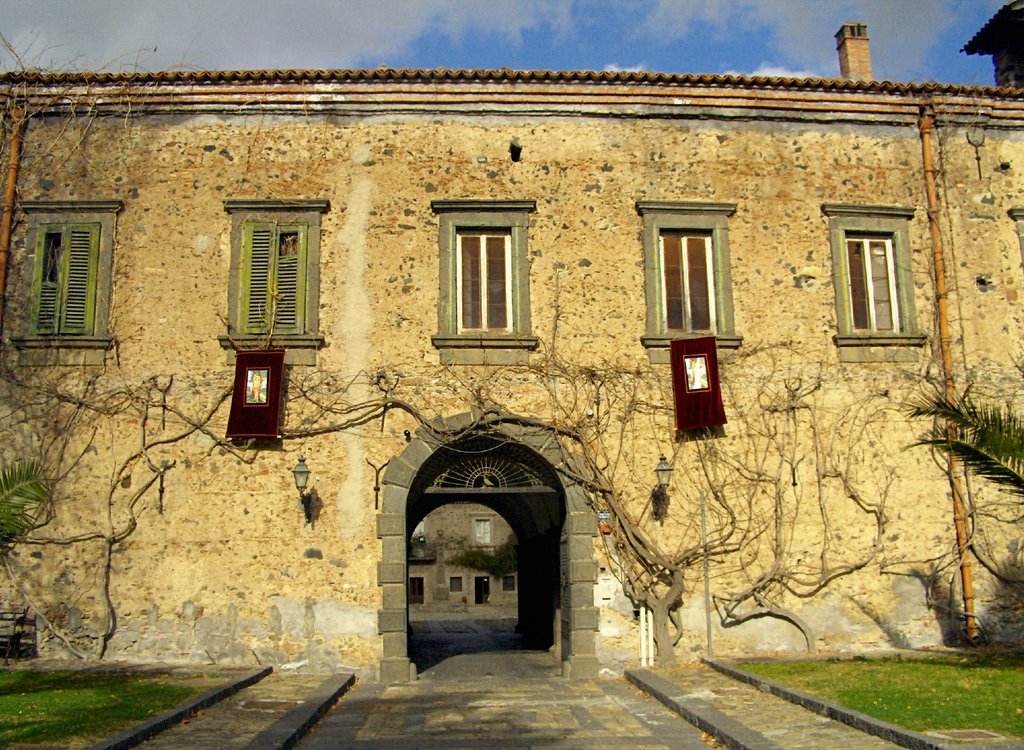
About 37 miles northwest of Catania, tucked away in the shadow of Etna, lies the town of Bronte, the dukedom of which was bestowed upon a certain Admiral Horatio Nelson by a grateful King Ferdinando [III of Sicily and IV of Naples] in 1799. A little further on still is Maniace, where the former Benedictine Abbey became known as Il Castello dei Nelson. And that is where I have been today. It is a lovely and impressive place, as I hope the photos will show - much lovelier than I had anticipated. I should like to be able to tell you that England's saviour lingered there in the sun with his Emma - and many Sicilians believe that he did - but, alas, he died without ever having seen it. The first of his descendants to arrive there was his niece Charlotte, who, reaching it after a truly nightmarish journey, decided that it was not to her taste and stayed only three days! [More the fool her!] It was later used by other members of the family but under agrarian reform in Italy in 1961 much of the land was redistributed. The Nelson family sold the castle and park to the Comune of Bronte in 1981.
There may, however, be another British connection: the Rev. Patrick Prunty or Brunty, father of another Charlotte plus Emily, Anne and Branwell, changed his name to Brontë in 1802. I like to think that he did it as a homage to Nelson then added the diaeresis for effect and the dates do tally. By the way, I am not of the Mrs. Gaskell school of thought with regard to Patrick Brontë for I do not believe that he was a monster: he saw that his children were educated, encouraged them to write and cared for Branwell tenderly during the latter's last illness. I am also of the opinion that the main reason for his opposition to the Bell Nicholls marriage was concern for Charlotte's health, and in this he was, tragically, proved right. But I digress. Let us at least hope that poor, bereaved Mr. Brontë found some comfort in his name in the winter of his life. I wonder what, if anything, he knew of the little town in faraway, sunny Sicily? He was a well-read man, so it is possible that he knew something....
I now have to confess that I made this trip the lazy way. It would not be possible to get to Bronte and back in a day using public transport, so I hired a car and a driver. This is not a particularly cheap thing to do in Sicily but it was cheaper than staying in a Catania hotel overnight and, more importantly, saved me kennelling Simi for a night. ["And I should think so, too!" she is saying as she sits beside me, waiting for her walk.] This, again, is something the Sicilians need to sort out: no one will use Modica or anywhere else as a base if they can't get around. Not everyone wants to hire a car, as even if you are used to driving in Italy, to do so here is, at the very least, challenging! The best thing that towns of Modica's size could do to encourage tourism would be to organise escorted trips to places of interest such as Bronte.
But let us return to our hero. Nelson, me old hearty, I've always thought you looked terribly lonely all the way up there on that column. So next time I'm in London, I'll sit in the National Gallery's restaurant, gaze across at you and tell you all about your Duchy of Bronte today. How's that?

More photos - and more, and more - in a minute!

Here are links to the other posts about this visit:

On the Nelson trail - 2
On the Nelson trail - 3
On the Nelson trail - 4
On the Nelson trail - 5
On the Nelson trail - 6
On the Nelson trail - 7


I hope you enjoy them.

Tuesday, April 17, 2012

ARCHI DI PANE - BREAD ARCHES

About 38 kilometres north of Agrigento, nestling in hills even higher than the Valle dei Templi [which is not, of course, a valley at all] lies the little town of San Biagio Platani and that is where I headed with two friends on Sunday.

First of all, some views of the surrounding countryside:


These red flowers were everywhere and I'm not sure what they are but I think they might be wild red cyclamens:


But what was going on in San Biagio Platani, a town of 3,547 people?  What was so important that this nocturnal blogger was willing to get up at 4.30 am to see it?

Well, in the second half of the eighteenth century, the people of San Biagio Platani, who at that time numbered less than 1,000, began to make arches and pictures to celebrate Easter:  It was a chance to do something creative and produce objects of beauty in lives which consisted mainly of toil and preparing the decorations allowed the inhabitants to forget their poverty for a little while each year.  They used the materials that nature provided - grain, bamboo, willow, lentils and other pulses, beans and dates - and the women made bread dough and pasta which could also be used.  Rosemary was used as a symbol of death and remembrance, palms symbolised Palm Sunday and bay symbolised knowledge.  The arches and pictures as a whole represented Christ's triumph over death.

The tradition has continued to the present day and two confraternities, the Madunnara [representing the Madonna] and the Signurara [representing Christ] begin preparing the decorations months ahead.  There is no bitter rivalry:  those involved just want to create the most beautiful objects they can and all is unveiled on Easter Saturday morning when the images of Mary and Christ "meet" in the middle of the town's main street.  The Madunnara colour is blue while the Signurara's is red and each confraternity decorates their own half of the main street.  Whilst the overall theme remains the triumph of the Resurrection, a different artistic style is used for the arches each year.  This year it is oriental.


Confraternity banners outside the church


Now, without further ado, I'm going to let you enjoy the sights that we saw on Sunday. Remember that everything you see is made from natural materials or bread dough:


There were 33 of these white bread symbols on Christ's and on Mary's main arches, 
to symbolise the age of Christ at the Crucifixion.


Symbols of palm, rosemary and bay


And finally, who could resist this lovingly crafted bread, decorated with sesame seeds, to take home?


If you are coming to Sicily, the bread arches and other decorations in San Biagio Platini are on show until 1st May 2012.

Counters


View My Stats