Showing posts with label Bristol. Show all posts

Sunday, December 15, 2019

A LETTER TO BRITAIN


Modica, Italy
13th December 2019

Dearest Britain,


A park in Norwich, Norfolk

I don't live in you now and, though I left you 15 years ago for another country that had captured my heart, that doesn't mean I no longer love you, for it was you that bore me, nurtured me, educated and made me and there will always be a British girl inside the continental me. I write now because what happened to you yesterday was shocking, devastating, frightening and deeply upsetting; its consequences cannot be foreseen at this juncture, but 24 hours on they seem bleak. I may still love you – I always will – but I no longer recognise you.

The country I left was far from perfect and our imperialist past was not something that most of us boasted about. Of course there was racism, as there is everywhere and I witnessed it myself, but it also seemed to me that it was generally understood that democracy means that you cannot impinge upon the freedom of others. When exactly did that change? When did people begin to believe that they could make whatever anti-foreigner, anti-gay, anti-woman, anti-elderly, anti-you-name-it comment they liked with impunity – in one of the most diverse and tolerant countries in the world? I am too far away to know and I doubt you know yourself but it has happened. Tolerance, it seems, has gone and soon it could be followed off our little group of islands by accountability in the “Mother of Parliaments”, the independence of the judiciary and perhaps even the constitutional monarchy.

When you see your own country from afar, you are unable to balance your pessimism regarding events there with a healthy dose of observation of your countrymen and women just getting on with their normal lives, but I would guess that what happened is simply that democracy is fragile and, having enjoyed it for so long, we took our eye off the ball. Then the 2008 recession gave the charlatans the opportunity they had been waiting for to exploit discontent. And you fell for it, my country. Not having known an occupation within living memory, you failed to see the danger when it came and you are failing to understand it now. This tide will turn, of course, whether peacefully or not I cannot say, and I certainly would not hazard a guess as to how long it will take.

So let us think back for a moment to a generation, that of my parents, who did recognise a serious threat to their freedom, for what I really want to talk about tonight are memories. Whenever I fly back to you, Britain, as the plane comes in over the Channel and Kent, I think first of Folkestone, a town of which I have no memory but to which I was sent at the age of eight weeks – to an orphanage there, because my natural mother couldn't afford to keep me. (Do you really want to go back to that, Britain? A narrow, judgemental state in which single mothers are forced to give up their children? It seems that you do, judging from remarks made by the now re-elected Prime Minister.) Seven months later, in the cold November of 1950, two kind, loving people who longed for a baby – a Bristol newsagent and his wife, both of Welsh origin – visited that orphanage in Folkestone and they drove back to Bristol with an extra passenger - me. My bond with the man who had just become my father was instant and I miss him to this day. I was told that I also went willingly into my mother's arms but took longer about it!

As the plane nears London, I look down and try to get my geographical bearings of that enormous city and its outskirts and I remember that somewhere down there I went to school, accompanied my big-hearted, generous but flawed dad to both casinos and Gamblers Anonymous meetings (somewhere near Buckingham Palace), became part-Londoner and grew up. Also down there his ashes mingled with my mum's, in the Ruislip Garden of Remembrance named after the only English Pope, Nicholas Breakspear. I only went back there once after their respective funerals (twenty years apart), on the 25th anniversary of my dad's death and I learnt that they were not there, for they are where I am. If I hadn't known that, I would have been unable to leave.


Westminster Abbey

They sat in their North London Garden, the girl and her dad, and he spoke to her sometimes in Latin, sometimes in French and he bequeathed to her his love and knowledge of books. Without him, she would not have become a linguist. He also bequeathed to her his humour, his quintessentially British irony and his gift for repartee. They served her well as a teacher and they serve her well now, when humour is all there is, she thinks, to help her deal with the situation.

Chronic illness had prevented dad from fighting (much to his frustration), so back in Bridgend, Wales, he had worked in the Arsenal, then in Bristol hosted American soldiers and joined the Home Guard. He and mum had been horrified by fascism and, like many of his era, he had, before what was always referred to as “The War”, been a member of the Communist Party because it was thought to be the only way to stop Hitler. Later, disillusioned, he left it and received threats for doing so. During the war and during our Bristol years he worshipped Churchill. That was a different kind of Conservatism, though – a party of the rich for the rich, yes, but there was a sense of decency and of responsibility for the fate of their fellow-Britons. In London during the Heath premiership, dad switched his allegiance to the Labour Party because, he said, they cared for the ordinary worker.


Dad (second from left) in the Bridgend Arsenal

My journey from the airport usually continues by coach and down we go, towards the South-West. I still have a sense of childish excitement when I see the motorway signs to “The South-West and Wales”. It's best before evening, when you can still see the green on either side, and as we near Bristol I muse that in some of these fields, cut through by the very road I am travelling on, the little girl and her dad used to go mushroom-hunting. Then she became a teenager and suddenly she was hurtling along the nearby country lanes in her boyfriend's car. She wept and wept when they left for London in the spring of 1965.

And now we come to the Bridge - the span across the River Severn which takes you into Wales. And Wales it is which gives me my real British identity. I grew up among its gentle accents, heard and sang its music every day, assimilated its culture and regarded it always as “home”. As you cross the Bridge you can still see the loading point for the old Aust ferry, which (if you were lucky) took you across before the miracle of the First Severn Bridge. (If you are unfamiliar with that part of Britain, you may be interested to know that the Severn has the third highest tidal range in the world. Hence the two bridges across it that now exist are true feats of engineering.) Sometimes you queued for hours, only to be told that they could take no more cars across that evening, either because of the current or because of the time, and then you had to get into Wales by driving “all around bloody Gloucestershire” as dad would bad-temperedly put it. Once in Wales, we were home and we stayed with my uncle and aunt or in the Cardiff Central Hotel owned by dad's cousin Frank. Years later, as a university student, I spent many drunken nights in its bar – Frank, the hotel guests and its staff had long gone – and later still it was all destroyed by fire. Wales was, and is, the sound of kindly, sing-songy voices, the land of the cwtch (cuddle - and believe me, there's nothing like a Welsh one), the aroma of Welshcakes cooking on a bakestone, a carpet of daffodils in March and April and the land of childhood warmth.


In Wales you'll find daffodils even when there aren't any!
Here, daffodil ornaments are on sale
 at Cardiff Christmas Market

But now I make another journey on these rare trips home: from Cardiff to Norwich, or sometimes straight from London to Norwich, another town of which I have no childhood memory, and yet it is where it all began. For that is where I was born and spent such a short time with my natural mother, who already had a three-year-old daughter called Jill, my sister. How we met after 64 years is a story I have told elsewhere but it is in Norwich that my British life comes full circle and yes, I do have a strange sense there, too, of coming home, of having been there before. Sadly I can only visit my natural mother at her graveside and I take her Welsh daffodils or, at this time of year, a little Christmas tree, and I hope she knows that Jill and I are there together. I have come to love Norwich in its own right, too – its lanes, the glory of its Cathedral, which I have found to be welcoming, and the peace of the nearby Broads.


A peaceful morning in Norwich


A Christmas tree for my natural mother
And on the way there I cross London again and remember other times, fashions and events, both in its life as a city and in my own.

To borrow from Rupert Brooke, all these things I have loved in you, Britain and, even though I do not recognise you now in your national life, they endure, for no politician can take my memories, though age may do so. Therefore I set them down now, for I want you to know that I have loved you, and I hope that you will come through this dark period as you have come through others – stronger, more determined to preserve what is good and, hopefully, kinder – and that if I do not live to see it, others will.

Saturday, February 20, 2016

A MIGRANT TALE FROM LONG AGO

This week I have been watching events in my own country, and in Brussels as I was writing this last night, closely.  As a former state sector teacher, I can empathise with frustrated junior doctors in Britain as I know how hard it is when your profession becomes a political pawn. What I cannot imagine, however, is what it is like to become a political pawn simply because of your provenance or geographical situation and, as if that were not hard enough, to be unable to defend yourself because you do not have that right. I am thinking, of course, of migrants, whose position within the EU has become part of the British "in or out" [of the EU] debate.

Despite plenty pf posturing post- Brussels meeting, I have not heard one politician refer to the fact, tweeted by UNHCR yesterday, that on average two children a day have died crossing the Mediterranean since 15th September. In 2015 12,272 unaccompanied minors reached Italy - a country the world has once again forgotten in this crisis - on migrant boats.

Every time I see that look of anguish on the face of a migrant child being carried ashore by kind helpers, I wonder where I have seen it before and then I remember a boy I called "Winter" long ago. This is an edited version of a post I wrote about him in 2007 and I hope you will bear with me as I tell his story again: 

WINTER


It is usually winter when I think of “Winter”. I don’t know why; I was too young for the time of year to have really registered in my mind; but I think it must have been winter when I knew him, as I remember him in long, woolly socks, short, dark trousers and a grey, rough-textured coat that would scratch my face as he hugged me in the playground.

Everyone wore drab clothes then, mostly grey or a very dull green. Some women used to try to brighten things up by wearing red lipstick and dead foxes round their necks [which used to terrify me] but mostly the dreariness was unrelieved. People of my parents’ generation were still in shock from the Second World War and certain items remained on ration. Interiors were dark, too [though people were shortly to rebel against this], there were still bombsites in Bristol and the streets seemed grey and cold. There was a lot of poverty and it was so normal for children to wear threadbare old clothes to school that no one remarked upon it.

I could only have been about five and school was St Gabriel’s Cof E, at the top of Twinnel Road in Bristol. [It was one of the roads leading off Stapleton Road, where our shop was.] I can’t remember a sunny day in that playground, though there must have been some! I can only visualise it as dark and dismal.

"Winter's" name was actually Gunther, but there was no way I could pronounce it. He used to spend ages trying to get me to say it properly, but his tuition was of no avail to the future linguist! I can hear him now: “My name is Gunther, not ‘Winter’. Say it: G-U-N-T-H-E-R”. “Winter”, I would diligently reply. [I honestly could not understand why he would laugh and I used to get quite upset about it!] Then he would kiss me and tell me that he loved me and I would feel a warm glow for the rest of the day. It was a lovely, all-enveloping feeling of knowing that you are loved and I’m not sure if I have ever recaptured it.

I don’t know what his nationality was or what tragedy his family had escaped; he always talked about his mother, never his father. There were so many families from Central and Eastern Europe pouring into the country then and there were a lot of Poles in Bristol; but obviously his name was not Polish.

“Winter” had ash-blond hair, worn with a long fringe flopping over his forehead, large, smiling blue eyes which I can picture even now and I don’t think I ever saw him without that overcoat on.

He must, I think, have been bullied because I can remember one day telling a teacher, “Winter’s crying”. Then I was pushed aside while Miss Adams [whom I hated with a vengeance from that moment] dealt with whatever it was that had upset him. [It was my job to comfort Winter, not hers!]

Breaks were the highlight of my little life, because I knew Winter would come and find me and we’d stand in a corner of the playground cuddling and exchanging chaste kisses while he told me that we were going to get married when we grew up. Winter had it all planned; he was going to buy the shop from Dad! I didn’t see him at lunchtimes; most women didn’t work then , so the majority of children went home for lunch. In fact the “dinner children” were regarded as something of an oddity. I couldn’t wait to get back to school in those days!

One day he just wasn’t there. “Gunther’s gone”, said Miss Adams when I enquired and that was that. Winter certainly hadn’t known about any move or he would have told me and I’m sure he would have cried! I suppose the family were suddenly rehoused in the efficient, unfeeling manner of the time; or perhaps he was taken out of school because of the bullying; or maybe his father reappeared; I just don’t know. The sense of loss was overwhelming and suddenly the world grew even colder.

We all need fantasies to keep us alive and one of mine is that one of these days I’ll be strolling along a street in Modica, Catania or Palermo, I’ll suddenly stop and there he’ll be – Winter!


"Winter" and his family did not endure the hardships that today's migrants do to reach what they hope will be safety but I have no idea what had had happened to them in their own country prior to their journey. What I do know is that every time my TV screen shows a frightened child looking, from the arms of a stranger, for the people who had always defended him and realising that they are not there, I see the face of Winter  - in a playground in  Bristol, UK, in 1955.

Tuesday, January 17, 2012

IF I COULD TURN BACK TIME - A "LET'S BLOG OFF" POST


Every two weeks, the blogosphere comes alive with something called a Blog Off. A Blog Off is an event where bloggers of every stripe weigh in on the same topic on the same day. The topic for this round of the Blog Off is "If you could turn back time...".


We've all done it, haven't we?  At certain moments, we've all thought, about trivial events or life-changing ones, "If only I had...", "If only I hadn't..." or "If only I had said / could say...".  Here are some of the the things I might change if I could turn back time:


I wish I could have come of age in an era when women wore hats - it would have spared me so many stressful moments on bad hair days


and I often wish I'd become a housewife and a mother instead of a career woman:


The garden shed my grandad made into a "little house"
for me to play in


I'd like to be able to say that if I could turn back time I wouldn't have broken a flowerpot over my friend "Wrecker's" head when I was four - she got the nickname because she broke all my toys - but I'd be lying, even 58 years later.


"Wrecker" sitting on my car [which she didn't break!]


Being blessed with curves was not an advantage in the late 1960s so I'd change the fashions of the Mary Quant era.


And I wish I'd spent more time studying and less living it up at university, but to have done so would have been to have denied being young.


If I could turn back time I would have spoken out more often about some situations and kept a wise silence about others. The advice in this early twentieth century postcard is not a bad maxim:


"I have often regretted my speech, never my silence."


I also wish that I had learned to live within my means long ago and had not, in Mr Micawber's words, "blighted the blossom".


If I could turn back time, I would have come to live in  lovely, Baroque Sicily sooner but we tend to forget how "life" can get in the way of our plans and dreams.


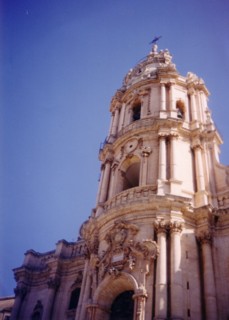
Duomo di San Giorgio, Modica


We can, of course, never know how things would have turned out on "the road not taken" and perhaps it is better thus so I would like to end this post by telling you about a happy moment that I would change only by prolonging it:


Christmas Steps (Rosalind Mitchell) / CC BY-SA 2.0


I do not know how old I was but probably not more than two or three.  I was standing with my mother at the top of Christmas Steps in Bristol, UK and we were waiting for my father.  

Christmas Steps:  such a wonderful, Dickensian-sounding name for a little street full of secondhand bookshops, as it was then, and in my mind, it snowed every time we went there.

And suddenly there was my father, walking up the steps towards us and beaming at me, holding his arms out.  I loved him so much at that moment and as his arms and warmth envelopped me I felt so safe.

If I could turn back the clock, I would make that moment last forever - as, indeed, it has, in my heart.


"I shall be telling this with a sigh
Somewhere ages and ages hence:
The roads diverged in a wood, and I -
I took the one less traveled by
And that has made all the difference."

- Robert Frost:  The Road Not Taken 


Below is the full list of bloggers participating in this week's theme:

Thursday, March 08, 2007

A TALE OF TWO LIBRARIES


I hope readers will bear with me in the little Bristolian tale I am about to tell, for the experience of spending much of my childhood in a library has shaped me, made me the person I am, influenced what I brought to Sicily and still affects my life here:

In 1950s Bristol, UK., my parents ran a newsagent's shop. "Nothing unusual in that", you may say and you would be right. But at the back of our shop was an oblong room with shelves all around and this was "Eggleton's Library". People subscribed to borrow books from it and could browse there for as long as they liked; to many, I believe, it was a haven from the cold, grey, still rationed post-war world outside. Dad, who knew all about books, would order them from far and wide for his customers and they appreciated his knowledge. But the star and doyenne of "Eggleton's Library" was my Great Aunt Mabel [always known as "auntie"] who lived with us. Totally self-educated, she had travelled and been a missionary in Africa and her wide reading would shame many Oxbridge graduates today. Auntie would sit there in what I suppose was a Victorian clerk's black gown, and all the borrowings and returns were recorded in her meticulous hand. So there, dear reader, began "Welshcakes Limoncello Eggleton's" love of books and ever since I have felt safe in a room filled with them. When I go into other houses, whether I am in the sitting room, study, bedroom or kitchen , if there are no books I start wondering, "Where are they?" and I feel uncomfortable. I know I have some Bristolian readers here,here and here and there may be others [sometimes the site meter gives only "UK"]; do any of them remember, or know anyone who remembers "Eggleton's Library" at 110 Stapleton Road?
All this is a preamble to telling you that when I examined the paper in some of Dad's "Tarzan" books [not my kind of reading anyhow though they didn't have the connotations in the 1940s and 50s that they would have today] I realised that it was too damaged and decayed to bring to a hot country. So, with regret, those books had to go but I kept 2 of the labels [above]. I have framed them and they were a source of interest to my Sicilian guests last Thursday. Thus it is that I have a daily reminder of that little library in Bristol, so long ago, in my own well-stocked library in Modica, Sicily. [Some of my Sicilian women friends don't say anything but are probably apppalled at the dust-attracting possibilities of having more than 5,000 books around. I don't care: next to Simi, my books are my most important possessions - and my excuse is that a linguist automatically collects more of them!]
Well, it occurred to me that you might like to see my cookery library. So here is part of it, in the kitchen. I have the books arranged by country / region , rather than author, and the "general" cookery books continue around the corner and into the hallway. In the left-hand bookcase, the top shelf consists of books on French cuisine and my treasured Larousse Gastronomique might well be my "desert island" book choice. Nearly all the rest of that bookcase [which was one of Dad's] until you get to the middle of the bottom shelf, is filled with books on Italian cookery, for this must be the richest country in the world in culinary traditions. I took a separate photo of my Sicilian section, which begins with Mary Taylor Simeti's Sicilian Food, which I believe to be the most authoritative tome on the subject in any language. Next to it you may be able to make out her Bitter Almonds [written with Maria Grammatico] the extraordinary tale of a young girl brought up by the nuns, from whom she learnt the art of Sicilian pastry-cooking. And then there is the excellent Victoria Granof's Sweet Sicily, another wonderful read on this aspect of the island's cuisine . Of course, I am adding to this section all the time and I will soon need Mr G... the carpenter to come and put up more shelves [somewhere!]
The last photo shows my own precious recipe books: they contain many recipes that I have collected from friends here over the years, plus cut-out recipes, all annotated with the magazine title and the date [perhaps I was in the wrong career as a teacher!] and recipes written in my mother's hand. Italian women learn early exactly how much pasta and how much water they need to cook it in for each meal, and, as Granof rightly points out, many of them do not like trying out new recipes as they cook the same traditional food, in the same way, day in, day out. They do not need to look anything up because they will have learned the methods orally from their grandmothers and mothers. But how many young British women, I wonder, will have recipes passed on to them by their mothers these days? Is mine the last generation to enjoy this heritage? I do hope not. What do you think?
When I am in need of comfort I look around my library and remind myself that Mr Eggleton would have been very happy to know that his daughter thanks him, from Sicily, for the love of literature he instilled in her and that Mrs Eggleton would have been delighted that some of her recipes have travelled so far!


Counters


View My Stats