Showing posts with label world war 2. Show all posts

Wednesday, July 02, 2025

ARANDORA STAR 85th ANNIVERSARY

I have posted about the Arandora Star tragedy many times over the years and I think it is worth doing so again today, not only in memory of those who perished and in solidarity with their families, but because this sad event is a timely reminder of what can happen when we "other" immigrant communities or make unfounded assumptions about them. This is an edited version of my 2021 post:

At the outbreak of World War II "enemy aliens" living in Britain were divided into three categories: those in class A were deemed to represent a high security risk and were interned; those in class B were "doubtful" and were subject to some restrictions; and those in class C were thought to pose no security risk at all. However, following the Fall of France in 1940 Churchill decided, in his own words, to "collar the lot" and the majority of class B aliens were interned. When Italy declared war on Britain and France on June 10th the internment of Italian males was ordered. Many of the Germans interned had opposed the Nazis or were German Jewish refugees. Most of the Italians interned had lived in Britain virtually all their lives and many had sons who were serving in the British military. Others were in Britain because they had opposed Mussolini and later fled their country in fear for their lives. The majority of the men were detained in internment camps on the Isle of Man or Orkney, where they were treated inhumanely.
A policy of deporting internees was in place and on 1st July 1940 the SS Arandora Star, a converted cruise liner, sailed from Liverpool for Canada with 1,864 people on board. Of these 734 were Italian internees, 479 were German internees, 89 were German prisoners of war and the rest were guards and crew, 80% of the crew having been newly signed on that morning. The internees were forced to sail in appalling conditions, packed onto a ship built to carry only 250 passengers and extended, in wartime, to carry 200 more.
The ship was painted battleship grey, making her look like a troop carrier, and displayed no Red Cross flag, which would have distinguished her as a vessel carrying civilians. On her second day out from Liverpool the ship was torpedoed by a German submarine off the west coast of Ireland. There had been no lifeboat drills, the rafts were immovably strapped to the sides of the ship anyway, and few lifejackets had been issued. In addition, the decks and the lifeboats were separated by walls of barbed wire - a measure which the Captain had protested about before sailing. Most of the Italians did not stand a chance, as they had come from mountainous areas of Italy and had never learnt to swim. Those few who did survive the freezing sea were again harshly treated after being rescued and some were then deported to Australia.
When the British media reported the tragedy, the public were told that Nazis on board had dashed for the lifeboats knocking everyone else out of the way. No mention was made of the fact that respectable people who had made positive contributions to British society had been on board, along with refugees who had risked their lives, in their own countries, for the very freedoms the British now claimed to be fighting for.

No apology has ever been made by a British government.

This year (2025) the Foreign Affairs Committee of the Italian Camera dei Deputati (the Italian equivalent of the House of Commons) decided to dedicate a day every year for  the country to remember the victims of the Arandora Star tragedy. It will not, of course, be a holiday, but an opportunity for education and remembrance.

Thursday, January 27, 2022

HOLOCAUST MEMORIAL DAY 2022

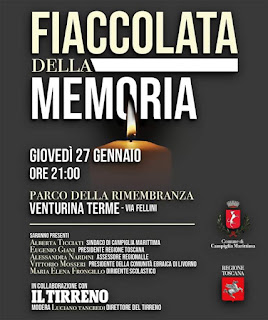
 A young person asked me today what I thought about this commemoration. I replied that I thought it was essential, as an event in Italy this week has sadly shown us: On Sunday in Venturina Terme, a hamlet of Campiglia Marittima in the Province of Livorno, Tuscany, a twelve-year-old boy was bullied, called names, kicked and spat upon by two teenage girls simply because he is Jewish. They also, appallingly, told him that he should "die in an oven."  The worst of it, perhaps, is that onlookers did nothing. Nothing. And that, as history, we would have hoped, had taught us, is where it begins - when onlookers do and say nothing.

Long ago, as a French and Italian student, I studied what happens under occupations and totalitarian régimes and what defines "collaboration" in such circumstances. We would all like to think we would have been heroes but the truth is that very few of us would have been. Some citizens "collaborated" to keep their jobs and feed their families but on the everyday level of simply keeping their heads down. Others went further and actively helped the oppressors. By this time, of course, the bullies were the ones in power, but how did they get there? They got there because reasonable people let them, listened to their propaganda and cheered them on, even in the most cultured of countries. They did not notice as their freedoms were eroded little by little. They noticed when it was too late and now the bullies were the ones holding the guns. And they were holding the guns because the small incidents were not called out.

Alberta Ticciati, the Mayor of Campiglia Marittima, though, is calling it out. Shocked when the boy's father reported the incident to her and to the police, she has written on Facebook,

"I am a public administrator but first I am a person, a woman and a mother... I understand how complex and difficult it is to bring up a child and guide them as they grow. But there are no excuses. There can be no justification."

No justification and regretfully no surprise. Liliana Segre, the Italian Holocaust survivor and Life Senator said that this kind of incident does not surprise her as unfortunately she is used to it. 

Tonight a torchlit Memorial Procession is being held in Venturina Terme and among those attending is the Governor of Tuscany. Let us hope that the boy and his family are able to take some comfort from the genuine solidarity being offered here.


Depressingly it has been reported that 2021 saw the highest number of reports of antisemitic incidents worldwide - an average of ten per day - in a decade and shamefully Europe accounts for 50% of these. Many more go uncalled out and unreported.

I told my young friend that there are few Holocaust survivors alive today; Liliana Segre, who has spent her life educating young people about it, no longer feels able, at ninety-one, to travel the country to speak in schools; and my generation, whose parents lived through World War II and who conveyed the horror of the Holocaust to us, will soon be gone too. Now it is up to my eighteen-year-old friend's generation to keep the memory alive, call the small incidents out so that they do not become massive ones and, if I may paraphrase a much decried British Prime Minister who did, however, get several things right, "Educate, educate, educate".


Friday, July 02, 2021

ARANDORA STAR 81

Today is the 81st anniversary of the Arandora Star tragedy and I again post part of an article I wrote about it in 2009. I do this in memory of the victims and in solidarity with their families but also because, sadly, the story is a much-needed reminder of what can happen when we designate immigrant communities as "the others". 

At the outbreak of World War 11 "enemy aliens" living in Britain were divided into three categories: those in class A were deemed to represent a high security risk and were interned; those in class B were "doubtful" and were subject to some restrictions; and those in class C were thought to pose no security risk at all. However, following the Fall of France in 1940 Churchill decided, in his own words, to "collar the lot" and the majority of class B aliens were interned. When Italy declared war on Britain and France on June 10th the internment of Italian males was ordered. Many of the Germans interned had opposed the Nazis or were German Jewish refugees. Most of the Italians interned had lived in Britain virtually all their lives and many had sons who were serving in the British military. Others were in Britain because they had opposed Mussolini and later fled their country in fear of their lives. The majority of the men were detained in internment camps on the Isle of Man or Orkney, where they were treated inhumanely.
A policy of deporting internees was in place and on 1st July 1940 the SS Arandora Star, a converted cruise liner, sailed from Liverpool for Canada with 1,864 people on board. Of these 734 were Italian internees, 479 were German internees, 89 were German prisoners of war and the rest were guards and crew, 80% of the crew having been newly signed on that morning. The internees were forced to sail in appalling conditions, packed onto a ship built to carry only 250 passengers and extended, in wartime, to carry 200 more.
The ship was painted battleship grey, making her look like a troop carrier, and displayed no Red Cross flag, which would have distinguished her as a vessel carrying civilians. On her second day out from Liverpool the ship was torpedoed by a German submarine off the west coast of Ireland. There had been no lifeboat drills, the rafts were immovably strapped to the sides of the ship anyway, and few lifejackets had been issued. In addition, the decks and the lifeboats were separated by walls of barbed wire - a measure which the Captain had protested about before sailing. Most of the Italians did not stand a chance , as they had come from mountainous areas of Italy and had never learnt to swim. Those few who did survive the freezing sea were again harshly treated after being rescued and some were then deported to Australia.
When the British media reported the tragedy, the public were told that Nazis on board had dashed for the lifeboats knocking everyone else out of the way. No mention was made of the fact that respectable people who had made positive contributions to British society had been on board, along with refugees who had risked their lives, in their own countries, for the very freedoms the British now claimed to be fighting for.

No apology has ever been made by a British government.

Thursday, July 02, 2015

ARANDORA STAR 75

Today is the 75th anniversary of the Arandora Star tragedy, one of the most shameful episodes in British wartime history and about which I first wrote on this blog in 2009. Since then, due to the tireless work of campaigners, memorials have been unveiled in Cardiff and Glasgow and public awareness has been raised but no British government has ever apologised.

Today, in memory of those who died and their loved ones , I am re-posting this:


At the outbreak of World War II "enemy aliens" living in Britain were divided into three categories: those in class A were deemed to represent a high security risk and were interned; those in class B were "doubtful" and were subject to some restrictions; and those in class C were thought to pose no security risk at all. However, following the Fall of France in 1940 Churchill decided, in his own words, to "collar the lot" and the majority of class B aliens were interned. When Italy declared war on Britain and France on June 10th the internment of Italian males was ordered. Many of the Germans interned had opposed the Nazis or were German Jewish refugees. Most of the Italians interned had lived in Britain virtually all their lives and many had sons who were serving in the British military. Others were in Britain because they had opposed Mussolini and later fled their country in fear of their lives. The majority of the men were detained in internment camps on the Isle of Man or Orkney, where they were treated inhumanely.
A policy of deporting internees was in place and on 1st July 1940 the SS Arandora Star, a converted cruise liner, sailed from Liverpool for Canada with 1,864 people on board. Of these 734 were Italian internees, 479 were German internees, 89 were German prisoners of war and the rest were guards and crew, 80% of the crew having been newly signed on that morning. The internees were forced to sail in appalling conditions, packed onto a ship built to carry only 250 passengers and extended, in wartime, to carry 200 more.

The ship was painted battleship grey, making her look like a troop carrier, and displayed no Red Cross flag, which would have distinguished her as a vessel carrying civilians. On her second day out from Liverpool the ship was torpedoed by a German submarine off the west coast of Ireland. There had been no lifeboat drills, the rafts were immovably strapped to the sides of the ship anyway, and few lifejackets had been issued. In addition, the decks and the lifeboats were separated by walls of barbed wire - a measure which the Captain had protested about before sailing. Most of the Italians did not stand a chance , as they had come from mountainous areas of Italy and had never learnt to swim. Those few who did survive the freezing sea were again harshly treated after being rescued and some were then deported to Australia.
When the British media reported the tragedy, the public were told that Nazis on board had dashed for the lifeboats knocking everyone else out of the way. No mention was made of the fact that respectable people who had made positive contributions to British society had been on board, along with refugees who had risked their lives, in their own countries, for the very freedoms the British now claimed to be fighting for.

In total 486 Italians lost their lives in this tragedy.  No apology has ever been made by a British government.


Counters


View My Stats