Showing posts with label UNESCO. Show all posts

Monday, June 13, 2022

JUST A FEW PHOTOS...

 Just a few photos of where I live, in Modica, a Unesco World Heritage Site, from its highest point, the Pizzo.

And what Saturday night is complete without a pizza?  This delicious Ortolana pizza was consumed with pleasure at the smart new Pizzeria S. Antonio , Modica Alta.


Tuesday, May 17, 2022

THE RETURN OF A FAVOURITE FESTA

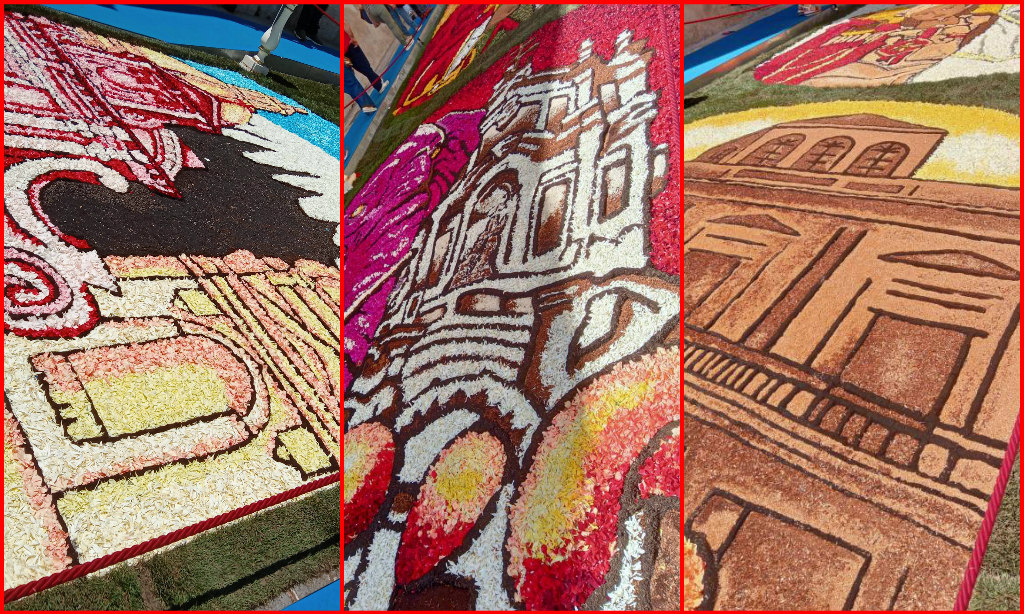
 It was a great pleasure, on Saturday, to be able to visit the Infiorata di Noto (carpet of flowers) again in person, as it has not been held as a "live" event for the past two years because of the pandemic. This year's theme was the Val di Noto Baroque cities, marking the twentieth anniversary of these eight towns becoming, collectively and deservedly, a UNESCO World Heritage Site. 

For the first time, the Infiorata has been held for five days instead of three, from last Friday until today, allowing many more people to enjoy it. Also for the first time, it has been necessary to buy a ticket - not to enter the city but to walk along via Nicolaci where the carpet has been displayed - at the very reasonable price of €2,50 per person. These could be purchased on site or online, though I have to say that the latter system took some time!

Because you are walking on one side or the other of the display you are contending with some strange angles for photos and also with sun and shadow and having to crop out faces, so I did the best I could:


As always, no visit to Noto is complete without a visit to the Caffè Sicilia, where you can partake of delicious and unique ice creams such as this one. Finally, here is your faithful blogger enjoying the Noto sunshine.


Well done, Noto and thank you for a great day!

Tuesday, November 16, 2021

BOUNTY FROM ETNA

What a lovely surprise today when a friend brought me these fruits from the Etna area, where she had been over the weekend.


I knew that the small Etna apples are special, as there is something in the soil that makes them very sweet, and the clementines are delightful too. But the chestnuts - ah, the chestnuts, for therein lies a tale:

My friend told me that on the eastern slope of Mount Etna, a very special chestnut tree can be found. It is called the Castagno dei Cento Cavalli  - "The Hundred Horse Chestnut Tree" and it derives its name from the legend that a certain queen, travelling with her ladies and one hundred knights, took shelter from a storm under the tree's ample branches. (Oh, dear - I hope it wasn't a thunderstorm!) The tree must have provided excellent camouflage, for it is said that the storm lasted all night and the queen was able to lie with several of her lovers among the knights. Who was this queen? For a long time it was thought that she was Giovanna I of Anjou, Queen of Naples, but history proved a bad sport and revealed that she had never visited Sicily. Never mind, then - perhaps it was another queen conveniently named Giovanna, Giovanna of Aragon, also Queen of Naples. But others say it was Isabella of England, third wife of King of Sicily and Holy Roman Emperor Frederick II. Well, it was a medieval queen, anyhow.

Apart from (possibly) sheltering amorous queens, the tree, first documented in the 16th century, is the oldest in Europe. It has multiple trunks, which is perhaps why there is some dispute over its age, but it seems it is at least 2,500 years old. Both its circumference and height are 22 metres and its crown spreads for over 100 metres, making it also the largest chestnut tree in the world.

The tree is protected as an Italian Heritage Green Site and is in the Etna Regional Park, parts of which, along with Mount Etna itself, enjoy various levels of protection as a UNESCO World Heritage Site. 

The tree is, of necessity, surrounded by a fence which you cannot go beyond, but my friend assures me the chestnuts come from nearby and have a very distinctive taste.


Late note: Tonight I learned that the Castagno dei Cento Cavalli has won Italy's "Tree of the Year" competition and will be representing Italy in the European competition in February. Well deserved.

Friday, July 21, 2017

18 THINGS YOU MAY NOT KNOW ABOUT PALERMO

Palermo has been selected as Italian Capital of Culture 2018 so here, in no particular order, are 18 facts - some quirky, others not so - that you may not know about the city:

1.  Its Palazzo dei Normanni was, from 1130 , the seat of the Sicilian Parliament, one of the oldest in the world. (I've met a lot of Sicilians who claim that it is, in fact, the oldest.] It now houses the Sicilian Regional Assembly.

2.  In 2016 Palermo was declared the worst city in Italy for traffic congestion.

3.  Frutti di Martorana, the marzipan "fruits" you will see everywhere in Sicily in autumn, were, according to legend, first made in The Martorana Convent in Palermo.

4.  The city's most important Arab and Norman buildings, along with the Cathedrals of Cefalù and Monreale, were collectively named a UNESCO World Heritage Site in 2015.

San Giovanni degli Eremiti, Palermo


5.  Palermo street food is legendary. Eat it first, then ask what's in it!

6.  The Palermo football team's badge has been ranked (by the British Daily Mail) as among the best in the world.

7.  The city has wide boulevards reminiscent of towns in France.

8.  The word for traditional Sicilian rice balls, arancini, is used in its feminine form, arancine there.

9.  The Catacombe dei Cappuccini (Capuchin Catacombs) are a very macabre, and often upsetting, sight but must be seen. I once decided to leave them till last on a school trip but my students, having been shown the Parliament, Cathedral and other beautiful buildings, were impatiently demanding, "Can we go and see the dead people now?" by mid-morning.

Me with students in Palermo, 1995


10. The city is second only to Naples for the number of coffee manufacturers that call it home (47 in 2011).

11. During the reign of Ruggero (Roger) II, Palermo was a city in which Muslims, Christians and Jews lived side by side in harmony. This was to come to an end, however, under Frederick II, who expelled the Muslims in 1224.

12.  In 1185 Roger's daughter and Frederick's mother Costanza d'Altavilla (Constance d'Hauteville) travelled to Germany to be married with the greatest dowry the world had ever seen. She gave birth to her son in the market square in Ancona on her way back to Sicily. You can read more about this extraordinary journey in a book I reviewed here. Costanza is buried in Palermo Cathedral.

13.  Palermo has a museum of traditional puppets  (opera dei pupi) where you can also see puppet shows at certain times of the year.  You can find out more about opera dei pupi in my post here.

Some of my own Sicilian puppets


14.  Traditional Sicilian carts vary, from province to province, in their design and size. Those from Palermo were squarer and wider than many of the others and were originally used for transporting grapes. This is a link to an article on Sicilian carts that I wrote for Italy Magazine in 2010.

15. Not strictly in the City of Palermo but in Palermo Province and a short bus ride away is Monreale, whose cathedral, begun in 1174, is one of the best preserved examples of Norman architecture anywhere. It contains Byzantine mosaics throughout. There are stunning views of Palermo from Monreale.

16. In 2014 the priests of Palermo Cathedral were much criticised for displaying a prominent WC sign in a side chapel there. I don't know about you, but when being a tourist I've often desperately needed the loo by the time I got to a city's cathedral!

17.  Palermo was named Panormus ("complete port" or possibly "well-protected bay") by the Greeks, This became Balarme under Arabic rule.

18.  To end on a sombre note, Palermo Airport, formerly known as Punta Raisi, was renamed in 1995 in honour of the anti-Mafia judges Paolo Borsellino and Giovanni Falcone who were both murdered in 1992, the latter along with his wife. The airport's full name is now L''aeroporto Internazionale Falcone e Borsellino di Palermo-Punta Raisi but it is usually referred to as aeroporto Falcone e BorsellinoItaly has been remembering the two judges in this, the 25th anniversary year of the stragi (massacres) of Capaci and via D'Amelio. We must not forget that all but one of their bodyguards died with them on those terrible days.

The candidates for Italian Capital of Culture 2020 are Agrigento, Catania, Messina, Noto, Ragusa and Siracusa. Guess which two I'll be rooting for!


City of Palermo
Coat of Arms


Saturday, April 22, 2017

AN AWARD FOR A HUMANITARIAN


In the midst of so much tragedy and sorrow in the Mediterranean and when it so often seems that recognition that it is happening at all only comes from the wider world when politicians want to use the migration crisis for their own ends, an acknowledgement of Italy's humanitarian work with migrants and, in particular, the part played by one tiny island, is a welcome development. 

This week, Giusi Nicolini, Mayor of Lampedusa, was awarded the UNESCO Peace Prize or Félix Houphouët-Boigny Prize for the humanity and commitment with which she has managed the migration crisis as thousands of refugees - and, often, sadly, their bodies - have arrived on Lampedusa over the years.

In her acceptance speech, Giusi Nicolini said.

"At a time when there are those who want to close their borders and build walls to stop a non-existent invasion, the award of this prize gives us hope for a Europe of solidarity, which has not lost its humanity. It is upon these principles that Europe is built. If we ignore them we, too, risk drowning along with the refugees and migrants who try to cross the Mediterranean."

Giusi Nicolini dedicated the prize to "the migrants who didn't make it across the Mediterranean because they lie beneath it", to Gabriele Del Grande, an Italian journalist and human rights activist who has been imprisoned in Turkey since April 9th for interviewing refugees near the Syrian border and, of course, to the people of Lampedusa.

SOS Méditerranée was also awarded the UNESCO Peace Prize for saving lives in the Mediterranean.

Update, 25.4.17:  Gabriele Del Grande has been freed and is back in Italy.

You can find links to all my posts on migration in the Mediterranean since 2006 here.

Friday, July 03, 2015

CONGRATULATIONS, PALERMO

San Giovanni degli Eremiti, Palermo


Many congratulations to the city and Province of Palermo, whose most important Arab and Norman buildings were collectively named as a UNESCO World Heritage Site at a meeting in Bonn today. The Palermo buildings are: The Palazzo dei Normanni,  the Palatine Chapel,  the Church of San Giovanni degli Eremiti,  the Church of Santa Maria dell'Ammiraglio [Martorana],  the Ammiraglio Bridge, San Cataldo Church, Palermo Cathedral, the Zisa Castle and The Cuba Palace. The Cathedrals of Monreale and Cefalù also form part of this new World Heritage site.

This is the 51st UNESCO World Heritage Site in Italy and the 7th in Sicily.


Duomo, Cefalù

Friday, December 12, 2014

THE INSPECTOR IS SAVED

In September I reported that Sicily was at risk of losing one of its most beloved fictional characters, il commissario Montalbano [Inspector Montalbano]. This was because the company that films the popular television series felt frustrated at what it perceived as a lack of support from the Sicilian region.  Given that "Montalbano tourism" had generated millions of euros for the island over 15 years, the dissatisfaction of the company's executives was understandable.

Happily, the situation now seems to have been resolved, as under an agreement signed last week between the production company and the Mayor of Ragusa the town has committed itself to supporting the productions. In addition, each council in Ragusa Province will have a representative who will liaise with the production company to offer both practical and logistical help. 

But what's this? In the same week, Sicily was warned that it is at risk of losing the UNESCO World Heritage Site status of some of its attractions due to poor maintenance or poor or non-existent infrastructure. Sometimes I want to scream in exasperation at the lack of planning, foresight and even common sense that could allow this to happen. Come on, Sicily! You've saved the inspector - now save his island.

Monday, March 10, 2014

"A FORGOTTEN VILLAGE"

Do you ever wonder how talk show presenters prepare their programmes? You might think that they would read everything they can about people they are going to interview, bone up on geographical locations that are going to feature or, at the very least, make sure they are well-briefed by people who can do this for them. 

Miss Barbara d'Urso, the presenter of the Sunday afternoon programme Domenica Live on Canale 5, appears to have done none of these things this week and has caused a Sicilian storm by referring to Siracusa as "a forgotten village in southern Italy" whilst interviewing the teacher who arranged a school concert to welcome new Premier Matteo Renzi to the city.

Siracusa: 2,700 years old, the birthplace of Archimedes and the most important city in Magna Graecia. Siracusa: UNESCO World Heritage Site. The city has a Greek amphitheatre to rival those in Greece itself and classical plays are performed there to this day. It also has a Roman amphitheatre and Cicero described Siracusa as "the greatest and most beautiful" of Greek cities.  

Teatro greco, Siracusa being prepared for the performance of a Greek play


Mayor of Siracusa Giancarlo Garozzo is understandably appalled and points out that the city is ranked fourth in Italy [after Rome, Venice and Florence] for its artistic and architectural heritage. He also thinks that Miss d'Urso should have glanced at Wikipedia before the programme went on air. This morning his administration sent a written protest to Mediaset [Silvio Berlusconi's group of television channels, which includes Canale 5]. Both the city council and the tourist board are now likely to invite Miss d'Urso to visit the city. 

Ironically Miss d'Urso is from Naples and changed her name from Maria Carmela - judged "too southern" by her bosses at Tele Milano, a precursor of Canale 5 - to Barbara in 1977. What a pity she didn't change her reading habits too.

Tuesday, July 02, 2013

WELL DONE, ETNA!


Let's start the week with belated congratulations to Mount Etna, which on 21st June was inscribed as a UNESCO World Heritage Site, becoming the 49th Italian site listed. There are 981 sites listed altogether and of these 759 are cultural, 193 are natural and 29 are of mixed properties. Sicily now has six sites in the list and these are:

The Archaeological Area of Agrigento
The Val di Noto cities
Siracusa
The Necropoli rupestri  [Rocky Necropolis] of Pantalica
The Aeolian Islands
Etna

Part of the Italian Delegation's submission reads,  "

"Mount Etna has erupted many times in human history; its intense and persistent volcanic activity is at the base of myths, legends and naturalistic observation since classic times. Consequently Mount Etna has been known, studied and visited by innumerable scientists and tourists from all around the world."   

It goes on to say, 

"Mount Etna has been, and still is, a major centre for international research with a long history of influence on volcanology, geology and geomorphology."

You can read the full justification here but anyone who has seen Sicily's most famous smoky lady will need no convincing!


Saturday, August 04, 2012

SABATO MUSICALE

Laura Mollica, accompanied by Giuseppe Greco, performing at the Teatro San Barnaba,Valderice [Trapani] where she is to perform again tonight.  Laura Mollica's voice has been entered as a cultural treasure in the UNESCO Register of the Intellectual Heritage of Sicily [REI - UNESCO].

Laura Mollica con Giuseppe Greco - La Vuci Mia


Counters


View My Stats