Showing posts with label EIS. Show all posts

Wednesday, March 14, 2012

GRAMMAR PEEVES - A "LET'S BLOG OFF" POST


Every two weeks, the blogosphere comes alive with something called a Blog Off. A Blog Off is an event where bloggers of every stripe weigh in on the same topic on the same day. The topic for this round of the Blog Off is "What's your grammar pet peeve?"


Oh, what a gift this week's topic is to a language teacher! I could go on and on and I probably will!  As those nice folk say over on the Blog Off site, nearly everyone is publishing at least some content on the internet these days and "the English language is being abused like never before." 

Yes, everyone is a "writer" these days and, by prefacing their names or twitter handles with either that word or "author", many are making sure that we know it.  Grammar rules are being broken everywhere and there are already societies for the protection of the apostrophe, semicolon and comma.  

The point is, does this rule-breaking matter?  That will depend to a large extent on who the target reader is and if he or she is someone like me the answer is "Yes" because if the writing is ungrammatical I will stop reading. 

Ridding the publishing world of the "men in suits" might be a good development in some ways but with them we are losing the quality control that used to make reading a joy and what the self-publishing outfits won't give you is an editor.  If, as a consequence, we are all to become our own editors, then, we need to take extra care and respect the reader by making our offerings legible - and yes, that means grammatical.

So what are the grammar mistakes that really drive me mad?  Number one has to be misuse of the apostrophe.  I cannot for the life of me understand why so many people find its use difficult because the rules are actually so simple. In my hometown of Cardiff I used to want to go around with a red pen to correct the signs of traders offering "potatoes' " or "carrots' ". I wish I'd written a book about it before Lynne Truss got the idea and I'm sure the erudite Stan Carey won't mind if I quote here a ditty I made up for a competition on his site a while ago. [No, I didn't win!]


Oh, what a problem is “it’s”
It’s driving me out of my wits
When “its” means “belong”
the apostrophe’s wrong
but students think “its” is the pits!

I wish that my name were Lynne Truss
who, spotting this error in us,
put it all in a book -
you should have a look,
She made a few million thus.


I took the photograph below in Modica Bassa some years back and it illustrates perfectly the kinds of mistakes that are made with the possessive apostrophe.  I would add that there is some excuse for the non-native speaker of English but none whatsoever for someone brought up and educated in the UK!


In case any of my students are reading this post I have explained the rules here on the EIS blog.

Other pet grammar peeves of mine are "could / should / would of" for "could / should / would have", the fairly new habit of using the continuous tenses with "state" verbs [ as in "I am loving"] and the use of "sat" for "sitting". 

Of the mistakes that Italians learning English most commonly make, "use to" to express a present habit [as in "We use to go to the sea every summer" for "We go to the sea every summer"] is the hardest to eradicate and I'd better not even get started on the present perfect tense ["have done" rather than "did"] because you Americans use it less often than the Brits.  The placing of "very much" in a sentence is also a nightmare and day after day I have to remind students that it is usually placed at the end. ["I like English very much", not "I like very much English."]

Any linguist will tell you that much erroneous grammar eventually becomes acceptable in the language - if that were not so we would still all be speaking Elizabethan English - but this is a slow process and it is almost as if there is an invisible consensus.  The jury's still out on the apostrophe so I will continue, when in the UK, to carry a large red pen with me wherever I go.

I have been loving very much this topic.

Below is the full list of bloggers participating in this theme:

Wednesday, February 22, 2012

OUR JUBILEE AMBASSADOR?

This is Giovanna, an EIS student who has recently spent a few days in London.  As you see, she has come back full of enthusiasm and we think she should be Sicily's Ambassador to the Jubilee celebrations in the UK!


Giovanna also brought us some delicious, homemade chiacchiere to celebrate the end of Carnival:


Thursday, January 26, 2012

WOMEN AT WORK!

In November Cathy, the Director of the English International School, Modica and I were interviewed for an article in the Ragusa Province magazine Freetime and I thought you might like to see a couple of the photographs:

Cathy [right] and me at the school

Welshwoman at the chalkface in Sicily,
 talking about an American festival.

Photos:  Simone Aprile and reproduced here with his kind permission. 

If you are in Ragusa, you can see the article, our newsletter and more pictures in the December - January edition of Freetime but if you are elsewhere and can read Italian, the text of the article is here on the school blog.

Tuesday, November 01, 2011

A TOUR OF CHOCOBAROCCO


This evening I am going to take you on a tour of the 2011 Modica Chocobarocco Festival, which began on Friday and finishes today.

But first here is an image of another journey, that of chocolate to Modica in the sixteenth century.  The tradition of chocolate making arrived here with the Spaniards and they, of course, had learned their techniques in Mexico.  The Aztec method of chocolate making, which uses no dairy products, is still observed in Modica.


Are you ready?  Hold on to your hat!

As you board the little train, you will see an advert for the English International School  and I unashamedly give the school a plug here.

As you tour the exhibits, you will see chocolate worked into all sorts of shapes and forms:


Fancy a new caffetiera?


The chocolate computer mice proved more popular with children than the skeletons!

Want to update your winter wardrobe?  How about a chocolate shoe?


Or maybe a rose for your love?


Modican chocolate experts were joined by colleagues from other towns with a chocolate making tradition, such as Perugia:


Anna from Modica shows us a white chocolate creation:


Antique implements for working chocolate were on display:


Moulds like these are still in use.

One of the festival's main attractions has been this water-powered clock, inspired by the clock on Modica's Norman castle and made by local craftsman Enzo Terranova. The clock, made of iron and steel,  is 1.5 metres high and 600 litres of water, in a container below it, power it by means of a hidden electric motor, which takes the water up.


There was chocolate-inspired art to enjoy:


This map is made of foil chocolate containers.


And there were chocolate pizze of all flavours:


I took home a slab of the chilli pepper chocolate above.  My, it packs a punch on a cold, rainy evening!

This article is cross-posted at the blog of the English International School, Modica.

Monday, July 04, 2011

SPY'S PIZZA

Thursday and Friday were external oral examination days at the English International School and I am happy to say that all our candidates got through.  One of my adult students was so pleased with his result that he took me out on Saturday evening to celebrate and this is what we ate:

Here is the restaurant's idea of a "small" plate of antipasti for one person:


Then my student had "007" pizza.  Neither of us had any idea why it was given this name - it contained peas, eggs, frankfurter sausage, ham, mushrooms and, of course, mozzarella cheese:


I went for an aubergine pizza and very good it was, too.  The crust was sinfully crispy!


And for dessert there was almond semifreddo:


A meal worthy of any celebration!

Sunday, May 22, 2011

ENGLISH DAY AT RAFFAELE'S


English lessons [via yours truly] tea and even shortbread biscuits [from the local Lidl] were on offer at Raffaele the hairdresser's "English Day" yesterday.

For those of you who would like to know what to say at an Italian hairdresser's, here is a quick guide.  You can see some more vocabulary and try our "hairdressing word search" on the English International School, Modica blog.


What to say at the hairdresser’s – Cosa dire dal parrucchiere

I’d like to make an appointment, please – vorrei prendere un appuntamento

Monday – lunedì
Tuesday – martedì
Wednesday – mercoledì
Thursday – giovedì
Friday – venerdì
Saturday – sabato

at eleven o’clock – alle undici
at half past eleven – alle undici e mezza
at quarter to eleven – alle undici meno un quarto
at quarter past eleven – alle undici e un quarto

How much does it cost for …. ? -  Quanto costa per …. ?  [vedere la scheda di vocabulario]

How do you like your hair? – Come li asciughiamo?

Not too short – non troppo corti
Can you just trim the ends? – Può tagliare solo le punte?
With the fringe to the right / to the left  - con la frangia a destra / a sinistra
With the ends going under / up – con le punte sotto / insù

Can you do a comb-out, please? – Può fare la pettinata, per favore?

Thank you - grazie

Raffaele's salon is at:  yellow Parrucchiere,  via Sacro Cuore 6, 97015, Modica [RG].  
Tel: 0039 0932 906879.

Thursday, February 03, 2011

A FOOTBALLING PRODIGY?

myspace layouts codes


I am not a sports fan and I readily admit, reader, that what I know about the "beautiful game" can be summed up in the following five sentences:

1.  Football is not rugby.
2.  It has something to do with goals.
3.  In the 1960s a Bristol Rovers player called Bobby Jones used to cross himself before he took a corner - or  whatever the verb is for what footballers do with corners - and then wiggle his bum rather seductively.
4.  Another Bobby, Bobby Moore, seemed the cutest thing in the neatest of shorts to me in 1966.
5.  The Italian national team has the hunkiest players in the world.

Thus it was that a young student of mine who wishes to speak about A.C. Milan as an exam topic had to spend half an hour physically demonstrating to me what an "assist" is this afternoon.  "Do you know what a pass is, at least?" he asked in exasperation towards the end of this time.  I replied that even I could probably work that out, then turned to the internet where I learned, to my consternation, that "assist" is an English noun for whatever a footballer does when "assisting" the player who is about to score the goal.

Meanwhile my student, having given up on me, had written,

"Ibrahimovic is the best player and he does many assists and I have his teacher."

"You have his teacher?!" I exclaimed, wondering if we had a footballing prodigy in our midst.  But frantic scribbling out ensued and my student substituted the word, "t-shirt".

There endeth the lesson.

Image of Zlatan Ibrahimovic - Wikipedia

Saturday, January 22, 2011

A FUTURE SOMMELIER

myspace layout images


Young people have always taken for granted the scientific and technological advances that their parents marvel at and today's teenagers - born, I am certain, with a mobile phone clamped to one ear - cannot remember a time when people did not have portable telephones.

When men landed on the moon in 1969 I, whilst conceding that this was, indeed, a momentous event, did not exclaim, like my parents, great aunt and grandfather, that I had never expected to live to see the day but wondered, with all the coolness of my generation, why no one had walked on the moon before.

I was reminded of all this yesterday whilst helping a class of fouteen-year-olds with our school's January quiz:  in one question, I had referred to the winter of 1205, when the Thames froze over and wine which had turned to ice was sold by weight.  Why, asked one of my charges -a sommelier-to-be, no doubt - hadn't people just kept the wine at the correct temperature in refrigerators?  I replied that this might have been rather difficult in the year 1205.

Friday, December 24, 2010

'TIS THE SEASON [4]....

.... if you are the owner of the English International School in Modica, to introduce your students to Vegemite.  I'll leave you to imagine their reactions!


Buon appetito, Cathy!


But don't worry:  we invited them to taste some more traditional Anglo-Saxon Christmas fare as well:

Sunday, September 05, 2010

English International School

The English International School, Modica has a new blog.  We'll be adding information, grammar and vocabulary explanations, exercises and news as the school year gets under way.  Do take a look.


Friday, May 07, 2010

PICCOLO MONDO MODERNO

There I was standing at the counter in the Altro Posto at lunchtime  when a pleasant young man came up to me and asked, "Are you Patti?" He  introduced himself as Enzo and  after a second it dawned that this must be the Modican gentleman I talk to every day on twitter.  He'd told me he was coming home for a long weekend but we hadn't arranged to meet.  It turned out that he had known my student Giuseppe, who was with me, since the latter was ten years old so we all had a jolly chat.  Isn't technology amazing?


I'd gone to the Altro Posto to get this tiramisù to celebrate Cathy's birthday at the school:


And here's Cathy [ second from left] with students Graziana and Giuseppe:


This is the present I bought for Cathy.  And now it's over to you, dear reader.  Can you guess what it is?  I'll tell you tomorrow.


The Muppets and Spike Milligan - Small World


Update - 8.5.10:  The mystery object is a thingie to hang your bag from when you're out and about and don't want to put it on the floor:


Wednesday, May 05, 2010

INTERVIEW WITH A SICILIAN AGRONOMIST

This is an article of mine which was published in Italy Magazine on Friday:

Vittorio is a student of mine and he has an interesting job which I thought you’d like to read about:


Vittorio, can you tell us about your company?
Yes, it’s an international seed company with about 5,000 employees all over the world. In Sicily we have a team of five people: Two are researchers and they work with plant geneticists. Another person is in charge of developing new plant varieties and two of us work in Sales. The scientists are specialists in species like aubergines, tomatoes, carrots, peppers, lettuce, melons and watermelons. We export seeds to the Italian mainland and around the world.

Do you work from your office or do you travel?
I’m always travelling. I start my working day at about 7 am and I drive out to see my clients who are farmers and growers. I check the plants grown from our seeds in their greenhouses and give them advice. I have to check all the plants for diseases.

What sort of diseases are you looking for and what are the signs?
Well, there’s an insect called bemisia tabaci, also known as whitefly, which attacks tomato leaves. It infects the tomato with a virus called tomato yellow leaf curl [TYLCV]. Then there are parasitic nematodes, which attack the roots causing plant death and low or poor production.  On carrots I look for alternaria dauci [carrot leaf blight] which you find in winter when it’s cold and wet. There is also a disease called oidium. You find white spots which are fungal spores on the leaves.

Why does your company develop new varieties? Is it for appearance?
No, it’s always for nutritional reasons or to develop disease-resistant varieties. For instance, we have developed a carrot with some resistance to the diseases I just mentioned. This enables the grower to avoid or reduce the use of pesticides. We have also developed some elongated, cherry and date tomato varieties. Our varieties are not genetically modified, by the way.


I want to ask you more about carrots because the Sicilian carrot is special, isn’t it?
Yes, Sicilian carrots are early and they are the first crop of the new year. The carrots aren’t ready in other parts of Europe. Our carrot season is March until May and at the end of it the rest of Italy harvests its carrots.

Isn’t there something about the Sicilian soil that makes it suitable for carrots?
That’s right. We have what we call red Mediterranean soil. It’s a mixed soil with red sand in it and it’s clayless. Our soil gets hot early in the year. Carrots are cultivated in south-east Sicily because the soil is so near the sea. The Sicilian carrot has a very sweet taste.


I know. I love them! Can you tell us about greenhouse cultivation in Sicily?
Greenhouses in Sicily cover about 8,500 hectares of land and they are concentrated in the south-east of the island in a stretch of land from Agrigento to Pachino, comprising Agrigento itself, Caltanissetta, Ragusa and Siracusa. 80% of these greenhouses are in Ragusa Province.

What species are grown in these greenhouses?
Melons, watermelons, squash, tomatoes, peppers, aubergines and cucumbers. We have different kinds of tomatoes and these are: cluster tomatoes, ribbed beef tomatoes, cherry tomatoes, date tomatoes and plum tomatoes in three sizes – large, medium and mini-plum. We grow red and yellow peppers and elongated and round aubergines. But in Siracusa and Trapani they still grow lettuce in the open air.


I’d never seen a round aubergine till I came here.


Tell us about the melons.
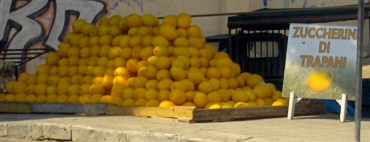
In spring and summer you only find the yellow melon in Marsala [Trapani] and Palermo. It’s called the “giallo di Paceco”. There’s another melon grown near Palermo and in Marsala called the “piel di sapo”. This is the melon that is candied for use in pastries such as cannoli with ricotta.


Trapani melons are incredibly sweet, aren’t they? I thought I’d gone to heaven the first time I tasted one!
Yes, they are famous.


Vittorio, how is the Italian agricultural sector faring during the recession?
In Italy everyone is talking about the industrial and economic crisis but no one talks about the agricultural sector because it is not well represented politically. Yet many families still have to make a living from this kind of work. The wealth created by Sicilian agriculture from the 1960s onwards saved the whole agricultural sector in Italy. But this is forgotten now.

Why did Sicilian agriculture start to create wealth in the 1960s?
In the post-war era Sicilian agriculture worked to an old system based on traditional means of production which were seasonal. This way of working brought in very little money. Then, when Italy had its economic boom in the 1960s, people’s tastes changed and so did their way of eating. In the late 1950s someone had the idea of introducing greenhouse cultivation into Sicily and the first one was built in Scicli [Ragusa]. This allowed the island’s growers to produce foods that were thought of as summer crops for the winter and they were able to export them to all parts of Italy and, later, to other countries.


I thought people ate seasonally in Sicily. Are you saying that they don’t any more?
People in Sicily don’t eat strictly according to the season like they used to but some crops remain seasonal, for example, prickly pears, lotuses, oranges, mandarins, clementines, figs, miniature pears, watermelons, pomegranates and quinces.

Vittorio, that was very interesting and I’ve learnt a lot about agriculture in Sicily. Thank you for talking to Italy Magazine.

Thank you. I’ve enjoyed it.

Note:  All plant photos are by Vittorio.

Counters


View My Stats